





A two-story dark-clad house with white-trimmed windows and a gray shingle roof stands behind a mown lawn photographed from ground level, with tall deciduous trees and a wire fence in the background under an overcast sky.

Heat Pump Repair in Bowman, ND

Tell us about the job

Takes about a minute. No obligation.

RepairHeat PumpBowman County, ND
Step 1 of 2

What ZIP code is the job in?

Heat here runs about ten months a year, from September through June, with just July and August off. That long a stretch wears on a heat pump, and the strain usually shows early, right when the unit switches back over. It sits idle for a couple months and then gets asked to heat on the first cool morning of September. If a contactor or capacitor was already weak, that first startup is where it quits. Catching it in August, before the switch, beats finding out the morning you need the heat.

10 months
September through June, your system heats
2 months
July through August, it cools
9°F
the average winter night it heats against
81°F
the average summer afternoon it cools against
Isometric grayscale illustration of a cutaway two-story house showing interior ductwork, an indoor air handler unit, and an outdoor condenser unit on a pad beside the building.
Your system heats September through June and cools July through August.

NOAA nClimDiv, 1991–2020 normals

Bowman County sees its share of hail, wind and winter storms, same as the rest of this part of North Dakota.

None of that is what's wrong with your heat pump. Look at the unit itself first.

Half the homes here were built by 1972, old enough that the heat pump has likely been replaced at least once

Half the homes here were built by 1972
70 damaging wind events from 2015 to 2024
44 hail events from 2015 to 2024

North Dakota homes paid 11.51 cents per kilowatt-hour for electricity in 2024, which is cheap enough that a heat pump here isn't fighting the power bill the way it might elsewhere. That matters because it means a sudden jump in your bill points at the unit, not the rate. If your heat pump is running longer to hit the same temperature, or short cycling instead of holding steady, something inside it is working harder than it should. A failing capacitor or a low refrigerant charge will do that. So will a reversing valve stuck partway. None of that has anything to do with what the power costs. It has to do with a part that's worn out and needs a contractor to find it.

Ask how much life is left before you pay for the repair

If your heat pump has already been replaced once since 1972, the one running now has fewer years behind it, but the same question applies. Before paying for the repair, ask the contractor how much life is left in it. That answer should decide whether you fix it or start planning to replace it.

Find a contractor
A gray heat pump outdoor unit mounted on a concrete pad next to the stone-accented exterior wall of a house.

What actually breaks, and why

A heat pump has to do something a standard air conditioner never does, which is switch direction. That job falls to the reversing valve, and it's one of the more common points of failure. A valve that sticks partway leaves the system blowing air that's neither hot nor cold, or stuck in one mode when you need the other. Outside, the capacitor and contactor that start the compressor take a hit every cycle. A capacitor weakens slowly, so the compressor struggles to start before it finally won't. Refrigerant doesn't get consumed, so a low charge always means a leak somewhere in the lines, and a leak left alone only gets worse. The outdoor coil also sits exposed through every swing in weather, and a coil caked with dirt or bent fins makes the whole system work harder to move the same heat. None of these parts fail because the unit works too hard. They fail because something wears down over time, and the switch between heating and cooling is usually where a weak part finally gives out.

What you can check from inside the house

Check the thermostat is set to heat and the temperature asked for is actually above room temperature. Check the batteries if it has a screen that looks dim or blank. Look at the air filter and replace it if it is gray or clogged, since restricted airflow can make a heat pump that's otherwise fine act like it is failing. Walk the vents and make sure none are closed or blocked by furniture.
What's worth a look outside, and what isn't

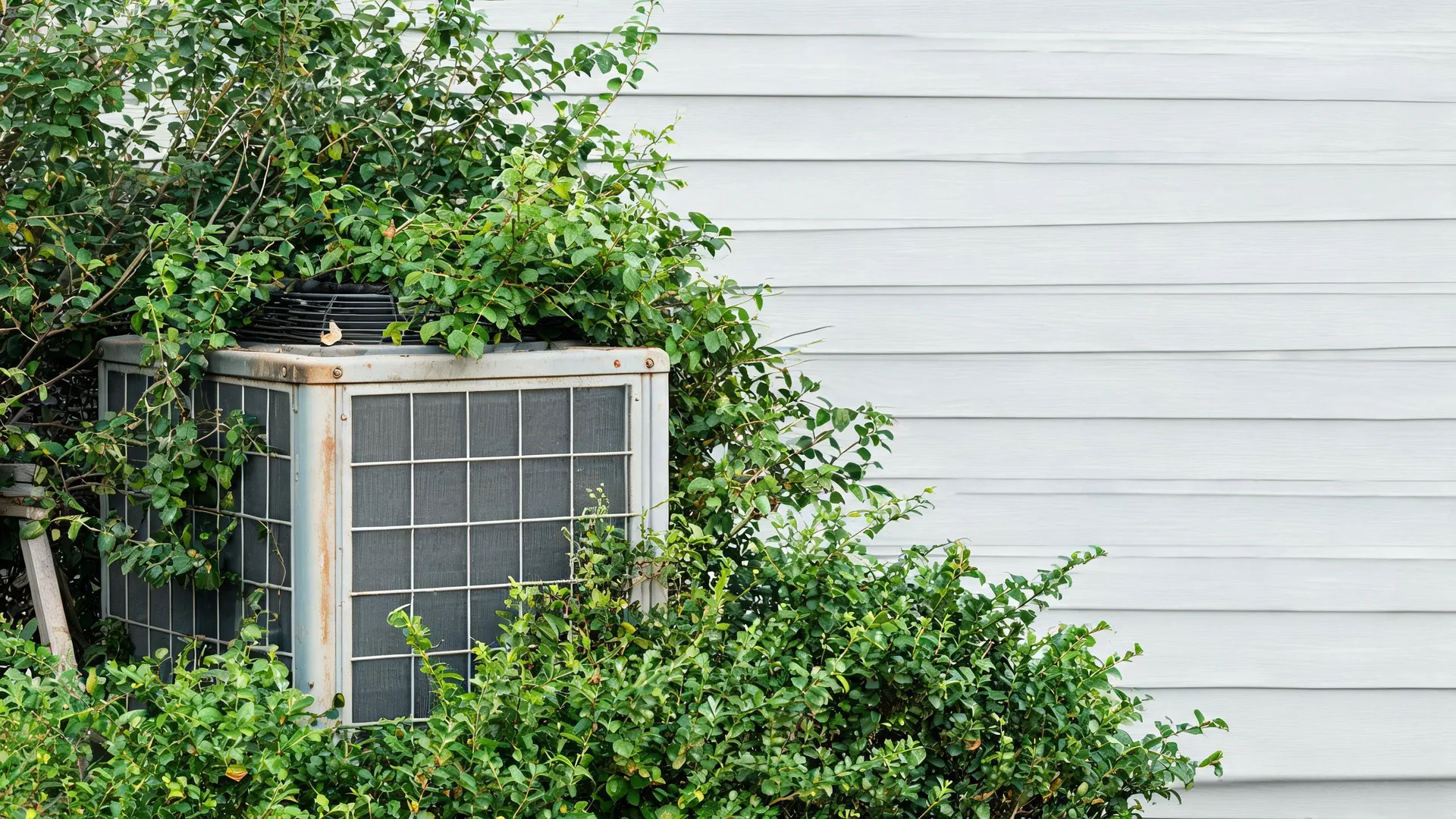
Look at the outdoor unit and clear away leaves, branches or anything piled against it, since blocked airflow around the coil shows up as weak heat inside. If you see ice on the coil, that alone is not a reason to call, since a normal defrost cycle puts frost there and melts it off on its own. Do not open the unit, touch the wiring, or add refrigerant yourself. That part of the job needs a gauge set and training, and a mistake there can damage the compressor.

Short cycling is one of the first things an owner notices, the unit kicking on and off every few minutes instead of running a steady stretch. So is air that comes out lukewarm, not quite warm enough to call heat. Listen for the outdoor unit too. A hard clunk when it switches modes, a hum that doesn't turn into a start, or a compressor that tries and gives up are all worth a call. Ice building up on the outdoor coil when it shouldn't be there is another one, especially if it's not melting off during the defrost cycle. Any of these mean a part is already struggling, not about to struggle.

A diagnostic visit starts outside, at the unit itself. A contractor will check the refrigerant pressure, look at the capacitor and contactor, and watch how the compressor behaves when it tries to start. Inside, they'll check the air coming off the vents against what the thermostat is asking for, since a gap between those points at where the problem sits. They'll also run the system through a mode switch on purpose, heating to cooling and back, to see whether the reversing valve moves clean or hangs partway. Most of this is watching the system work through a cycle rather than taking it apart. Once they've seen where it struggles, they can tell you which part is the cause and which are just symptoms of that one part failing.