





A snow-covered residential street at twilight with illuminated houses, bare trees, and an orange horizon glow beneath a deep blue sky.

Heat Pump Repair in Dickinson, ND

Tell us about the job

Takes about a minute. No obligation.

RepairHeat PumpStark County, ND
Step 1 of 2

What ZIP code is the job in?

A heat pump in Stark County earns its keep. Winter storms have hit the county 23 times between 2015 and 2024, and the outdoor unit has to keep pulling heat from the air through every one. Hail is part of that too, 64 events in the same stretch, and the coil and cabinet take that hit each time. That's not normal wear the way a dirty filter is normal wear. It's the same parts taking repeated stress, year after year, and it adds up faster than it would somewhere milder. When a heat pump here starts acting up, that strain is as likely a cause as anything else, and a tech who knows that will look in the right place first.

10 months
September through June, your system heats
2 months
July through August, it cools
7°F
the average winter night it heats against
81°F
the average summer afternoon it cools against
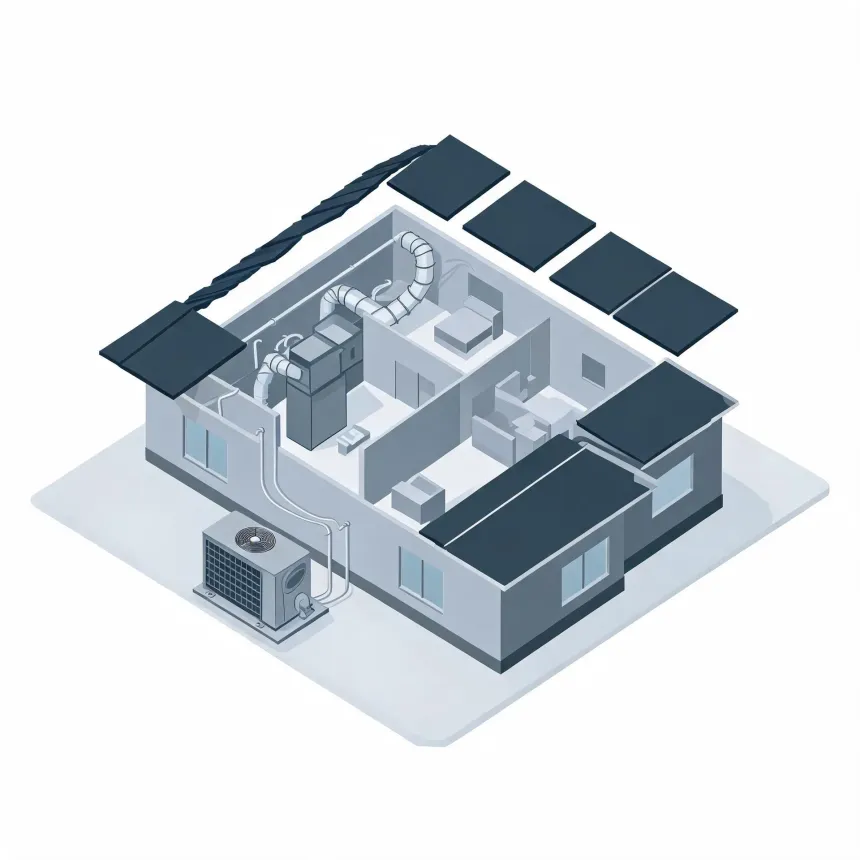
Isometric grayscale illustration of a cutaway single-story house showing interior rooms, ductwork and an air handler, an exterior condenser unit connected by lines, and dark solar panels on the roof.
Your system heats September through June and cools July through August.

NOAA nClimDiv, 1991–2020 normals

Electricity here runs 11.44 cents a kilowatt-hour, cheap next to most of the country.

A heat pump losing efficiency still costs you every month it runs this way, even with a low rate.

Most homes here are newer, so the strain hasn't had as long to add up

Half the homes here were built by 1986
Climate zone 6A
Power here costs 11.44 cents per kilowatt-hour

September is when heat takes over here, and that first cold snap is when a weak heat pump gets found out. The unit has been sitting since August, doing nothing, and then it's asked to run for the next ten months straight. A part that was already marginal, a contactor pitted from last winter or a capacitor reading low, often holds through the easy months and fails right when the load hits it hard. If your heat pump is going to act up, the first real cold week is when it happens. Getting it looked at before September, rather than after it quits on the coldest morning so far, is the difference between a repair on your schedule and one that isn't.

Find out what the weather did to your heat pump before it fails on you

The wind and hail that hit the outdoor unit year after year are usually what's behind a heat pump acting up here. A proper diagnosis finds which part took the hit, so the repair holds instead of just covering the symptom.

Find a contractor
A man in a gray t-shirt and tan work pants, seen from behind, carries a worn canvas tool bag up wooden steps toward a red front door of a gray clapboard house with a potted plant beside it.
A gray heat pump condenser unit mounted on a concrete pad against the gray lap-siding exterior wall of a house.

Ask how old the system actually is

If your heat pump came with the house, and the house is newer, the math favors fixing it over replacing it. A system with years of working life left just needs the worn part found and swapped out. Ask whoever comes out how old the unit actually is before any talk of replacement starts. If it's younger than the house, that's one more reason a repair is the right call here, not a new install.

What you can check yourself

Look at the outdoor unit first. If snow or ice has built up around the coil, clear it away so air can move through. Check that nothing is blocking the unit, no leaves, no debris, nothing stacked against it. Inside, swap the air filter if it's dirty, a clogged filter starves the system of airflow and can make it seem like the unit itself has failed. Check the thermostat has power and is set to heat, not fan only. Look at the breaker panel for a tripped breaker before assuming the worst.

What tells you to stop and call

If the outdoor fan isn't spinning at all, or the unit is making a grinding or clicking sound it didn't make before, that's not something to keep testing. Ice coating the whole unit, not just light frost, means something past normal defrost cycling is wrong. Warm air blowing when you've set it to heat, or air that's barely warm at all, usually points to the refrigerant side or the reversing valve, and that's a job for someone with gauges, not a screwdriver. Once you've checked the filter, the breaker and the thermostat, anything beyond that is a call, not a project.

A heat pump fails in a handful of predictable spots. The reversing valve is one, since it's what switches the system between heat and cool, and a valve that sticks will leave you with warm air blowing when you need heat. The defrost control board is another, telling the unit when to melt frost off the outdoor coil. If that board fails, ice builds up and never clears, and the whole system loses its ability to pull heat from the air. Capacitors wear out too, the small parts that give the compressor and fans the jolt they need to start, and a weak one shows up as a unit that hums but won't start, or a fan that spins slow. The compressor itself is the part nobody wants to hear about, since it's the heart of the system, and when it fails the repair gets a lot more serious than swapping a capacitor or a board. Most of these don't fail out of nowhere. They give some warning first, a sound, a cycle that runs longer than it used to, ice that doesn't clear on its own.

A heat pump that's lost its edge doesn't stop running, it just runs more. The defrost cycle kicks on more often, the compressor stays on longer to hit the same temperature, and the thermostat never seems satisfied. None of that shows up as a single big bill. It shows up every month, quietly, for as long as the problem sits there. A pitted contactor or a low-reading capacitor doesn't fix itself with time, it just makes the unit work harder to cover for it. Getting the part found now costs less than paying to run a struggling system through a Dickinson winter.