A dark-sided two-story house with a gabled roof and white-trimmed windows stands in front of dense green trees, behind a wire fence and a tall grass field in the foreground.

Heat Pump Repair in Marmarth, ND

Tell us about the job

Takes about a minute. No obligation.

RepairHeat PumpSlope County, ND
Step 1 of 2

What ZIP code is the job in?

Cold nights here are normal heat pump weather

Marmarth sees overnight lows around 9°F in the winter months. A heat pump is built to pull heat from outside air even at that temperature. If yours is running constantly or not keeping up, the cold isn't why. Something in the unit needs attention.


The cause is usually one specific part

A heat pump that short cycles, blows cold air, or won't keep up is often down to low refrigerant, a failing defrost control, a worn contactor, or a stuck reversing valve. A contractor who checks the actual part can tell you what's really wrong before touching anything.

9 months
September through May, your system heats
2 months
July through August, it cools
9°F
the average winter night it heats against
81°F
the average summer afternoon it cools against
Isometric cutaway illustration of a house showing attic ductwork, an indoor air handler, furnished rooms, and an outdoor condenser unit connected by lines along the exterior wall.
Your system heats September through May and cools July through August.

NOAA nClimDiv, 1991–2020 normals

Heat here starts up in September, after a long stretch where the heat pump barely runs.

A weak part can sit quiet all summer and give out the first cold week it has to work.

Half the homes in Slope County date to 1961 or earlier

Half the homes here were built by 1961
34 hail events from 2015 to 2024
21 winter storms from 2015 to 2024

Get the usual fix

Nothing about this area is especially hard on it. It's most likely the usual problem with the usual fix.

Find a contractor
A man in a cap, gray long-sleeve shirt and tan work pants walks up wooden porch steps toward a red door, carrying a canvas tool bag, with a potted plant beside the entry.
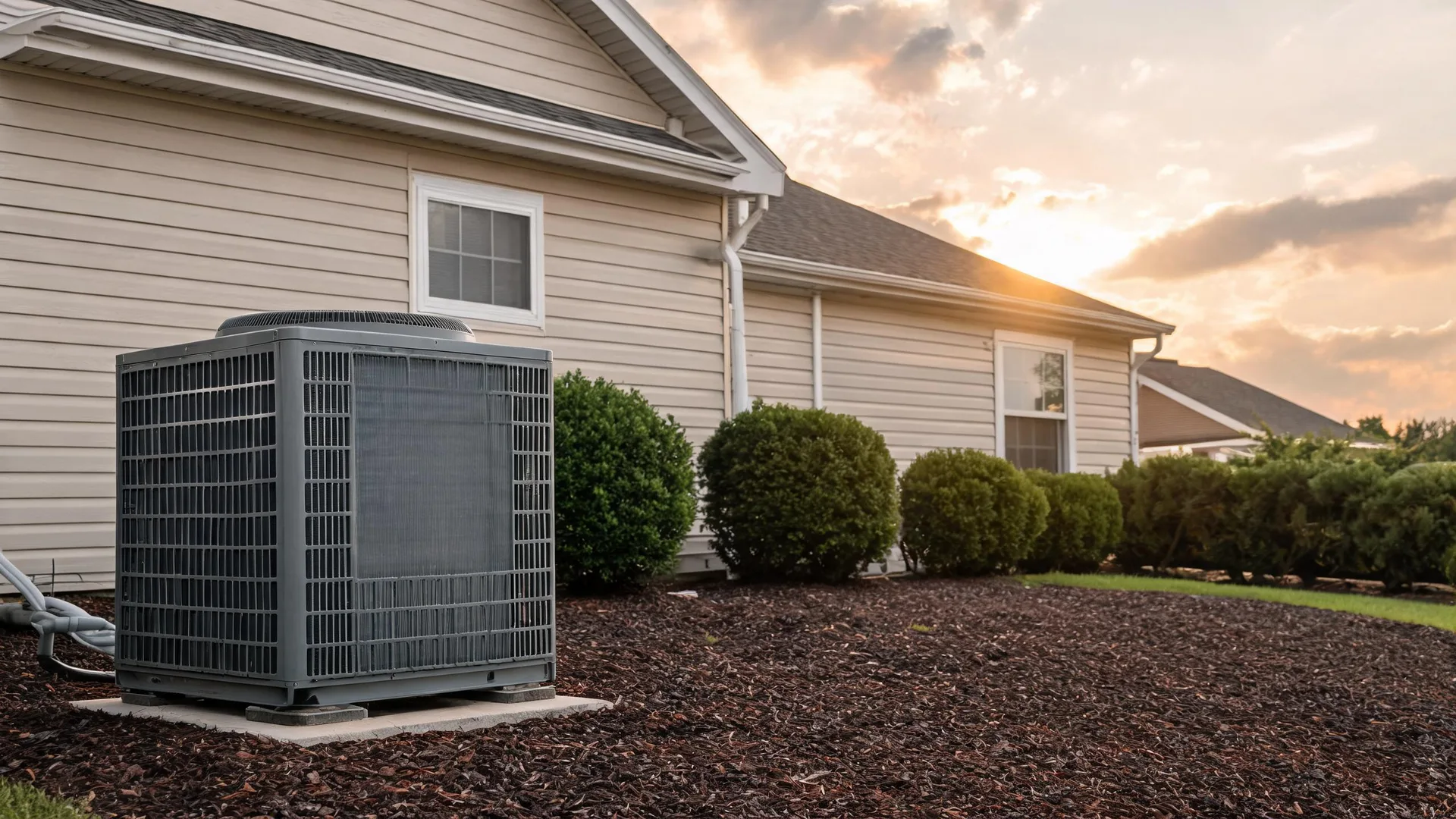
A gray heat pump outdoor unit mounted on a concrete pad next to a residential house with lap siding and stone accents.

What to check before the truck shows up

Before anyone comes out, look at the outdoor unit. Make sure nothing is stacked against it and the coil fins aren't packed with ice, leaves or dirt. A thin layer of frost is normal. A solid block of ice is not. Check the thermostat is set to heat and the setpoint is actually above room temperature. Go to the air handler and pull the filter out. A filter choked with dust cuts airflow and can make the whole system struggle to keep up, and it's the one thing on this list you can fix yourself. Check the breakers for both the outdoor unit and the air handler haven't tripped. Listen to the unit outside. Grinding, buzzing or a rapid clicking that never settles into normal running is worth telling the contractor about rather than chasing yourself. If the outdoor fan sits still while the system is calling for heat, mention that too. None of this tells you which part has failed. It just means the call starts with the real problem instead of a dirty filter or a flipped switch.

Moving parts wear out first

The reversing valve switches the system between heating and cooling every time it runs, and the contactor opens and closed every cycle to feed power to the outdoor unit. Both take a beating simply from being used so often. A reversing valve can stick partway, and a contactor's points can pit and burn until they stop making good contact. Either one shows up as a system that runs but won't heat right.

Refrigerant doesn't get used up, it leaks

A heat pump is a sealed system. If the charge is low, something let it out, usually a worn fitting, a rubbed line, or a joint that was never quite right. Low refrigerant shows up as weak heat, ice on the outdoor coil, or a unit that runs long and still doesn't catch up. Topping it off without finding the leak just means doing it again later.

A diagnostic starts outside at the unit, not with a guess. A contractor hooks up gauges to check refrigerant pressure, since that reading points toward a leak, a weak compressor, or a restricted line depending on what it shows. They run the system in heat mode and watch the reversing valve actually switch, because a valve that's stuck partway can look fine sitting still. Electrical readings come next. Voltage at the contactor, amp draw on the compressor and fan motor, resistance checks if something isn't pulling power the way it should. The defrost control gets tested too, since a board that won't trigger a defrost cycle leaves ice building on the outdoor coil until the system chokes. Whatever the gauges and meters show decides what gets replaced.

An aging heat pump on its second or third repair is worth weighing against a new one. A compressor or a reversing valve is not cheap to replace, and either job can run close to what the rest of the unit is worth. A unit with one bad part and no history of trouble is usually worth fixing. One that keeps coming up with a different failed part each time is telling you something. The compressor matters most in that decision. It's not practical to replace on most units, so a failing compressor is usually the point where repair stops making sense.