





A snow-covered small-town street at dusk, lined with illuminated two-story houses and a grain elevator on the horizon.

Mini Split Installation in Fargo, ND

Tell us about the job

Takes about a minute. No obligation.

New system or replacementMini-splitCass County, ND
Step 1 of 2

What ZIP code is the job in?

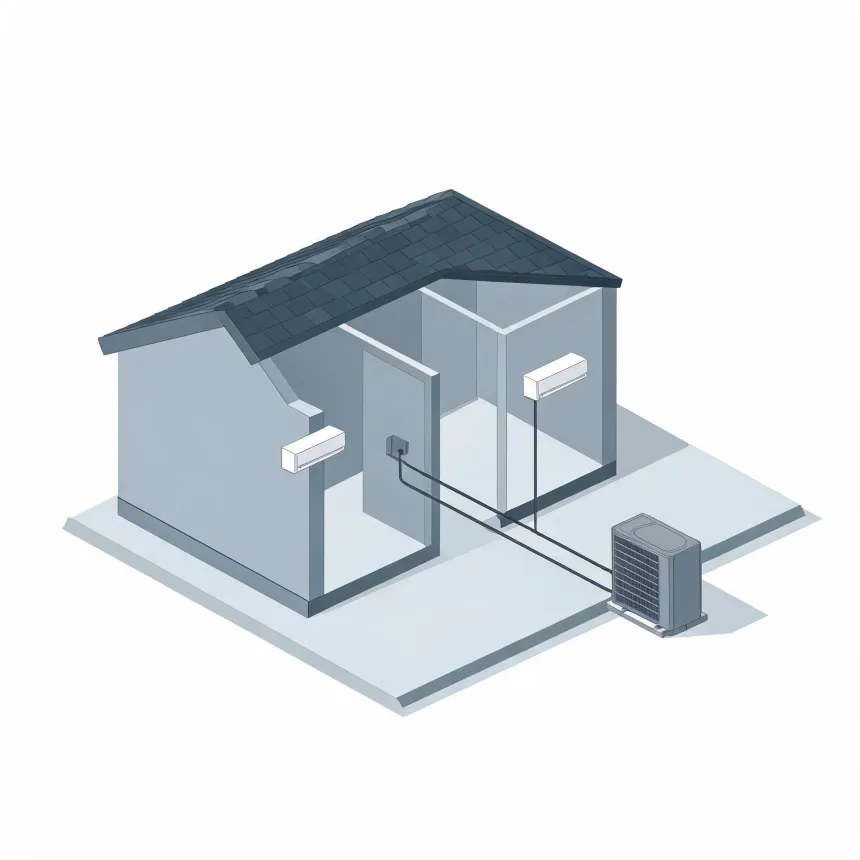
Electricity heats just under half the homes in Cass County, and utility gas heats most of the rest. A mini split runs on electricity, so it fits right into the first group without any new fuel line or gas hookup. For homes heating with gas now, a mini split still works. It usually ends up adding cooling and shoulder-season heat to a room the furnace does not reach well, like a converted garage or an addition. Either way the install is the same, an outdoor unit, an indoor head, and a line set between them.

9 months
September through May, your system heats
3 months
June through August, it cools
3°F
the average winter night it heats against
80°F
the average summer afternoon it cools against
Isometric illustration of a cutaway gray house with a dark shingled roof, showing two wall-mounted indoor air handlers connected by line sets to an outdoor condenser unit on a pad outside.
Your system heats September through May and cools June through August.

NOAA nClimDiv, 1991–2020 normals

Cooling in Cass County runs June through August.

May is the month to get a mini split installed, before the first hot week puts you in line behind everyone else.

Power here runs 11.51 cents a kilowatt-hour, cheap enough that the fastest payback isn't the point

Power costs 11.51 cents a kWh statewide
Cooling runs June through August
Summer afternoons average 80°F
A mini split sized for Cass CountySummer here means three months of 80-degree afternoons, June through August.

So pick the mini split for what it does well in a Fargo house, not for the efficiency sticker on the box. One unit rated a step above another will not pay back that gap quickly at 11.51 cents a kilowatt-hour. What matters more is whether the outdoor unit is rated to keep heating when temperatures drop well below zero, since not all of them are. It matters whether the indoor head is sized right for the room, a converted garage or an addition that the furnace does not reach. Ask the contractor about the low-temperature rating and the sizing before you ask about the efficiency number.

Any mini split installed here already clears 14.3 SEER2 and 7.5 HSPF2

Cass County falls under zone 6A. Federal rules set a floor for any new split-system heat pump, 14.3 SEER2 for cooling and 7.5 HSPF2 for heating. A mini split counts as a split system under that standard, so every unit sold here already clears it. There's a federal tax credit available too, on top of meeting that minimum. A contractor can tell you which models qualify.

Find a contractor
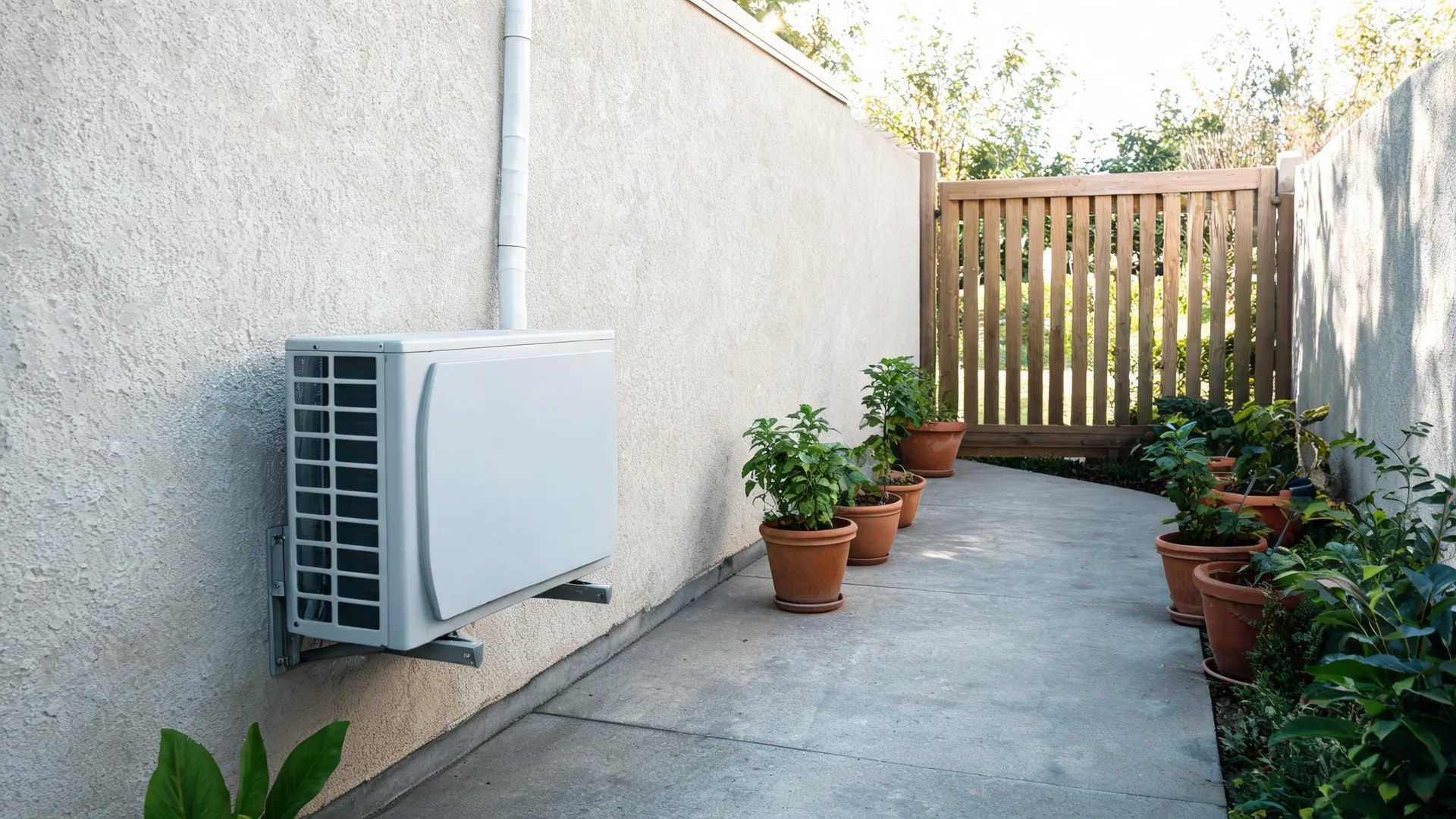
A beige split-system air conditioner outdoor condenser unit mounted on metal wall brackets atop a stucco wall.

More hours, spread differently

A furnace or an old central AC runs when the thermostat calls for it and sits idle the rest of the time. Once the mini split goes in, the outdoor unit takes over both jobs, so it cycles on through the shoulder months too, not just the hard freeze or the hot stretch. That's more total run hours over a year, spread out instead of bunched up. More run hours is not a problem for the equipment. Compressors are built to cycle on and off for years, and a unit sized right for the space spends most of its time running at a lower, steady output rather than straining at full blast. What actually shortens the life of a compressor is short cycling, shutting off and firing back up too often because the unit is oversized for the room. The old system, meanwhile, either gets removed or left in place as backup. A furnace that still works can keep handling the coldest stretch if the mini split's outdoor unit isn't rated for it. An old AC condenser usually comes out, since there's no reason to keep a second cooling system taking up space outside.

Sizing comes from a room by room heat loss and gain calculation, not square footage alone

A contractor measures each room's windows, wall area, and exposure to work out how much heat it loses in winter and gains in summer. Square footage alone skips all of that, so a room with big west-facing windows can need a bigger head than a same-sized room that doesn't.
Oversized or undersized both cause problems, just different ones

A unit too big for the room cools or heats it fast, then shuts off, then fires back up again soon after. That short cycling wears on the compressor and leaves the room swinging between too cold and too warm instead of holding steady. A unit too small runs constantly and still can't keep up on the hardest days. The right size runs long stretches at a steady, lower output, which is what the equipment is built to do.

What drives the installed price is mostly the work outside the box itself. Running the line set is one of the biggest factors, how far the outdoor unit sits from the indoor head and what the line has to pass through to get there, siding, brick, a joist bay. A straight shot through a rim joist costs less than a run that has to snake around framing or climb between floors. The number of indoor heads matters too, a single room is a simpler job than a whole house split across several zones, each with its own head, its own line set, and its own spot on the outdoor unit. Electrical work can add to it as well, some outdoor units need a dedicated circuit, and if the panel doesn't have room or the wire run is long, that's its own piece of the job. Where the outdoor unit sits counts for something too, a pad on the ground is simpler than a wall bracket that has to carry the unit's weight securely. None of this shows up on the price tag in the showroom, it shows up once a contractor sees the house.

The label carries a rating for cooling and a rating for heating, and both describe the same thing, how much heat the unit moves for the power it draws. They don't describe how big the unit is or how hard it can work. A higher number next to another unit the same size means it moves more heat per watt, that's the whole claim. It doesn't say whether the compressor can keep pulling heat out of the air on the coldest night, and it doesn't say whether the head matches the room it's going into. Those ratings come from a lab test run under set conditions, not from your house during a cold snap. A unit can carry a strong rating and still be the wrong fit for the space, or still fall behind when it's needed most. Treat the number as one fact about the equipment, not the one that settles the choice.