














Why your heat pump smells like burning in North Dakota

After you send the request, you're done searching.

I'm done searching

Why does my heat pump smell like it's burning?

You walked by the unit and caught it, a hot, dusty smell, maybe something sharper underneath. Your gas furnace handles the hard part of winter here, so the heat pump mostly runs in spring and fall and through the warm summer stretch, and a burning smell from a system that doesn't run constantly can feel more alarming, not less. You want to know if this is dust burning off or something you need looked at now.

It's usually dust burning off the coils or a motor, but not always

If the heat pump sat idle for a while, the first run can push a dusty, hot smell through the vents for a few minutes as dust on the coils or the blower motor burns off. That clears on its own. A smell that keeps coming back, or one that's sharper, like burning plastic or something electrical, points to a different cause: a motor bearing wearing out, a belt or wire rubbing somewhere it shouldn't, or a component overheating. North Dakota's cold stretches put real strain on a heat pump's defrost cycle, and that's often where a failing part shows up first. A smell that doesn't fade after a few minutes of running is worth having looked at.

A smiling man in a navy long-sleeve shirt sits at a wooden table in a kitchen and dining area, with a ceramic mug, a potted plant, and a sliding glass door behind him.
A smiling bearded man in a green henley shirt stands at a kitchen island with a gray mug, looking off to the side, with a dining area and shelves blurred behind him.
A smiling bearded man in a navy sweater sits at a white kitchen island with a ceramic mug, with open shelves, potted plants and a range hood behind him.
A smiling man in a dark olive long-sleeve shirt sits in a kitchen beside a counter with a dark mug, with a dining table, sideboard and hallway visible in the blurred background.

What's Actually Burning Inside

  • A burning smell usually means dust burning off the heat strips or coil, not the refrigerant itself.
  • Heat pumps here sit idle most of the summer, so dust settles on the coil and electrical contacts between runs.
  • A failing capacitor can arc and give off a sharp, burnt smell before it ever trips the breaker.
  • Auxiliary heat strips kick in on the coldest days and will scorch any dust that built up since spring.
  • A blower motor with a dying bearing runs hotter than it should and can smell like hot metal.
  • Loose wire connections inside the control board heat up under load and give off a burnt plastic odor.

Most of the time what you're smelling is dust, not a wire or a part failing outright. Your heat pump sits parked for long stretches here since the furnace carries the cold months, and dust has time to settle on the coil, the blower wheel, and the electrical contacts while the unit isn't running. When it kicks on, that dust burns off fast and clears in a few minutes. If the smell sticks around or gets sharper, something else is going on. A capacitor that's starting to fail can arc inside its casing and put off a burnt smell well before it trips anything, since it doesn't have to fail completely to cause trouble. On the coldest stretches, the auxiliary heat strips come on to back up the heat pump, and if dust has built up since spring, those strips will scorch it on contact, same as a dusty baseboard heater smells when you first turn it on for the year. A blower motor with a worn bearing runs hotter than normal and gives off a hot metal smell rather than a dusty one, which is worth noting when you describe it. Loose connections at the control board are another source. Under load they heat up and the insulation around them can give off a faint burnt plastic smell long before anything looks visibly wrong. None of these show up by looking at the outside of the unit. Knowing which one you're dealing with means someone checking the capacitor's reading, the blower bearing, and the wiring at the board, not just running the system and listening.

A smiling man with dark curly hair in a navy t-shirt sits on a gray couch indoors, with a large-leafed plant and a window in the background.
A bearded man in a plaid flannel shirt stands in a kitchen looking out a window toward snow-covered shrubs, with a steaming mug on the windowsill and potted plants on a shelf behind him.

Your heat pump isn't the system you lean on when it's ten below. That job belongs to the gas furnace. But the heat pump still has to switch on and off through spring and fall, and a smell that keeps showing up every time it cycles means something inside it is working against itself. Dust burns off once and that's that. A part running hotter than it should keeps smelling long after the dust is gone. Left alone, that part wears down faster, and the day it finally quits is rarely a convenient one. It tends to happen when the weather turns and you need the system to carry its share of the load before the furnace takes over for good. A contractor who works on heat pumps in this area all year has likely seen the same part fail in the same models before. One visit now, while the unit is barely running, is a smaller thing than a repair call in the middle of a cold snap when parts and patience both run short.

What This Means For Your House

  • A burning smell you catch once and never again is worth a service call before the next cold snap arrives.
  • If the smell comes back every time the unit cycles on, the dust has burned off and something else is heating up.
  • A dusty smell that keeps returning points toward a part working harder than it should, which can shorten its life.
  • Ignoring it through one more mild stretch costs you nothing until the day your gas furnace needs the heat pump's help and it can't give it.
  • A local contractor who services heat pumps all year knows which part in your model tends to go first.
  • Catching it now, while the unit sits mostly idle, means one visit instead of a breakdown on the coldest week of the year.
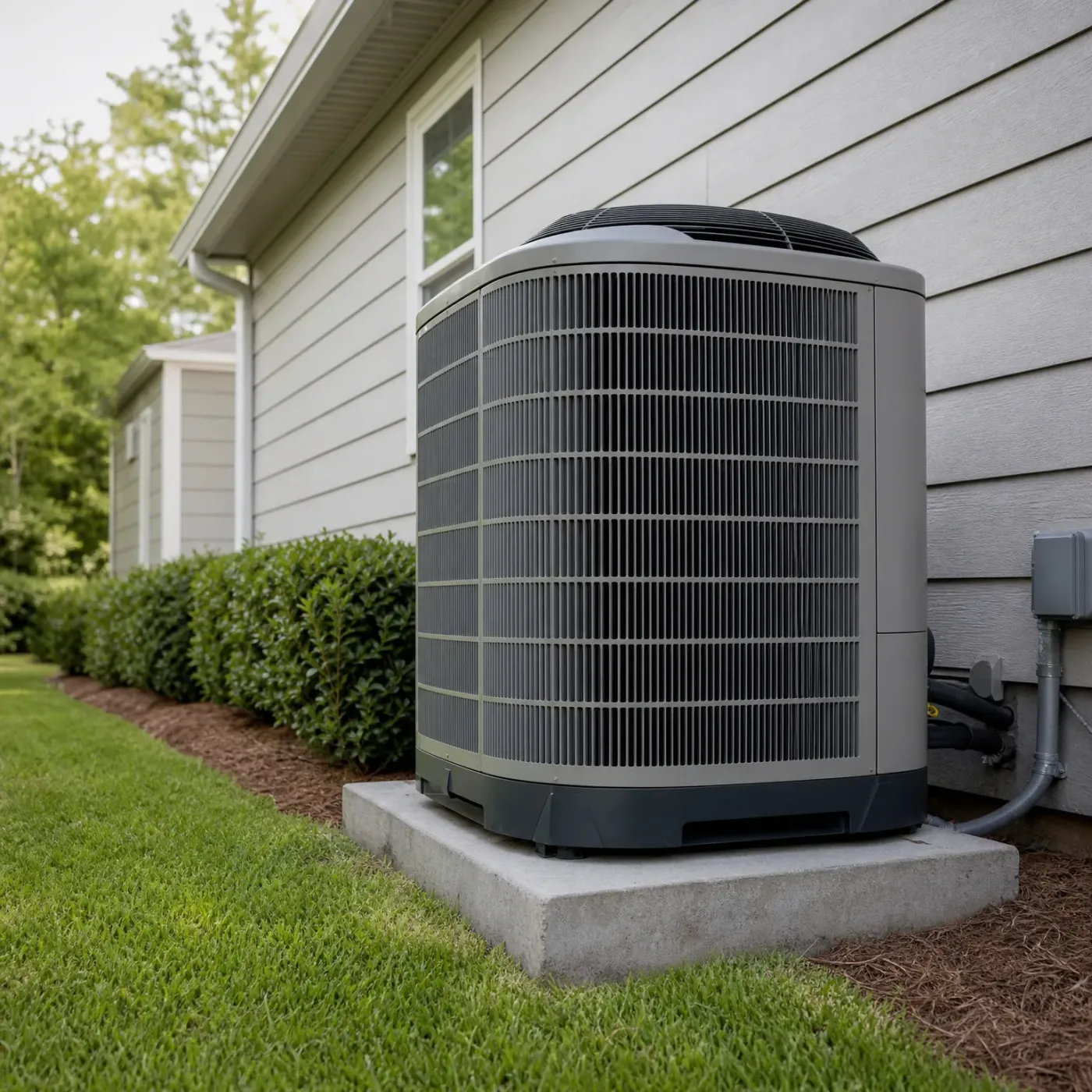
An outdoor air conditioner condenser unit on a concrete pad beside a house with horizontal lap siding, with a gray electrical disconnect box and conduit on the wall and bare dirt and mulch in the foreground.
Before you get your heat pump repair
A gray outdoor condenser unit on a concrete pad beside a light-colored lap-sided house, with a wall-mounted disconnect box and conduit, dark mulch, and a green shrub to the right.
After you get your heat pump repair
An outdoor condenser unit on a concrete pad beside a light-colored lap-sided house, with a trimmed hedge, mulch bed and mowed lawn nearby and an electrical box and conduit on the wall.

It's off your list after this

Only one pro gets your request, so you hear from one company.

Send the request today and stop worrying about who to call.

Hand it over

No fee to send it, and nothing to sign.

Is this something you're noticing right now

Maybe the smell shows up for a minute when the unit kicks on, then fades. Maybe you hear a buzz or a click from the outdoor unit that wasn't there before. Some households notice it near the thermostat, others only catch it standing outside by the unit itself. If it's been months since this heat pump ran a full cycle, a little dust burning off on startup is normal and clears fast. What's worth paying attention to is whether the smell changes, gets sharper, or starts showing up with warm spots on the wall near the wiring. Left alone, a failing capacitor or a loose electrical connection can damage the unit further or trip a breaker at a bad time.

  1. The unit sits idle for weeks between spring and fall startups.

  2. Dust settles on the coil and electrical contacts while it's off.

  3. Startup heats the coil and strips, burning off that dust.

  4. A technician checks the capacitor and contacts if the smell persists.

Call now or wait it out

Call now

  • A technician who works on heat pumps in North Dakota all year knows which parts fail first after a slow summer.
  • One licensed contractor gets the service call, so you are not fielding calls from three different companies while you're trying to figure out what's wrong.
  • Finding out whether it's dust or a failing capacitor now means it's settled before the first real cold snap.
  • A local contractor who services this equipment every season has likely seen the exact smell you're describing before.
  • Once the form is sent, you are not the one calling around; that part is off your plate.

Wait and see

  • If the smell was dust burning off and it hasn't come back, there may be nothing left to check.
  • Leaving it alone means you're betting the smell doesn't come back worse once the heat pump is running harder in spring.
  • A capacitor that's starting to arc won't fix itself by waiting, and it tends to get worse, not better.
  • Your gas furnace is doing the heavy lifting most of the winter, so it's easy to put off the heat pump until it's needed again.
  • Waiting costs you the chance to catch a small problem while it's still just a smell and not a failed startup.
A single-story gray horizontal-siding house with multiple front-facing gables, white-trimmed windows, a dark front door, and a concrete walkway crossing a partly dry lawn under a clear blue sky.

Summer air in North Dakota runs light, with dew points averaging 53°F across June, July and August, according to NOAA climate data. That keeps your heat pump's summer cooling runs short and spread out, since the air doesn't hold much moisture to wring out. Short, infrequent runs mean more idle stretches in between, and idle time is when dust settles on the coil and the electrical contacts. So when the unit finally kicks on for a longer run, maybe on a warm afternoon, that's when you're most likely to catch the burning smell as the dust heats off.

NASA POWER T2MDEW county cells weighted by homes

A dark gray outdoor condenser unit on a concrete pad beside a house with beige horizontal siding, with a gray electrical disconnect box and conduit on the wall, mulch beds, a hosta plant, a shrub, and mowed lawn in front.
A clean outdoor unit like this one draws in air freely, so dust has less chance to settle on the coil between runs.
A weathered outdoor condenser unit on a concrete pad beside a house with light horizontal siding, surrounded by bare dirt and a shrub.
Caked grilles like this trap dirt against the coil and contacts, which is what burns off and smells hot at startup.

Power costs 11.82 cents per kilowatt-hour statewide

At 11.82 cents a kilowatt-hour, running the heat strips to chase down a burning smell instead of fixing it isn't cheap insurance. A short repair call costs less than letting a failing part force your heat pump to lean on backup heat all winter.

EIA-861 2025 statewide residential average

A gray outdoor condenser unit on a raised pad beside a house with horizontal lap siding, with refrigerant lines, conduit and an electrical disconnect box on the wall, and shrubs on a mulch bed to the left.

Running clean

This is what a heat pump should look like, sitting on its pad with the lines and conduit tucked in close to the house. Air moves through the coil without catching on anything. Nothing builds up on the contacts inside, so startup after a slow summer stays quiet.


An outdoor air conditioner condenser unit on a gray composite pad beside a house with horizontal lap siding, with refrigerant lines and a conduit running to a wall-mounted disconnect box, and a shrub at left.

Caked and struggling

Grime like this coats the coil and the grille around it, and some of it works its way to the electrical contacts underneath. That's what heats up and burns off when the unit kicks on. Left alone, it's also what wears down a capacitor faster than it should.

A burning smell from your heat pump almost always traces back to dust that settled during the months your furnace was doing the work instead. That's the answer, and it holds whether the smell fades after a minute or keeps coming back every cycle. The second case is the one that needs a technician, not a guess. A contractor who services heat pumps through a North Dakota summer has seen this exact pattern on units that sat idle since spring, and knows to check the capacitor and contacts before anything else. When you send the request, it goes to one licensed local contractor, so you're not sorting through calls from three companies while you're trying to figure out if you need your heat pump fixed or just vacuumed out. You already know what you heard and smelled. What's left is getting someone out to look at the unit before the first cold snap asks more of it than a dusty coil can handle.

A single-story stucco house at dusk with a lit paver walkway lined by low path lights, desert plants and boulders in front, and distant mountains under an orange and blue sky.

Heat Pump Repair

Hand off the search today

RepairHeat PumpNorth Dakota
Step 1 of 2

What ZIP code is the job in?

  • A ceramic vase holding leafy green branches and a shallow wooden bowl sit on a wooden window ledge beside a sunlit window, with a cream upholstered chair and knit throw in the foreground.
    • Tell a local repair pro what your heat pump is doing.
    • Say what's going on with your heat pump, and a pro who works on them reaches out.
  • Sunlit living room corner with a beige upholstered sofa, a round wooden side table holding a ceramic vase of olive branches, linen curtains at a window, a floor vent in the baseboard, and a woven jute rug on hardwood flooring.
    • After this form, you can stop searching for a heat pump pro.
    • One request and the search for a pro is handled.
  • A wooden side table with a single drawer holds a shallow carved wood bowl and a white ceramic vase of green eucalyptus stems, beside a window and an upholstered chair draped with a cream knit throw.
    • Describe what your heat pump is doing once, in one form.
    • Skip searching for a heat pump pro and answer a few questions instead.
  • Corner of a house with horizontal siding, a white-framed window and stone veneer base, beside a covered entry with wooden steps, a potted plant, mulched beds of green shrubs and a flagstone path.
    • Your request goes to one pro, not a list of companies.
    • The pro who reaches out is licensed in North Dakota.



