A snow-covered residential street at twilight with illuminated houses, bare trees, and an orange horizon glow beneath a deep blue sky.

AC Maintenance in Bottineau, ND

Tell us about the job

Takes about a minute. No obligation.

Tune-up, service, or cleaningCentral ACBottineau County, ND
Step 1 of 2

What ZIP code is the job in?

The refrigerant charge gets checked, not just the filter

A quick visit means someone swaps the filter, glances at the outdoor unit, and calls it done. A thorough one has the tech check refrigerant pressure against what the system calls for, clean the condenser coil, and check the capacitor's readings against its rating instead of just confirming it powers on.


A rushed tune-up misses the problem that takes the system down later

A weak capacitor or a coil caked with debris can still run fine on the day of the visit. What a real tune-up catches is the part that's drifting out of range before it fails outright, so the breakdown gets caught in the driveway instead of in the middle of a hot stretch.

2 months
July through August, your air conditioner is on duty
78°F
the average summer afternoon it cools against
65 hail events
in ten years, and hail bends the fins on outdoor coils
34 wind events
in ten years, and wind drives debris into outdoor units
Isometric cutaway illustration of a house showing attic ductwork, an indoor air handler, refrigerant lines running outside, and an outdoor condenser unit on a pad.
Your air conditioner works hardest from July through August.

NOAA nClimDiv, 1991–2020 normals

A dirty filter chokes airflow across the evaporator coil, and a starved coil can ice over before anyone notices.

The filter and the drain line need the same attention as the refrigerant charge, because a clogged drain backs up and spills water right where the air handler sits.

Two months of real work a year, that's not much to wear a system down

Cooling runs July through August
Summer afternoons average 78°F
34 damaging wind events from 2015 to 2024
Once a year covers it hereHalf the homes here were built in 1976 or earlier, half later. Neither age changes what this system needs checked.

July is when the system has to run every day here, not just start up. That makes June the month to have it looked at, while it's still off and there's no afternoon heat pushing it. A tech checking a system that isn't under load can catch what's marginal before it has to prove itself. Book the visit in June and there's still time to order a part if something needs replacing. Wait until July and the unit is already working while someone's trying to figure out what's wrong with it.

Keep up the yearly check

Easy duty still wears parts. A yearly check keeps it going a long time.

Find a contractor
A man in a cap, blue long-sleeve shirt and tan pants climbs porch steps toward a red front door, carrying a canvas tool bag beside a red planter.
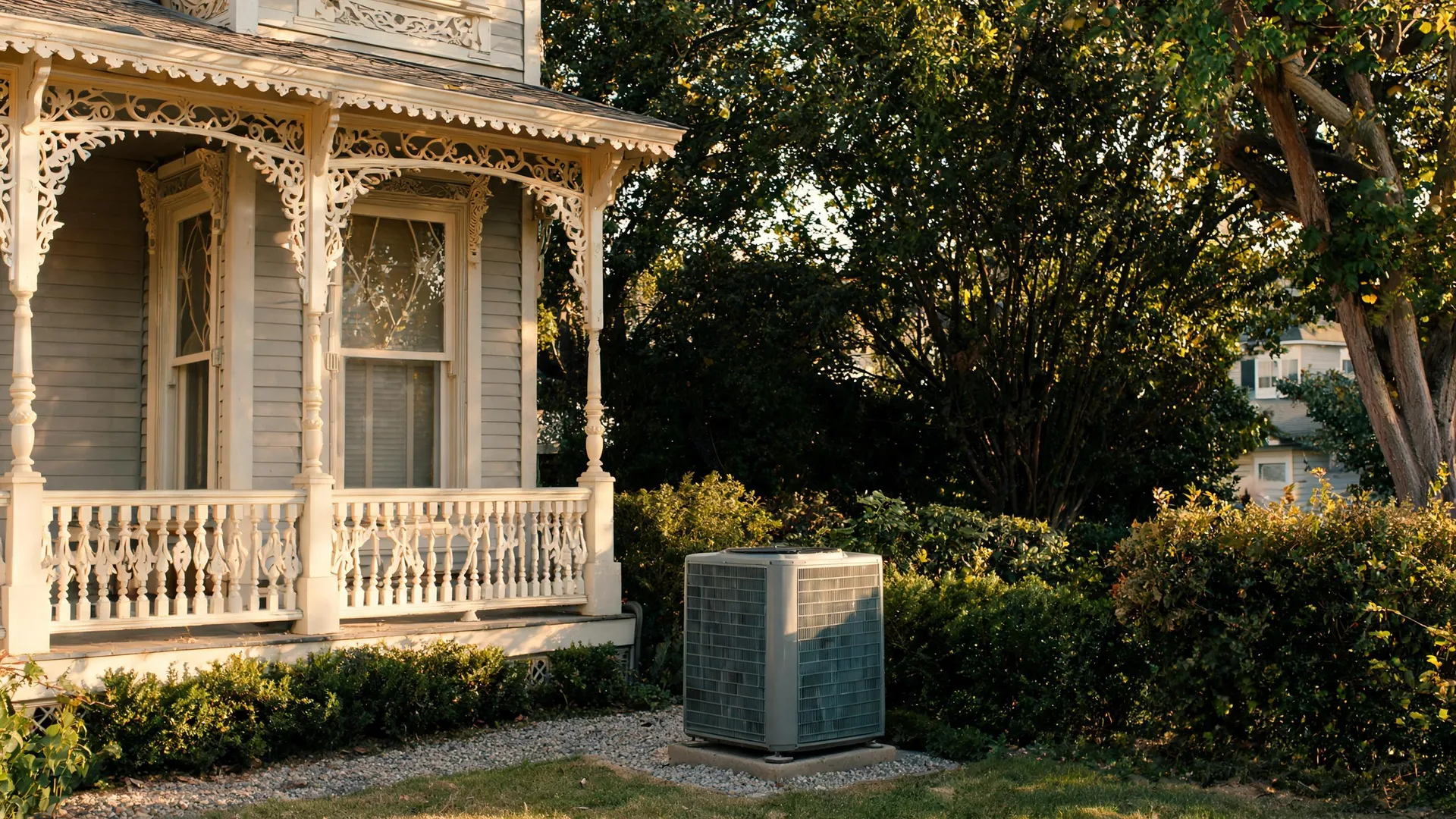
A gray cylindrical air conditioning condenser unit mounted on a concrete pad next to a light-colored vinyl-sided house exterior.

What you check, what you leave shut

Between visits, the filter is the one thing worth checking on a schedule. Pull it and hold it up to the light. If you can't see light through it, swap it. A dirty filter doesn't just block dust, it starves the coil behind it of air, and a starved coil can ice over even on a hot day. Keep the area around the outdoor unit clear too. Grass clippings, leaves, a fence line built too close, all of it blocks the airflow the coil needs to dump heat. Walk past it now and then and clear anything piled against it. Inside, check the pan under the air handler once in a while. Standing water there means the drain line is backed up. Past that, leave the refrigerant and the electrical side alone. Low charge or a failing capacitor won't show themselves by looking. Opening the cabinet without gauges and meters to check them does more harm than good.

The contactor arcing a little more each season

The contactor is what kicks the outdoor unit on and off, over and over, all season. Every cycle wears the contact points down a little. A tech can check the contacts for pitting and burn marks and see it heading toward failure. Left alone, it eventually sticks or stops closing, and the outdoor unit won't start at all.

Why that matters before the system has to prove itself

None of this shows up by looking at the unit or listening to it run. A pitted contactor, a capacitor reading under its rating, a coil losing its charge slowly, all of it runs fine on the day someone glances at it. A tune-up means someone's actually tested those parts against what they're supposed to read, so the one that's close to done gets replaced on a bench instead of in the middle of a run of hot days.

Aerial view of a residential air conditioning condenser unit mounted on a concrete pad next to a house with vinyl siding and a sliding glass door.

Book your AC tune-up in June, before homes here start needing cooling in July.

  1. Jan
  2. Feb
  3. Mar
  4. Apr
  5. May
  6. Jun
  7. Jul
  8. Aug
  9. Sep
  10. Oct
  11. Nov
  12. Dec

A tune-up checks the refrigerant charge, cleans the coils, tests the capacitor and tightens the electrical connections.

A tune-up also covers things that have nothing to do with refrigerant or electrical parts. The blower wheel picks up dust over time, and a caked wheel moves less air even at full speed, which makes the whole system work harder to push the same amount of cooling through the ducts. The tech checks the blower motor's amp draw against what it should pull, because a motor working too hard shows it there before it shows it anywhere else. The thermostat gets checked too, not just whether it powers on, but whether it's actually calling for cooling and getting a response within a reasonable time. Outside, the fan blades get looked over for cracks, since a cracked blade can throw itself off balance and wear the motor bearing out early. None of these are dramatic failures. They're the slow kind, and a proper visit catches them while they're still small.