










AC can't keep up on hot days in Minot, ND

Let a pro reach out

A hot stretch in Minot shouldn't end with you standing in front of a vent that's barely blowing cool. Summers here don't carry the heavy air other places get, but when the heat sets in and the system can't keep up, the house holds onto it fast. Maybe it runs all afternoon and never gets the house below 80. Maybe it cycles on and off without ever catching up. Either way, you're left trying to figure out who to call, whether they can come out before the week is over, and whether the quote you get is fair. That's the part you can hand off. Send the form and stop being the one who tracks down a contractor, calls around Ward County to see who answers, and explains the same problem three times over. Someone who works on home cooling systems gets your information and takes it from there.

When an AC runs all day and the house still sits at 78 or higher, the system is losing the fight against the heat instead of winning it. That usually means it is low on refrigerant, the coil is iced over or dirty, or the unit is undersized for the house it is cooling. A dirty coil or low charge stops the system from pulling heat out of the air, so it runs constantly without bringing the temperature down. An undersized unit was never built to handle a stretch of real heat in the first place, and North Dakota summers get hot enough to expose that even without the humidity other places carry. Either way, running longer does not fix it. The longer a struggling system runs, the harder the compressor works, and that shortens its life. A contractor can tell within a visit whether this is a repair, a cleaning, or a sign the unit itself is the wrong size for the house.

A smiling man in a dark green sweater sits at a wooden table with a light gray mug in a kitchen with white tile backsplash, pendant lights, and an adjoining living room visible.
A smiling man in a dark gray sweater stands indoors looking to the side, with a kitchen counter holding a ceramic mug and open wooden shelves behind him and a living area in the background.
A smiling man in a dark blue button-up shirt stands at a white kitchen island, with open shelving, a gas range, a potted plant and a window in the background.
A smiling man with dark wavy hair and a beard, wearing a dark green knit sweater, sits in an open-plan living room and kitchen with a brown sofa, large windows, and a counter holding a mug and a wooden bowl.

Why does my AC run constantly but never cool the house down?

A hot stretch in Minot shouldn't end with you standing in front of a vent that's barely blowing cool. Summers here don't carry the heavy air other places get, but when the heat sets in and the system can't keep up, the house holds onto it fast. Maybe it runs from morning to night and the thermostat barely moves. You want to know why it's working this hard for so little.

The system is moving air but not pulling enough heat out of it

A healthy air conditioner cycles off once or twice an hour on a hot day. If yours runs without stopping, the refrigerant charge is probably low, which means the coil can't absorb heat the way it should even though the blower keeps pushing air through the house. A dirty outdoor coil does the same thing, since it can't release the heat the refrigerant is carrying. Either way, the air coming out of the vents feels cool against your hand but isn't cold enough to pull the house down to 72 or 74. The compressor keeps running because the thermostat never sees the temperature it's waiting for, and that extra runtime on a system already struggling adds wear it wouldn't see on a normal July day.

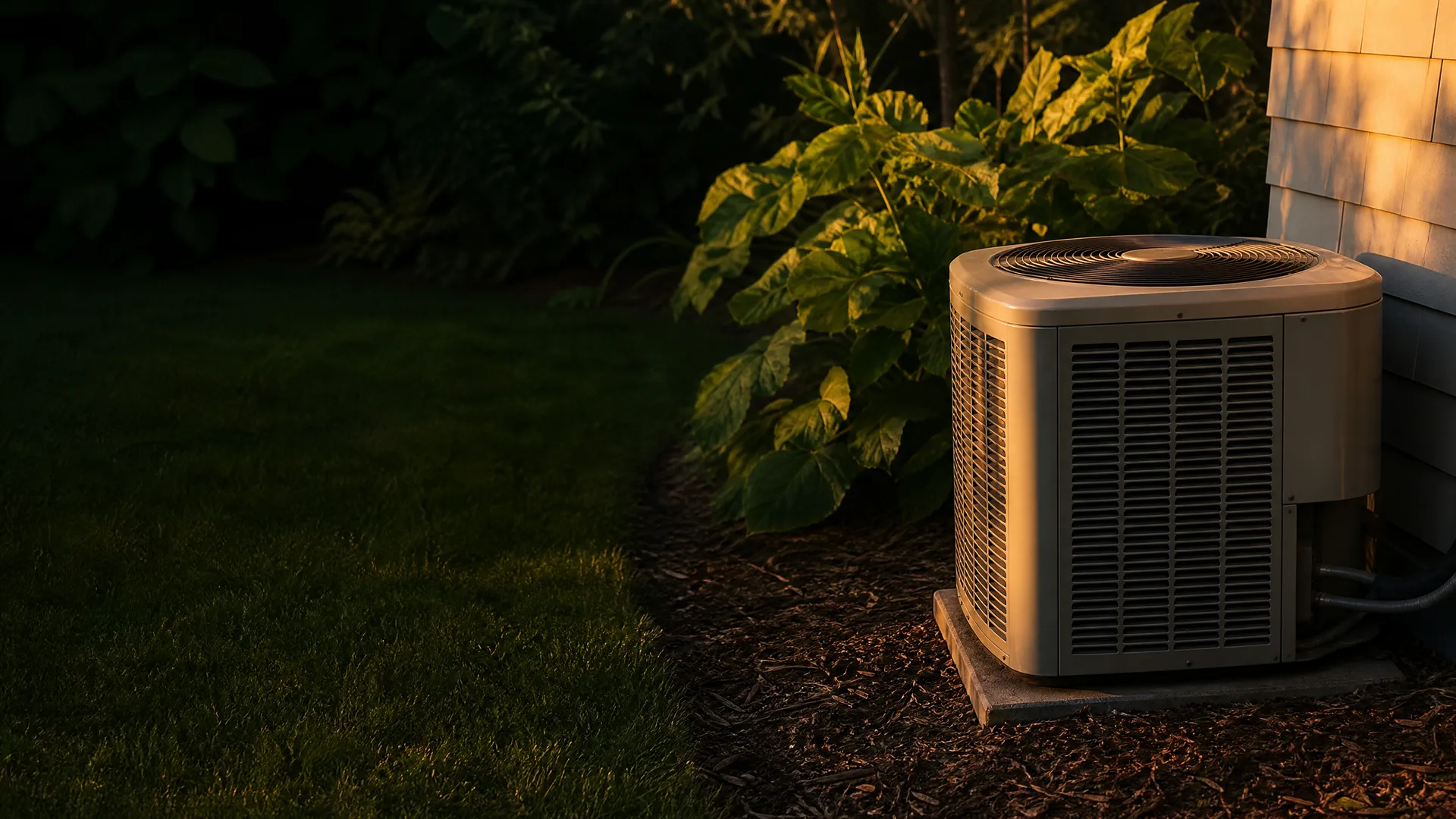
An outdoor air conditioner condenser unit sits on a concrete pad beside a shingled house wall, surrounded by mulch, broad-leaved shrubs and a lawn in low evening light.

You're out back around eight, the light still gold over the fence line, and the air hasn't given up its heat yet. The condenser sits against the house, and you notice it before you place why: no hum, no fan turning behind the grille. You crouch and check the vents are clear and nothing's tripped. Inside, the thermostat reads a number higher than you set it. Ward County evenings like this don't cool off fast once the sun drops, and a unit that's stopped moving air isn't getting you there tonight. You stand there a minute longer, waiting to see if it kicks back on. It doesn't.

A gray outdoor air conditioner condenser unit on a concrete pad beside a house with horizontal siding and a stucco foundation, with a disconnect box and conduit on the wall, decorative gravel, mulch, and a shrub nearby.
Clear gravel bed around the pad, clean coil grilles, and open airflow let this unit shed heat the way it was built to.
An outdoor air conditioning condenser unit on a concrete pad beside a house with horizontal lap siding, with an electrical disconnect box and conduit on the wall, mulch and a green shrub to the right, and a concrete walkway in the foreground.
Dirt packed into the coil grilles traps heat against the unit, so it runs longer and still loses ground on the hottest days.
  1. Heat inside the house moves into the refrigerant at the indoor coil.

  2. The compressor pulls that refrigerant in and squeezes it hot.

  3. The outdoor coil dumps that heat into the outside air.

  4. The condenser fan has to pull enough air across the coil to carry the heat away.

An outdoor air conditioner condenser unit on a concrete pad beside a house with light horizontal vinyl siding, surrounded by bare dirt, gravel and dry leaves, with refrigerant lines and conduit running along the wall.
Before you get your air conditioner repair
A gray outdoor air conditioner condenser unit on a concrete pad beside a house with horizontal lap siding, with a flowering shrub at left and a disconnect box with conduit on the wall at right.
After you get your air conditioner repair
A gray outdoor air conditioner condenser unit on a concrete pad beside a house with horizontal siding and a stone veneer foundation, surrounded by mulch, ornamental grasses, and shrubs, with a conduit and disconnect box on the wall.

Stop chasing an air conditioner pro

Describe your air conditioner job once, to one pro.

Get the air conditioner repair search off your mind today.

I'm done searching

There's no charge for the request.

Why does the heat seem to win by late afternoon?

You notice it most around four or five, when the sun's been on the roof for hours and the thermostat still won't move. The air coming out of the vents feels more lukewarm than cold. Upstairs rooms lag behind the rest of the house by several degrees. The outdoor unit might be running the whole time, loud and steady, without much to show for it. A bedroom that was fine at noon turns uncomfortable enough that nobody wants to sleep in it. Left alone through a run of hot days, a system working that hard can trip its own safety switch and shut down, or ice up the indoor coil, leaving you with no cooling at all instead of just weak cooling.

A gray outdoor air conditioner condenser unit on a concrete pad beside a house with dark horizontal siding and a stone base, surrounded by gravel, with a flowering shrub at left and a concrete walkway in front.

Clean unit, clear airflow

This condenser sits on open gravel with nothing crowding the cabinet. Air pulls through the fins easily and leaves just as easily, so the coil sheds heat the way it should on a 90 degree afternoon. A unit set up like this can still need a repair, but it isn't fighting its own setup to do the job.


An outdoor air conditioner condenser unit sits on a concrete pad beside a stucco wall, with refrigerant lines and conduit running to the wall and a shrub to the left.

Grime and crowding

Years of dust and yard debris have packed into the fins on this older unit, and the lines running into the wall show their age. A coil caked like this can't dump heat the way a clean one can, so the compressor runs longer and the house still falls behind on the worst days.

A bearded man in a navy T-shirt sits on a light-colored couch indoors, smiling while looking down at a laptop screen in the foreground, with a framed picture and a potted plant blurred behind him.
A bearded man in a plaid flannel shirt sits indoors looking out a window at snow-covered trees, with a steaming mug on the sill and wooden kitchen shelves behind him.

Cooling runs July through August

Your AC only has to earn its keep for about two months here, July and August. That short stretch is exactly when a struggling unit gets exposed, since there's no mild stretch beforehand to mask a weak compressor or a low charge before the real heat hits.

NOAA nClimDiv 1991-2020

What Keeps Your AC From Catching Up

  • A system that runs nonstop and still can't hold 78 is losing, not just struggling, and that points to a specific cause.
  • Low refrigerant, a dirty or iced coil, or a unit sized wrong for the house are the usual reasons an AC can't keep up in Ward County heat.
  • July and August are the only real test, so a weak compressor or a low charge has nowhere to hide once the heat sets in.
  • A dirty coil or blocked airflow around the condenser makes the unit work harder for less cooling on the hottest afternoons.
  • Finding a licensed contractor, explaining the problem, and comparing quotes takes time you don't have when the house is already holding heat.
  • The cause is usually one of a few specific problems, and a contractor who checks the charge, the coil, and the sizing can tell you which one it is.

A system that runs all day without ever holding the house at 78 isn't struggling, it's losing, and that losing comes down to one of a few things. The refrigerant charge is low. The coil is dirty or iced over. The condenser isn't getting the airflow it needs because something's crowding it. Or the unit was never sized right for the house it's cooling, and no amount of runtime fixes that. July and August are the only months here that really test a system, so whichever of these is wrong has nowhere left to hide once the heat sets in.

None of these show up the same way from the outside. A low charge and a dirty coil both leave you with warm air at the vents, but one gets fixed with a gauge and the other with a hose. Sizing is a different problem again, one no amount of cleaning or refrigerant solves. That's the part that's hard to sort out on your own, and it's exactly what a licensed contractor checks for when they look at the charge, the coil, and the equipment itself.

Getting to that answer usually means finding someone licensed, calling around, explaining what the house is doing, then doing it again for the next quote. That part isn't the fix, but it's the part that eats the afternoon while the house keeps holding onto its heat.

An outdoor air conditioner condenser unit on a concrete pad beside a dark horizontal-lap sided house, with mulch beds, shrubs and ornamental grasses nearby.

Hand off the air conditioner problem

Explain the air conditioner problem once instead of to every shop in Ward County.

RepairCentral ACWard County, ND
Step 1 of 2

What ZIP code is the job in?

