






A dark-painted two-story house with white-trimmed windows and a gray shingled roof stands behind a wire fence in a grassy field, backed by tall deciduous trees under an overcast sky.

AC Maintenance in Fort Yates, ND

Tell us about the job

Takes about a minute. No obligation.

Tune-up, service, or cleaningCentral ACSioux County, ND
Step 1 of 2

What ZIP code is the job in?

Half the homes in Sioux County were built in 1984 or later. That's not old for a house, and if your AC came with the house or was put in sometime after, it's probably not near the end of its life. A yearly check now keeps a newer system running the way it should instead of catching problems after a few years of wear nobody noticed. The county has a fair number of mobile homes too, and those systems benefit the same way, maybe more, since a small AC unit doesn't have much room for a part to fail quietly.

3 months
June through August, your air conditioner is on duty
82°F
the average summer afternoon it cools against
37 hail events
in ten years, and hail bends the fins on outdoor coils
49 wind events
in ten years, and wind drives debris into outdoor units
Isometric cutaway illustration of a house interior showing ducted HVAC piping, an indoor air handler unit, and an outdoor condenser with fan connected by a line, rendered in grey tones on a white background.
Your air conditioner works hardest from July through August.

NOAA nClimDiv, 1991–2020 normals

Three months of cooling a year, June through August, is a short season for an AC to work in.

A compressor that only runs three months a year still needs a yearly check, because age catches up to it even when the load doesn't.

May is the month to book it, before June asks the compressor to work

Cooling runs June through August
Summer afternoons average 82°F
49 damaging wind events from 2015 to 2024

Between visits, keep the area around the outdoor unit clear. Grass clippings, leaves, and cottonwood seed drift into the fins and block airflow, and a unit that can't breathe works harder than it should. Check the air filter once a month and swap it when it looks gray or matted. A clogged filter starves the system of airflow and can ice up the coil behind it. Inside, keep the vents open and unblocked by furniture or rugs. If the condensate line has a cleanout, listen for a gurgle or notice if the drain pan ever shows standing water, since that line clogs with algae over time and backs up into the house.

Keep it in good shape

If your system is fairly new, a yearly check keeps it in good shape for longer.

Find a contractor
A man in a cap, dark jacket and tan work pants carries a worn duffel bag as he steps up onto a porch toward a red front door, with a potted shrub beside the entry.
An outdoor residential air conditioning condenser unit mounted on a concrete pad, surrounded by gravel with a blue sky in the background.

Skip the check and the small parts take the hit first

A system that never gets opened up still wears the same parts every season it runs. The capacitor loses its charge a little at a time, the contactor points pit from the arc of switching on and off, and the refrigerant charge can drop slowly from a fitting that was never quite tight. None of that announces itself. The AC still turns on, still blows cold, right up until the day the start capacitor can't kick the compressor over or the low charge has iced the coil solid. A yearly check catches those while they're still a reading on a gauge, not a dead unit on the hottest day of the season. Skip enough checks in a row and the compressor itself ends up absorbing the wear that smaller parts were supposed to take instead.

A dirty coil makes the compressor work harder

The outdoor coil gives up heat to the air outside, and the indoor coil pulls heat out of the house. Either one caked with dust or clogged with fins full of debris can't move heat the way it should, so the compressor runs longer to do the same job. That extra strain is what wears a compressor out early.

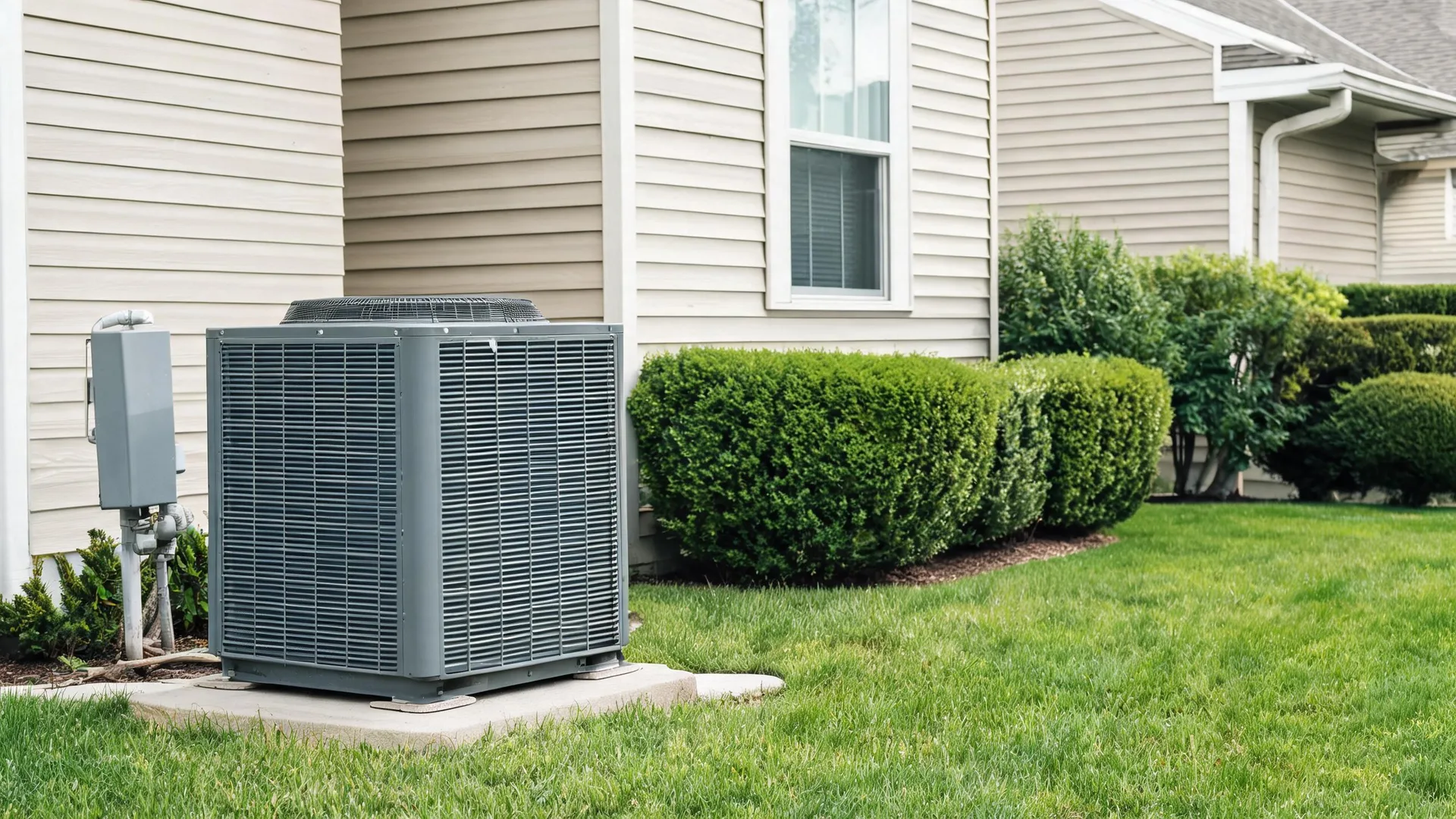
Why the drain line is part of the job

The indoor coil pulls moisture out of the air as it cools, and that water has to go somewhere. The drain line carries it out, but algae builds up inside that line the same way it does in any damp, dark tube. A clog there backs up into the drain pan and from there into the house.

An outdoor air conditioning condenser unit mounted on a concrete pad next to a blue-sided residential house at sunset.

Book your AC tune-up in May, before homes here start needing cooling in June.

  1. Jan
  2. Feb
  3. Mar
  4. Apr
  5. May
  6. Jun
  7. Jul
  8. Aug
  9. Sep
  10. Oct
  11. Nov
  12. Dec

A tune-up checks the refrigerant charge, cleans the coils, tests the capacitor and tightens the electrical connections.

A tune-up starts with the electrical side, since that's where AC trouble usually begins. The tech checks the capacitor's charge against its rating, looks at the contactor points for pitting, and tightens any connection that's worked loose from vibration. Next comes the refrigerant charge, checked against what the system is supposed to hold, because a slow leak shows up as a pressure reading before it shows up as warm air. Both coils get inspected and cleaned if they're dirty, since airflow across them is what lets the system move heat at all. The condensate line gets flushed clear so it can't back up later. Last, the system runs through a full cycle so the tech can listen for anything off and check that it's actually cooling the way it should, not just turning on.