





A row of similar two-story houses with gray and beige siding and covered porches, seen across a mowed lawn with concrete walkways, with a chain-link fence in the left foreground and tree branches overhead.

AC Maintenance in LaMoure, ND

Tell us about the job

Takes about a minute. No obligation.

Tune-up, service, or cleaningCentral ACLaMoure County, ND
Step 1 of 2

What ZIP code is the job in?

Skip a season of maintenance and the first thing to go is airflow. Dust builds up on the coil and the system has to work harder to pull heat out of the house. Keep ignoring it and the compressor is what pays for that strain, since it's the part under the most load when the coil is dirty and refrigerant pressure runs off. A weak capacitor tends to get missed too, and that's the part that can leave the whole unit dead on the hottest day instead of failing gently. None of this fixes itself. It just gets worse the longer it runs that way.

2 months
July through August, your air conditioner is on duty
79°F
the average summer afternoon it cools against
37 hail events
in ten years, and hail bends the fins on outdoor coils
44 wind events
in ten years, and wind drives debris into outdoor units
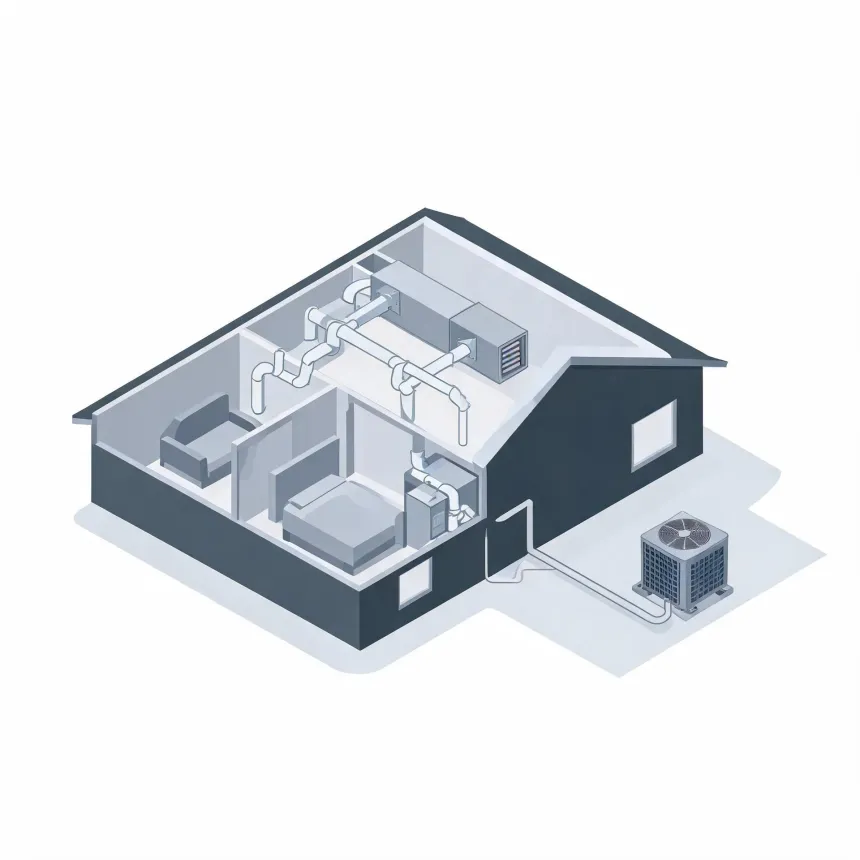
Isometric cutaway illustration of a house showing interior ductwork, an air handler and furnace unit, and an outdoor condenser connected by lines outside the wall.
Your air conditioner works hardest from July through August.

NOAA nClimDiv, 1991–2020 normals

A dirty filter is the one thing a homeowner can actually see.

Check it every month and swap it when it looks gray, and the coil behind it stays out of trouble.

Half the homes here were built by 1965, and a system that old is worth checking every year

Half the homes here were built by 1965
Cooling runs July through August
Summer afternoons average 79°F
Two easy months a yearCooling runs July and August here, afternoons near 79°F, and a yearly check still matters.

A tune-up checks things a filter change never touches. The capacitor gets tested under load, not just looked at, since a weak one can read fine sitting idle and still fail the moment the compressor tries to start. Refrigerant charge gets measured against what the system actually calls for, because both a low charge and an overcharged one wear the compressor down in different ways, and neither shows up as anything a homeowner would notice from inside the house. The contactor gets checked for pitting, since that's a part that burns a little every time it cycles and eventually stops closing properly. The condensate drain gets cleared too, because a clogged one backs up quietly until it's a bigger mess. None of this announces itself ahead of time. It just works until it doesn't.

Catch it while it's small

If your system has been in the house a long time, a yearly check is how you catch problems while they're small.

Find a contractor
A gray residential air conditioning condenser unit mounted on a concrete pad outdoors, surrounded by green grass under a partly cloudy blue sky.

The system tells you before it quits

An AC that's about to need a check doesn't go quiet about it. It runs longer than it used to before it hits the temperature you set. It cycles on and off more than it should, short bursts instead of full runs. Airflow at the vents feels weaker, even with a clean filter in place. You might hear a hum when the compressor tries to start and fails, or notice warm air coming out when it used to run cold. Ice can even form on the coil or the refrigerant line, which sounds backward for a problem that's really about heat, but it happens when airflow or charge is off enough. None of these stop the system outright. They just mean it's spending more effort to do the same job, and that's the point where a check finds something small instead of a tech finding something broken.

Gauges attached, or no gauges at all

A thorough tune-up puts gauges on the system and measures refrigerant pressure against what the system actually calls for. A quick one skips that step entirely, or glances at a reading without checking it against anything. Without gauges, there's no way to know if the charge is right.

The capacitor gets tested, not just eyeballed

A capacitor can look fine and still fail under load, so testing it means checking it while the compressor tries to start, not just checking that it's there. A tech who only glances at the capacitor can miss the one part that leaves the system dead on a hot afternoon.

Aerial view of a gray central air conditioning condenser unit on a concrete pad next to a house with vinyl siding.

Book your AC tune-up in June, before homes here start needing cooling in July.

  1. Jan
  2. Feb
  3. Mar
  4. Apr
  5. May
  6. Jun
  7. Jul
  8. Aug
  9. Sep
  10. Oct
  11. Nov
  12. Dec

A tune-up checks the refrigerant charge, cleans the coils, tests the capacitor and tightens the electrical connections.

A tune-up also covers the outdoor unit itself, not just what's inside. The fan motor gets checked for play in the bearings, since a motor that wobbles on its shaft will wear out its bushings early. The coil gets cleaned from the outside in, because dirt packed between the fins blocks airflow in a way that rinsing the surface won't fix. Electrical connections get tightened, since a loose lug heats up under load and that heat damages the wire insulation around it. The blower wheel gets inspected too, because a wheel caked with dust moves less air even when the motor spinning it works perfectly fine. Each of these wears down on its own schedule, quietly, and a tune-up is built around catching all of them in one pass rather than waiting for one to announce itself.