





A snow-covered suburban street at dusk with lit houses and bare trees under a twilight sky.

AC Maintenance in Leeds, ND

Tell us about the job

Takes about a minute. No obligation.

Tune-up, service, or cleaningCentral ACBenson County, ND
Step 1 of 2

What ZIP code is the job in?

Skip maintenance long enough and the signs show up slow, then all at once. A dirty condenser coil can't shed heat the way it should, so the compressor runs longer to hit the same temperature. Airflow problems compound the same way. A clogged filter starves the system of return air, the evaporator coil gets too cold, and ice can form right on it. Run it like that and you risk the compressor itself, which is the one part in the system you don't want to lose. A yearly check catches the coil before it's caked, the refrigerant charge before it's low enough to strain the compressor, and the electrical connections before a loose one burns through. None of that announces itself ahead of time. It just runs fine until it doesn't.

2 months
July through August, your air conditioner is on duty
78°F
the average summer afternoon it cools against
60 hail events
in ten years, and hail bends the fins on outdoor coils
87 wind events
in ten years, and wind drives debris into outdoor units
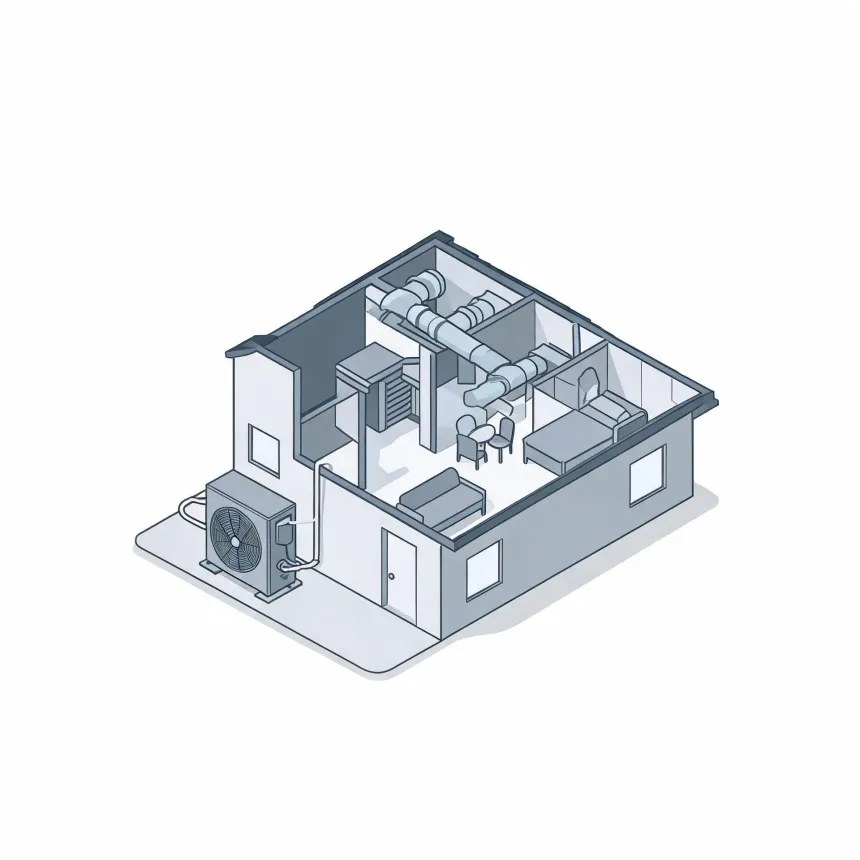
Isometric line illustration of a cutaway house showing interior rooms with furniture and ceiling ductwork, connected to an outdoor condenser unit with a fan beside the building.
Your air conditioner works hardest from July through August.

NOAA nClimDiv, 1991–2020 normals

Leeds asks for cooling about two months a year, July and August, with afternoons averaging around 78 degrees.

A system that runs that little still needs a yearly check, since the parts tend to fail from sitting unused more than from hard work.

Half the homes in Benson County date to 1972 or earlier, so the AC has likely outlasted a part or two already

Half the homes here were built by 1972
Cooling runs July through August
Summer afternoons average 78°F
Best time for a tune-up is before it starts runningSchedule the check before July, when the system starts its two months of work.

A tune-up starts with things a gauge can see that a hand on the vent never will. The refrigerant charge gets checked against what the system actually calls for, not just whether air feels cold. A unit can run low for a long time before the house feels it, and by then the compressor has been working harder than it should every single day. The contactor and capacitor get tested under load, since a capacitor can be weak enough to cause trouble without failing outright yet. The condensate drain gets checked too, because a clogged one backs up quietly until it overflows somewhere you'll notice. None of this shows up from across the room. It shows up on a gauge, or it doesn't show up until the system stops.

Keep up the yearly check

Easy duty still wears parts. A yearly check keeps it going a long time.

Find a contractor
A gray metal air conditioning condenser unit mounted on a concrete pad in a flat grassy field under a partly cloudy sky.

What you can watch, and what to leave alone

Between visits, the filter is the one thing worth your attention. Check it monthly during the months it runs, and swap it when it's gray or furred with dust. A dirty filter starves the system of airflow, and that alone can ice the evaporator coil or push the compressor harder than it needs to work. Outside, keep the area around the condenser clear. Leaves, grass clippings, a stray branch, anything piled against those fins blocks the airflow it needs to shed heat. A garden hose can rinse dirt off the fins from the outside in, but skip anything that sprays hard enough to bend them. Indoors, make sure nothing is blocking the supply vents or the return grille. Past that, leave the refrigerant, the electrical connections and the drain line to a gauge and a trained eye. There's not much else to do between checks, and that's by design.

Gauges and meters, not a glance

A quick visit gets you a filter swap and a look at the outside unit. A thorough one puts gauges on the refrigerant lines, checks the amp draw on the compressor and fan motor, and tests the capacitor under load instead of just eyeing it for bulges. Anyone can tell you the unit kicked on and air came out cold. Only a meter tells you if it's pulling more current than it should, or if the charge is a pound low.


What it skips tells you more than what it covers

Ask if the condensate drain gets flushed, since a clogged one backs up slow and quiet until it overflows somewhere you won't see right away. Ask if the electrical connections get tightened, since a loose one is what burns a wire when the system is working hardest. A tech who only wipes down the coil and checks the thermostat setting isn't doing anything a dirty coil wouldn't eventually show on its own. The point of a tune-up is catching what doesn't announce itself yet.

An outdoor air conditioning condenser unit installed beside the exterior wall of a blue vinyl-sided house at sunset.

Book your AC tune-up in June, before homes here start needing cooling in July.

  1. Jan
  2. Feb
  3. Mar
  4. Apr
  5. May
  6. Jun
  7. Jul
  8. Aug
  9. Sep
  10. Oct
  11. Nov
  12. Dec

A tune-up checks the refrigerant charge, cleans the coils, tests the capacitor and tightens the electrical connections.

A tune-up also means pulling the blower access panel, not just the ones that pop off with a thumb latch. The blower wheel collects dust on its blades the same way a ceiling fan does, and enough buildup there throws off the airflow the whole system depends on, no matter how clean the coil is. The fan motor bearings get checked too, since a motor that's starting to wear makes itself known by running hotter or louder long before it quits outright. On the outside unit, the fan blade gets checked for wobble, since a blade that's slightly bent or loose pulls air unevenly across the coil and makes the compressor work around a problem instead of past it. Thermostat calibration gets a look as well, because a thermostat reading a few degrees off tells the system to run longer than the house actually needs. None of this is guesswork. Each check either passes or it doesn't, and the ones that don't are the ones worth knowing about before the first hot day asks the system to prove it.