An outdoor air conditioning condenser unit mounted on a concrete pad next to a blue-sided residential house at sunset.

AC Maintenance in Marmarth, ND

Tell us about the job

Takes about a minute. No obligation.

Tune-up, service, or cleaningCentral ACSlope County, ND
Step 1 of 2

What ZIP code is the job in?

The tech checks the refrigerant charge, not just the filter

A quick visit gets you a new filter and a glance at the outdoor unit. A thorough one checks refrigerant pressure against what the system calls for, pulls the capacitor and tests it under load, and checks the contactor for pitting. Low charge and a weak capacitor are common reasons an AC quits in hot weather, and neither one shows up just by looking.

The condenser coil gets washed, not just rinsed off

Dirt and grass clippings pack into the fins of the outdoor coil over time, and a hose from a few feet away does not clear it. A proper cleaning uses a coil cleaner and flushes it from the inside out. A coil that stays caked with dirt makes the whole system work harder to move heat outside, and that shows up as a unit that runs longer than it should.

2 months
July through August, your air conditioner is on duty
81°F
the average summer afternoon it cools against
34 hail events
in ten years, and hail bends the fins on outdoor coils
62 wind events
in ten years, and wind drives debris into outdoor units
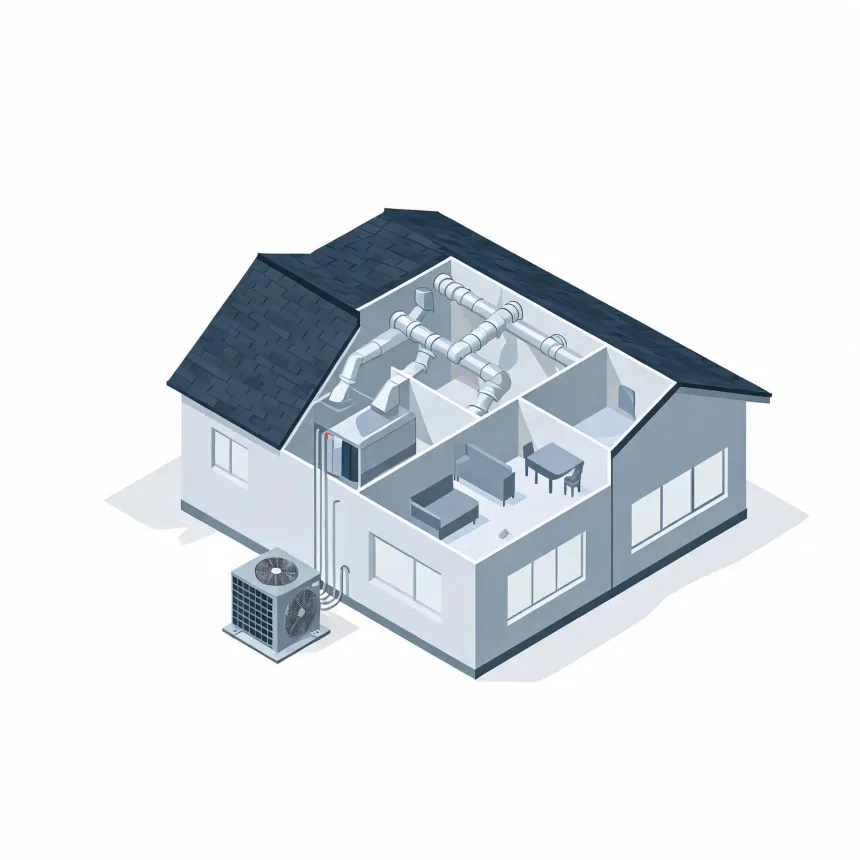
Isometric illustration of a cutaway single-story house showing attic ductwork, an indoor air handler, interior rooms with furniture, and an outdoor condenser unit connected by lines, on a white background.
Your air conditioner works hardest from July through August.

NOAA nClimDiv, 1991–2020 normals

Swapping the filter is the one job that falls to you between visits.

A clogged filter starves the system of airflow, and everything past it works harder because of that one part.

Half the homes in Slope County were built by 1961, and a system that old needs eyes on it every year

Half the homes here were built by 1961
Cooling runs July through August
Summer afternoons average 81°F

Cooling only runs two months a year here, July and August, with afternoon highs around 81. That's a short season and a mild one, nothing like what an AC in a hotter state deals with. The system spends most of the year sitting idle, so what wears it out isn't heat load. It's time, and whatever dust or corrosion builds up while it's off. A yearly check before July catches a weak capacitor or a coil that's gone dirty over the winter, before the first hot week asks the system to prove itself.

Catch it while it's small

If your system has been in the house a long time, a yearly check is how you catch problems while they're small.

Find a contractor
A man in a cap, dark jacket and tan work pants carries a worn duffel bag as he steps up onto a porch toward a red front door, with a potted shrub beside the entry.
An outdoor air conditioning condenser unit mounted on a concrete pad surrounded by gravel, photographed against a partly cloudy blue sky.

What a tune-up checks that the thermostat can't tell you

A tune-up is also a look at what the system can't tell you by running. A refrigerant leak can be slow enough that the system still cools, just not as well, and the only way to catch it is to put a gauge on the line and check the pressure against what the system calls for. A capacitor can read weak under a meter's test but still get the compressor started most days, right up until the day it doesn't. The contactor can be pitted from arcing and still close the circuit, so the system runs, but a pitted contact is one more spark away from failing to close at all. None of that shows up as a sound or a smell. It shows up as a number out of range, or a part that fails a load test, and those are things a gauge or a meter finds that a homeowner standing at the thermostat has no way to see.

A refrigerant leak gets worse, not better

A system low on charge doesn't fix itself by running longer. The compressor keeps pulling against a charge that's already short, and that strain is what burns a compressor out early. A yearly check catches the leak while it's a repair, not a replacement.

Skipped visits don't show up until the system won't start

A dirty coil or a weak capacitor doesn't make noise while it's building. The system keeps cooling, a little worse each season, until the day the compressor can't start at all. By then there's no small fix left, just a unit that needs to come out.

An outdoor air conditioning condenser unit positioned beside a blue-sided house at sunset.

Book your AC tune-up in June, before homes here start needing cooling in July.

  1. Jan
  2. Feb
  3. Mar
  4. Apr
  5. May
  6. Jun
  7. Jul
  8. Aug
  9. Sep
  10. Oct
  11. Nov
  12. Dec

A tune-up checks the refrigerant charge, cleans the coils, tests the capacitor and tightens the electrical connections.

A tune-up worth paying for goes past the coil and the capacitor. The tech checks the blower motor and wheel, since a wheel caked with dust moves less air even when the motor runs fine. The condensate drain gets flushed, because that line clogs with algae and when it backs up the water has nowhere to go but your ceiling. Electrical connections at the disconnect box get tightened, since a loose lug heats up and burns before it ever trips a breaker. The thermostat gets checked against a thermometer too, because a sensor that's drifted off true will short-cycle the system or run it longer than it needs to. Each of these is a separate check, not a glance at the whole cabinet.