A snow-covered residential street at twilight with illuminated houses, bare trees, and an orange horizon glow beneath a deep blue sky.

AC Maintenance in Medora, ND

Tell us about the job

Takes about a minute. No obligation.

Tune-up, service, or cleaningCentral ACBillings County, ND
Step 1 of 2

What ZIP code is the job in?

The refrigerant charge is never visible from outside

A unit can look fine and still run low on refrigerant from a slow leak at a fitting or coil. A gauge check during a tune-up catches this before it drags down the compressor. Left alone, a low charge makes the compressor work harder than it was built to and shortens its life.


The condenser coil gets checked, not just hosed off

Dirt and grass clippings pack into the fins where the coil releases heat, and from the yard it just looks dusty. A tech checks whether airflow through the coil is actually restricted, not just whether it looks clean. A coil that can't shed heat properly forces the whole system to run longer to cool the same space.

2 months
July through August, your air conditioner is on duty
81°F
the average summer afternoon it cools against
41 hail events
in ten years, and hail bends the fins on outdoor coils
38 wind events
in ten years, and wind drives debris into outdoor units
Isometric illustration of a cutaway house showing interior rooms, an attic furnace with large ducts, and an outdoor condenser unit connected by a line set, on a white background.
Your air conditioner works hardest from July through August.

NOAA nClimDiv, 1991–2020 normals

Your air conditioner in Billings County only earns its keep in July and August, with afternoon highs around 81.

Two months of real work a year means less strain on the compressor, so a yearly check is more likely to keep it running than to turn up a repair you can't justify.

July asks a lot right away, so get it looked at in June

Cooling runs July through August
Summer afternoons average 81°F
38 damaging wind events from 2015 to 2024

A quick visit means someone glances at the unit, maybe swaps the filter, and calls it done. A thorough one means they take the electrical readings on the compressor and fan motor, not just the amp draw but the capacitor's actual output, because a capacitor can test weak long before it fails outright. They check the contactor for pitting, since a pitted contactor can stick or burn and take the compressor with it. They measure temperature split across the evaporator coil instead of just feeling if the air is cold, because a few degrees off tells you something a hand never will. They check that the condensate drain is actually clear, not just that water isn't visibly pooling. None of this takes a special occasion. It takes someone willing to check the parts that cause trouble later instead of the ones that are easy to see.

Newer systems still need a yearly look to stay that way

Half the homes in Billings County were built in 1983 or later. If yours is one of them, or if the system itself was swapped out more recently than the house, it's still well within its working life. A yearly check is what keeps it there.

Find a contractor
A man in a dark shirt and tan work pants carries a worn canvas tool bag up concrete steps toward a red front door of a gray clapboard house, with a potted shrub in a red planter beside the entry.
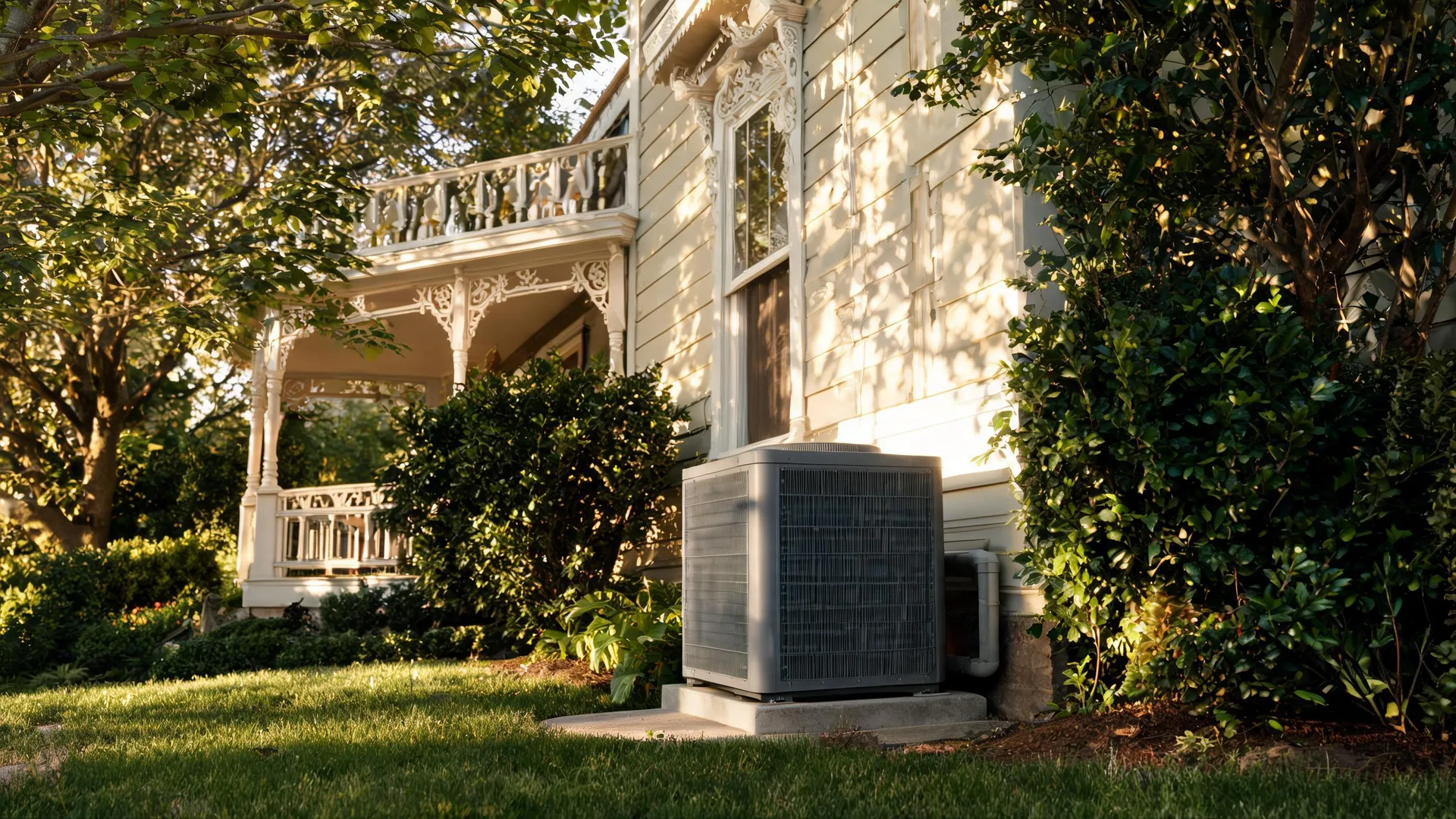
An outdoor air conditioning condenser unit mounted on a concrete pad beside a house, with electrical conduit running to a wall-mounted disconnect box.

The part you can see, and the ones you can't

The filter sits in the return before air ever reaches the coil, and it's the part you can actually get to without tools. A coil can only shed heat if air moves through it freely. Pack the fins with dust or starve them of airflow from a clogged filter upstream, and the system has to run longer to pull the same heat out of a room. The condensate drain does less obvious work. As the coil pulls moisture out of the air, that water has to go somewhere, and the drain line carries it out. Algae and dust settle in that line over time, and a clogged drain backs water up into the pan under the coil, sometimes far enough to trip a safety switch and shut the system down, sometimes far enough to overflow where nobody notices until there's damage. None of these fail on their own schedule. A dirty filter strains the coil, a dirty coil runs the compressor harder, and a clogged drain can stop the system cold even when everything else is working fine.

Keep the airflow clear

Keep plants, fence lines and stored items at least a couple feet back from the condenser outside, and check the filter inside every month, swapping it when it's visibly dirty. A clogged filter starves the coil of airflow and makes the whole system work harder to move the same air.

Know what to leave alone

Don't pull the panels off the condenser or touch the electrical connections. The capacitor can hold a charge even with the power off, and the refrigerant lines aren't something to open or adjust. If the system trips a breaker more than once, stop resetting it and get a tech to find out why.

An outdoor air conditioning condenser unit on a concrete pad next to the gray vinyl siding of a residential home.

Book your AC tune-up in June, before homes here start needing cooling in July.

  1. Jan
  2. Feb
  3. Mar
  4. Apr
  5. May
  6. Jun
  7. Jul
  8. Aug
  9. Sep
  10. Oct
  11. Nov
  12. Dec

A tune-up checks the refrigerant charge, cleans the coils, tests the capacitor and tightens the electrical connections.

A tune-up also covers the stuff you'd never think to check yourself. The blower wheel gets looked at for dust buildup, since caked-on dust throws it off balance and makes the motor work harder to push the same air. The refrigerant lines get checked for proper insulation, because a bare spot lets heat into the line before it ever reaches the coil. A tech checks the thermostat's calibration against an actual thermometer, not just whether it turns the system on and off. The outdoor fan motor gets tested under load, not just spun by hand, because a motor can turn freely and still be too weak to move air once it's working against real resistance. Each of these is small on its own. Together they're the difference between a system that limps through the season and one that doesn't have to.