






Overhead view of an air conditioning condenser unit on a concrete pad next to a house with asphalt shingle roofing and vinyl siding.

AC Repair in Mandan, ND

Tell us about the job

Takes about a minute. No obligation.

RepairCentral ACMorton County, ND
Step 1 of 2

What ZIP code is the job in?

Cooling here only runs from July through August. A capacitor or a charge that was already weak over the winter doesn't show it until the system finally has to work, so the first hot week of July is when it tends to fail. If your AC is acting up right now, that's likely what's going on. Worth getting it checked before you're into August with no cooling at all.

2 months
July through August, your air conditioner is on duty
81°F
the average summer afternoon it cools against
112 hail events
in ten years, and hail bends the fins on outdoor coils
114 wind events
in ten years, and wind drives debris into outdoor units
Isometric line illustration of a cutaway single-story house showing interior rooms, ducted air handler, ceiling ductwork, and an outdoor condenser unit connected by refrigerant lines.
Your air conditioner works hardest from July through August.

NOAA nClimDiv, 1991–2020 normals

Warm air from the vents with the thermostat set low usually means the charge is low or the compressor is on its way out.

Either one gets worse by the week, so the system is worth a look before it quits outright.

Two months of summer, nothing unusual about the heat itself

Cooling runs July through August
Summer afternoons average 81°F
114 damaging wind events from 2015 to 2024
Mandan weather isn't what wears out your ACMorton County saw 260 severe weather events from 2015 to 2024, mostly wind and hail, nothing unusual for a cooling system

A tech starts by asking what the system is doing and when it started, then checks the thermostat settings before touching anything outside. Next comes the refrigerant pressure, read off gauges hooked to the service ports, and the electrical readings on the compressor and capacitor. A failing capacitor shows up fast on a meter, so that part of the diagnosis doesn't take long. Low charge takes more thought, because refrigerant doesn't just run low on its own. If the pressures are down, the tech is also looking for where it got out, since a system that's low means a leak somewhere in the line. The indoor coil and the airflow across it get checked too, since restricted airflow can mimic a charge problem without being one. By the end of the visit you should know which of these it is, not just that something's wrong.

Get it looked at early

Problems tend to show up in the first weeks of the season, when the load hits a part that was already weak.

Find a contractor
An outdoor residential air conditioning condenser unit mounted on a concrete pad, surrounded by gravel with a blue sky in the background.

Nothing fails on day one

A capacitor fails because it's worn down, cycling on every time the system starts, until it can't hold the charge needed to get the compressor and fan going. A dirty condenser coil makes the whole system run hotter and longer than it should, and that extra strain is what finishes off a weak compressor or a motor that was already on borrowed time. Refrigerant doesn't wear out, but the copper lines carrying it can rub, vibrate or corrode at a joint until a leak opens up, and a system low on charge runs hot and strains the compressor the same way a dirty coil does. None of this needs a storm or a heat wave to happen. Ordinary running, season after season, wears these parts down on its own.

A weak compressor keeps drawing on a bad capacitor

When a capacitor can't deliver the jolt the compressor needs to start, the compressor pulls harder on every cycle trying to get going. Each hard start heats the windings a little more. Keep running it this way and you can turn a bad capacitor into a dead compressor, which is a far bigger job than the part that started it.

A small leak stays small only if you stop running it

Refrigerant doesn't get used up, so a system low on charge has a leak somewhere in the line. Keep it running low and the compressor runs hotter than it's built for, with less refrigerant to carry heat away from it. The leak itself won't grow from running the system, but the compressor wears down faster with every hour it runs hot.

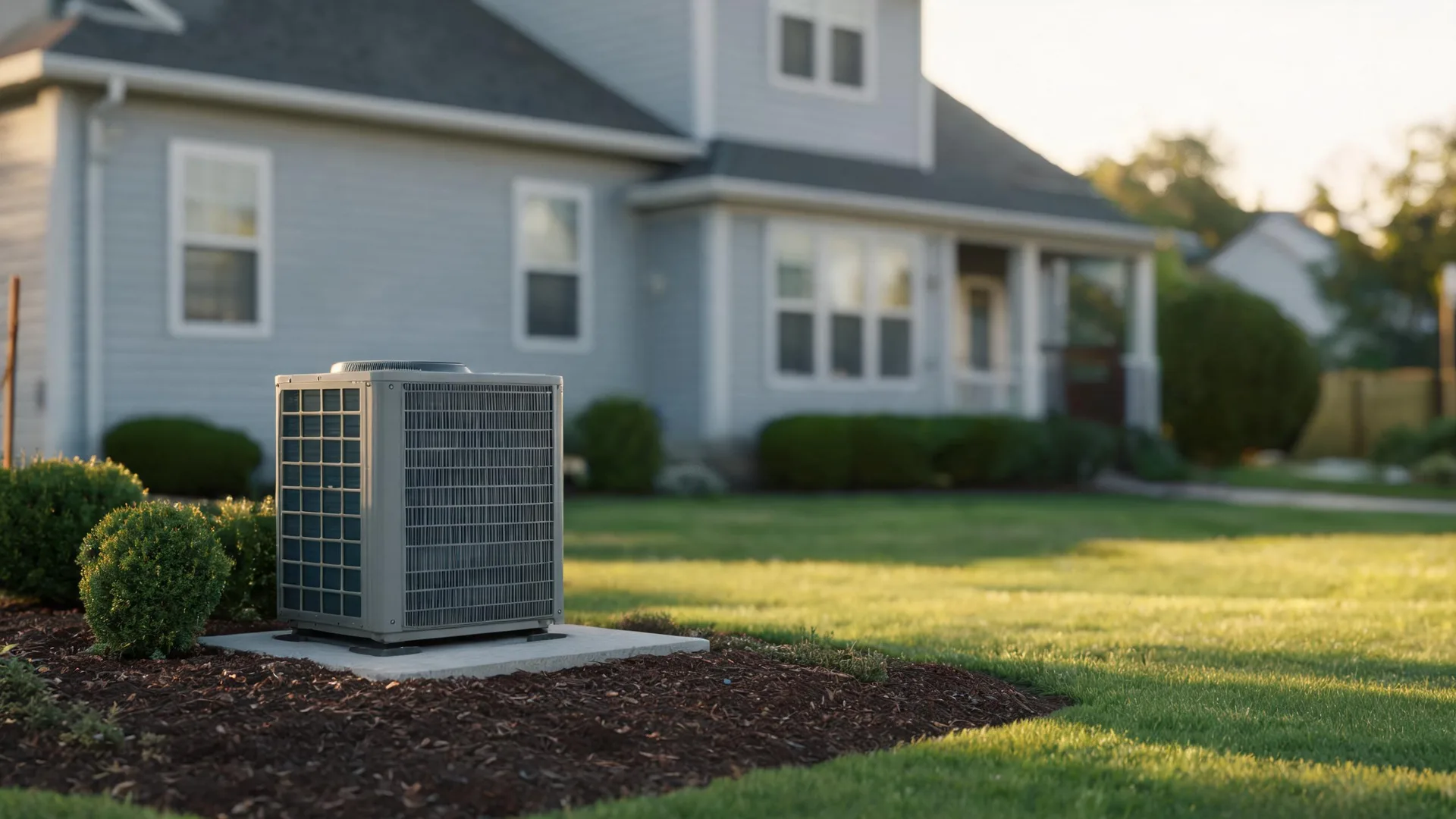
An outdoor air conditioning condenser unit mounted on a concrete pad next to a blue-sided residential house at sunset.

A new air conditioner would save little on running costs in Morton County, so the repair decision comes down to the unit's condition.

  • An older air conditioner$100 a year
  • A new one at the federal minimum, 13.4 SEER2$100 a year

Estimates for a typical Morton County home, compared with an older unit built to the previous federal minimum, from EIA household energy data, North Dakota fuel prices and NOAA climate normals. Your home will differ.

Repair makes sense when a part like a capacitor or contactor has failed.

Replacement makes sense when the compressor has failed or the system uses R-22 refrigerant, which is no longer made.

Age is the first thing worth weighing. A compressor that's given out after years of normal use is usually not worth replacing on its own, since the labor to swap it can rival putting in a new system anyway. A capacitor or a fan motor is a different story. Those fail on their own schedule, often early in a unit's life, and swapping one is a straightforward repair that has nothing to do with how old the rest of the system is. The other thing to weigh is whether this is the first repair or the third. One failure is just a part wearing out. A system that keeps needing attention, a different part each time, is usually telling you it's done as a whole, not asking for one more fix.