
AC unit frozen up in Minot, ND

Hand off the search

A frozen AC is still working to cool your house in Minot, it just can't right now, and running it longer makes the ice worse. The coil needs to thaw before anyone can find what caused it, whether that's low airflow, a dirty filter, or low refrigerant from a slow leak. Turning the system off and letting the blower run can help it along, but what froze it in the first place won't fix itself. Finding someone who works on these systems in Ward County and knows what tends to fail here is the slow part, not the repair. Send the request and that search is off your hands. It goes to one contractor, local and licensed, not a handful of companies competing for the callback, so your phone isn't about to blow up. Just the person who'll actually look at your unit.

Why does my AC unit freeze up in Minot, ND?

You went out to check on your AC and found the coil wrapped in ice, maybe even the line running to it. The air coming out of your vents has slowed down or stopped being cold at all. You want to know what's going on before you decide what to do next, and whether it's safe to just wait it out or if something needs attention now.

Something is blocking airflow across the coil or the refrigerant charge is low

Your AC needs steady airflow moving across the indoor coil to keep it at the right temperature. When that airflow drops, usually from a dirty filter, a closed vent, or a blower struggling to keep up, the coil gets too cold and the moisture in the air freezes onto it instead of draining away. A low refrigerant charge does the same thing from a different angle: less refrigerant means the coil runs colder than it should, even with good airflow. Either way, once ice starts forming it builds on itself, covering more of the coil and cutting airflow further. In Ward County summers, where the air runs warm but not heavy with moisture, a dirty filter is a common starting point since there's less humidity to carry dust away from it.

A gray outdoor air conditioner condenser unit on a concrete pad beside a house with horizontal lap siding, with a wall-mounted disconnect box and conduit, mulch bed, shrub, and lawn nearby.

Running normally

The coil stays dry and the lines run clean up the wall to the disconnect box. Air moves out of every vent, cold, and the unit cycles off on its own once the house hits temperature. Nothing on the cabinet or the lines should ever look wet or white.


An outdoor air conditioner condenser unit sits on a gray pad beside a light vinyl-sided wall, on a concrete slab next to a gravel bed.

Frozen up

Ice builds along the coil and down the refrigerant line, sometimes thick enough to cover the copper completely. Airflow from the vents drops off or stops, and what does come through isn't cold. Left running, the unit keeps pulling in warm, moist air and the ice only thickens.

A gray-haired man in a dark green knit sweater sits on a beige sofa with a dark cushion, looking to the side, with a potted plant, shelves and sunlit windows behind him.
A gray-haired man in a dark green sweater sits smiling on a sofa in a sunlit living room, with a houseplant, shelving unit, and dining table visible behind him.
A middle-aged man in a dark denim shirt sits on a light beige sofa in a living room with wooden shelving and a potted plant, looking off to the side.
A gray-haired bearded man in a dark green sweater sits on a light sofa indoors, looking to the side, with a houseplant, framed picture, table lamp and sunlit window behind him.

Shutting the system off is what lets the coil thaw. Running the blower alone speeds that up, since room air passing over the coil melts the ice faster than the system sitting off by itself.

Once it's thawed, the cause is usually easy to spot. A clogged filter restricts the airflow the coil needs, and that alone accounts for a large share of frozen units in Ward County.

Cooling runs July through August

Two months of real cooling load is all your system gets here, so it doesn't take much to tip it over. A dirty filter or a low charge that an AC in a longer, hotter climate might shrug off is enough to freeze a coil in Minot. When it runs, it needs to be running right.

NOAA nClimDiv 1991-2020

What it does to your house

While the coil is frozen, your house isn't getting cooled, and running the system longer only builds more ice instead of more cold air. If you keep flipping it back on hoping it catches, you're asking the compressor to run against a line that's iced over, and that's the part that costs the most to replace. Left alone long enough, the ice can work its way down the line and the water from the melt has somewhere to go, usually a drain pan that isn't built to hold it for days. None of that happens from one afternoon of ice. It happens from running a frozen system over and over, trying to force it to do what it can't do until it thaws.

What to check before calling

Pull the filter and look at it. If you can't see light through it, that's airflow enough to freeze a coil on its own. Check that every supply vent in the house is open and nothing is pushed up against a return. If the filter's clean and the vents are fine, the cause is inside the system, usually the refrigerant charge, and that's not something to chase yourself. Shut the system off, switch the fan to on so it keeps moving air over the coil, and let it thaw fully before anyone looks at it. A tech can't diagnose a coil still wearing ice.

An outdoor air conditioning condenser unit on a concrete pad beside a house with horizontal lap siding, with a shrub and mulch bed to the left and conduit and a small electrical box on the wall to the right.
Before you get your air conditioner repair
A gray outdoor air conditioner condenser unit sits on a concrete pad beside a house with horizontal lap siding, with conduit and an electrical disconnect box on the wall, dark mulch and a shrub to the left, and a concrete walkway in the foreground.
After you get your air conditioner repair

Let someone else find the pro

The pro who gets in touch is licensed in North Dakota and works in Ward County.

Sending the form costs nothing.

An outdoor air conditioner condenser unit on a concrete pad beside a house wall, with a gray electrical disconnect box and conduit above it and grass in the foreground.

Letting it thaw on its own

Turn the system off at the thermostat and leave the blower running, or switch it to fan only. That keeps air moving over the coil, which melts the ice faster than the system sitting off with no fan at all. It takes a few hours. Don't speed it up with a hair dryer or anything else aimed at the coil. Once the ice is gone and the coil's dry, a contractor can see what actually caused it instead of guessing under a layer of ice.

A gray outdoor air conditioner condenser unit on a concrete pad beside a house with horizontal lap siding, surrounded by white gravel and a lawn, with a white wall at left.

Calling before it's thawed

You can have someone look at it while the coil's still iced over, and in some cases that's the better call, especially if you're not sure the system will shut off cleanly or you want eyes on it sooner. A local contractor who works on these units every summer in Ward County has seen this before and knows what to check once things clear. What they can't do is diagnose refrigerant or airflow problems through a block of ice, so some of the wait is just physics.

Call Now or Let It Thaw First

Call now, while it's frozen

  • A tech can't open the panel and test anything until the ice is gone, so an on-site visit right now mostly means watching it thaw.
  • You still pay for a trip out even if the only thing that happens for the first hour is melting.
  • Some of what caused it, like refrigerant pressure, can't be checked while ice is covering the lines.
  • You'd be paying for someone to wait, same as you could do yourself with the system off and the blower running.

Thaw it, then call

  • By the time a contractor gets there, the coil is clear and they can see airflow, refrigerant pressure, and the filter right away.
  • A dry coil means the diagnosis happens on the first visit instead of a second trip after it thaws.
  • You've already ruled out the easy fixes, like a filter, so the time on site goes toward the actual cause.
  • If the ice comes back once it's running again, that's useful information a tech in Ward County can use to narrow it down fast.
  • Whatever repair it needs, from a low charge to a blower issue, gets done once the system is in a state where it can be tested properly.
  1. Warm air moves across the coil slower than it should.

  2. The coil surface drops below freezing instead of just cool.

  3. Moisture in the air lands on the coil and turns to ice.

  4. Each cycle adds another layer, sealing the coil in ice.

What you're probably seeing right now

A puddle under the indoor unit, or water tracking across the floor near it, once that ice you found starts to melt. Vents barely moving air, or air that's run warm for a while before you noticed. Maybe the outside unit is still running, fan spinning, even though nothing inside feels cold. If this has been going on for more than a day, check the drain pan and the area around it for standing water, since a pan not built for that much meltwater can overflow. The bigger risk is the compressor itself. Each time the system gets switched back on against a coil still sealed in ice, it's working against a blockage instead of cooling your house.

A gray outdoor air conditioning condenser unit on a concrete pad beside a house with horizontal lap siding and a stone veneer base, with a disconnect box and conduit on the wall, mulch bed and shrub to the right, and mowed grass in the foreground.

Running normally

The cabinet stays clean and the wire mesh around it shows bare metal, not dust. The disconnect box on the wall and the lines leading to it stay dry. A unit working right doesn't collect grime, because airflow is moving through it instead of sitting still.

An outdoor air conditioner condenser unit on a gray composite pad beside a house with horizontal siding, a concrete foundation, a basement window, and a conduit and disconnect box on the wall.

Running into trouble

Dust and dirt have built up across the cabinet and the mesh, the kind of buildup that blocks air from passing through the coil. The conduit and the wall behind it look untouched. It's the unit itself, caked with debris, that's struggling to breathe.

A woman with shoulder-length dark brown hair in a cream knit cardigan sits in an upholstered armchair beside a window, looking off to the side, with a white bookshelf and potted plant blurred behind her.
A woman and a child wrapped together in a thick knitted beige blanket on a sofa, both with eyes closed, beside a lit table lamp in a dim room.
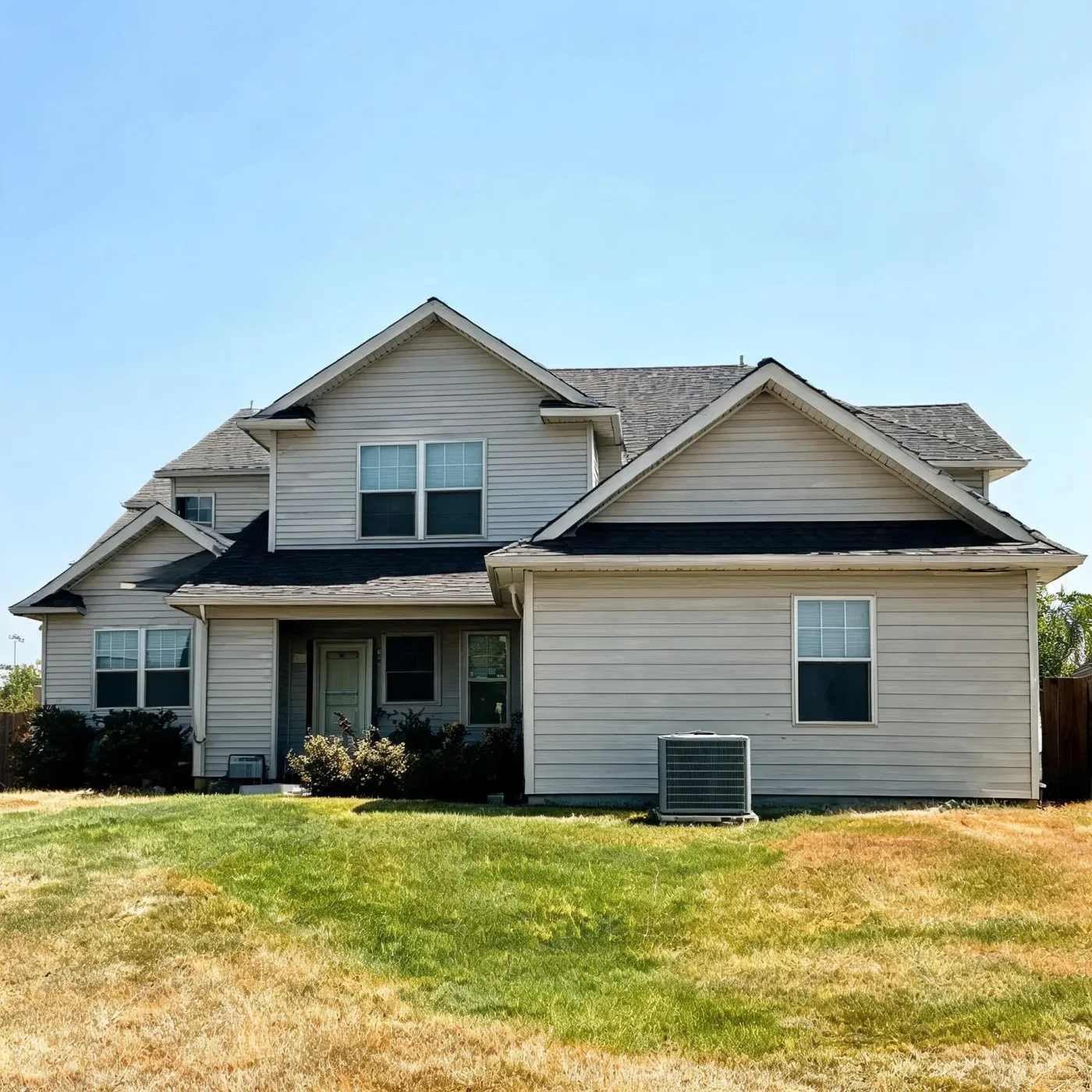
Two-story house with beige horizontal siding, gray shingled gable roofs and a covered front entry, with an outdoor air conditioning unit beside it and a partly dry grass lawn in front under a clear blue sky.

The dew point in Ward County averages 52°F across June, July and August, according to NOAA climate data. That's dry air, the kind where sweat evaporates fast and a house feels cooler than the thermometer says. It also means your AC isn't fighting much moisture to begin with, so when a coil freezes here, humidity usually isn't why. Look instead at what's blocking airflow across that coil, a dirty filter, a blower not pulling enough air, or a vent that's been closed off. In muggier places the air itself loads up the coil. Here, something else is making it ice over.

NASA POWER T2MDEW

A frozen coil almost always comes back to one of a few things: a dirty filter, weak airflow, or a refrigerant charge that's lower than it should be. Thawing it out doesn't fix any of those, it just gets the system back to where a tech can look at it and tell which one happened to you. Once the ice is gone and the cause is found, the fix itself is usually straightforward. What matters more is having someone who works on these systems around Minot every summer, who's seen what a short, hard cooling season does to a coil and knows where to look first. The request that follows goes to one licensed contractor local to Ward County, not a handful of companies competing for the job, so you're not stuck fielding calls while your house sits warm. You already know the coil is frozen and roughly why. What's left is getting someone out to confirm it and get the system running the way it's supposed to.

A single-story stone-clad house with low-voltage path lights along a gravel bed and lawn at dusk, with a tree line and orange sky on the horizon.

Air Conditioner Repair

One request and it's handed off

RepairCentral ACWard County, ND
Step 1 of 2

What ZIP code is the job in?

  • A beige upholstered armchair with an olive cushion sits in a sunlit corner beside a wooden side table holding a ceramic vase with leafy branches, under a framed abstract artwork, on a woven rug over a wood floor.
    • Tell a local repair pro what your air conditioner is doing.
    • Describe your air conditioner job, and a local pro who handles it gets in touch.
  • A gray outdoor condenser unit on a concrete pad surrounded by dark gravel, beside a dark wood-sided wall with an electrical disconnect box and a stone veneer wall with a small evergreen shrub.
    • Once you send the form, finding a pro is off your list.
    • After you send the request, you're done searching.
  • A beige upholstered oversized armchair with a matching cushion and a knit throw draped over one arm, beside a round wooden side table holding a vase of greenery near a curtained window, with a framed landscape print on the wall and a woven rug on a wood floor.
    • Answer a few questions instead of calling shop after shop.
    • Describe your air conditioner job once, to one pro.
  • Sunlit living room corner with a beige upholstered sofa, cushion and knitted throw, a round wooden side table holding a white ceramic vase of leafy branches and a small wooden bowl, a framed landscape painting on the wall, and a window at right.
    • Only one pro gets your request, so you hear from one company.
    • A licensed pro who works in Ward County gets your request.