Heat pump blowing cold air in Fargo, ND

Send it today

A heat pump blowing cold air in the middle of a Fargo winter is not something to sit with. Cass County winters don't leave room for a heating system that's not doing its job, and most homes here run on electricity, so there's no backup furnace quietly picking up the slack. Something is keeping the unit from switching into heat mode or from producing heat at all, and that needs a licensed contractor who works on heat pumps in this area, not a guess and a space heater. Finding that contractor is usually its own chore: looking up names, calling around, explaining the problem to one answering service after another, then doing it again when the first one can't come soon enough. Send the form here and that part stops being yours to handle. You're not left holding a list of numbers to call while your house sits cold. Someone takes it from here.

A heat pump blowing cold air usually means it's stuck in defrost, or it's run out of ways to pull heat from outside air that's gotten too cold. Below about 30 to 35 degrees, a heat pump works harder for less heat, and once outdoor temperatures drop into the single digits or below, which happens often in a Fargo winter, most heat pumps can't keep up at all. Some systems switch to backup electric resistance heat automatically when that happens; if yours isn't, or if the backup heat isn't working either, you'll feel cold air at the vents even though the system is running. It can also mean the reversing valve is stuck in cooling mode, the refrigerant charge is low, or the outdoor unit is iced over and not defrosting properly. None of these fix themselves, and with electric heat as the main source in most homes here, a heat pump that's not producing heat needs attention before the cold gets worse.

Why can't my heat pump keep up with a Fargo winter?

  • Winter nights average 3°F

    Overnight lows here average 3°F in December, January and February. That's well past the point where a heat pump is pulling much warmth from outside air.

  • Heat runs September through May

    Heat runs about nine months a year in Cass County, September through May. A heat pump that's struggling gets worked hard most of the year, not just in the cold snaps.

  • Cooling runs June through August

    Cooling only runs three months here, June through August. The same heat pump carries most of the load as a heater, so a defrost or airflow problem shows up fast.

NOAA nClimDiv 1991-2020

Cold air for a few minutes

A heat pump that blows cold air for ten or fifteen minutes before switching back to warm is probably running a defrost cycle. It melts frost off the outdoor coil, and while it does, the indoor side can put out air that feels cold compared to your skin even though the system hasn't failed. This happens more in Fargo winters than almost anywhere, because the outdoor coil sees frost a lot. If the warm air comes back on its own and the house holds its temperature, nothing is wrong yet. Watch it through one more cycle before you decide it needs a look.


Cold air that doesn't stop

A heat pump that blows cold air and stays that way is a different problem. It might mean the system has lost its charge, the reversing valve is stuck, or it simply can't pull enough heat from outdoor air that's dropped below what it can work with. At that point the house starts losing ground, and with winters here, that's not something to wait out. If a backup heat source isn't picking up the load, or there isn't one, the house will keep cooling until the problem gets fixed.

A smiling man in a blue denim shirt over a white tee sits at a light stone kitchen counter with a grey mug and a bowl of oranges and bananas, with pendant lights and shelving behind him.
A smiling bearded man in a grey long-sleeved shirt sits at a kitchen counter with a dark mug, with a dining table, pendant light and glass doors onto greenery behind him.
A bearded man in a dark green knit sweater smiles and looks off to the side while standing at a kitchen counter with a white mug of coffee, with open shelving, a potted tree, and a dining table near large windows behind him.
A man with dark curly hair in a dark green sweater stands smiling and looking to the side in a kitchen with white cabinets, a potted plant, a stone countertop with a ceramic mug, and a dining area with framed art in the background.

Stop chasing a heat pump pro

Explain the heat pump problem once instead of to every shop in Cass County.

You're not committing to anything by asking.

A white outdoor heat pump unit on rubber feet atop a concrete pad beside a light stucco wall, with gray siding and a small shrub at the left edge.

What a defrost cycle actually does

Frost builds up on the outdoor coil whenever the air is cold and damp enough, and a heat pump has to clear it to keep working. It reverses itself for a few minutes, sends heat outside to melt the coil, and the indoor air runs cold while that happens. This is normal between roughly 30 and 35 degrees outside. Below that range, the unit may run defrost cycles more often, and each one is a stretch of cold air inside.

A gray outdoor heat pump unit with a large circular fan grille sits on a concrete pad beside a house with horizontal siding, surrounded by gravel and grass, with a conduit and junction box on the wall.

Where the backup heat comes in

Most heat pump systems have a second heat source built in for exactly this weather, usually electric resistance coils, that kicks on when the outdoor unit can't keep up on its own. If that backup heat isn't firing, the system has nothing to fall back on once outdoor temperatures drop hard, and the air coming out of the vents stays cold instead of warming back up after a defrost cycle ends.

Why does my heat pump run so long before it ever feels warm?

A long run time before you feel any warmth is unsettling when it's single digits outside and you know the system has no backup furnace to fall back on. You start wondering if the heat pump is struggling to keep up or if something's actually wrong with it, especially when it seems to run and run without the house warming up the way it should.

Long run times are normal at Fargo's winter temperatures

A heat pump moves heat rather than burning fuel to make it, and the colder it is outside, the less heat there is to move. At 10 or 15 degrees, which is a normal morning here in January, the system has to run long stretches to keep the house at temperature, and the air coming out of the vents feels cooler than a furnace's because it's not as hot to begin with. That's expected. What's not expected is a system that runs constantly and still loses ground, or one that never seems to catch up even on a milder day in the 30s. That points to something other than the cold doing its job.

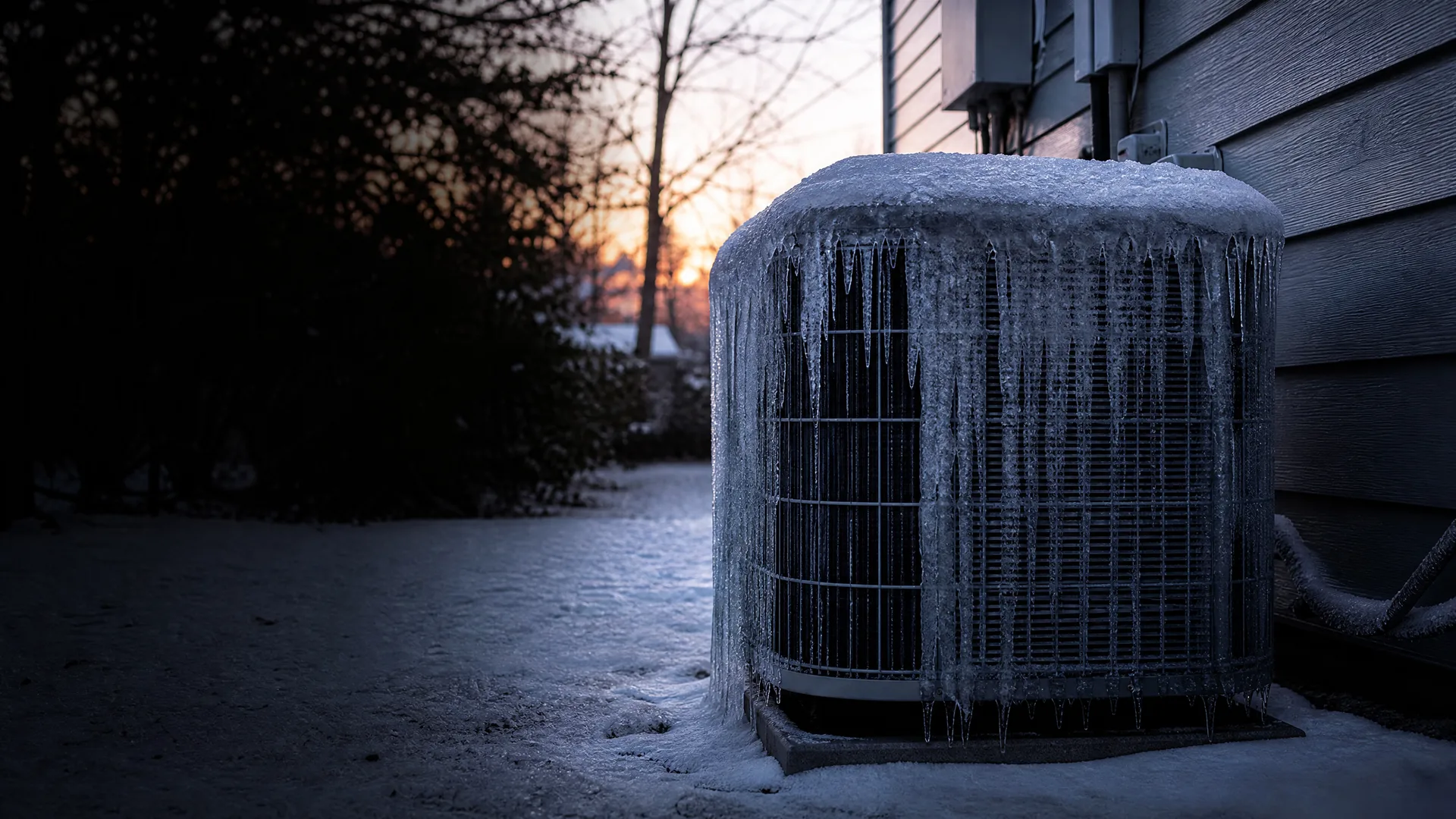
An outdoor condenser unit beside a horizontally sided house, encased in thick ice with hanging icicles, on snow-covered ground at dusk with bare trees and a sunset behind.

You go out for the mail just after six, still dark, and the side yard is quiet except for the hum of the outdoor unit. Your breath hangs in the air. The cabinet is coated in ice, thick over the coil and down the sides, more than you've seen on it before. Inside, the house feels off, the air from the vents gone cool, and you know the two things are connected. You crouch down and look closer at the ice, half expecting the fan to kick on and start clearing it. It doesn't. You stand back up, hands in your pockets, and decide it can't wait until after work.

A closed silver laptop and a glazed ceramic mug on a wooden table, with a blurred kitchen counter, potted plant, cutting board and window in the background.

Cold air for a few minutes is normal. Cold air that stays is not.

A heat pump that blows cold air briefly, then switches back, is running a defrost cycle or working through a cold snap. One that keeps blowing cold with the thermostat set high is telling you something is wrong, and in Cass County that's not a thing to wait out. With no backup furnace in most homes here, the gap between a working heat pump and a struggling one is the gap between warm and cold.

Once you know which one you're dealing with, the next step is getting a contractor out to look at it, not spending an evening calling around to find one who answers, explaining the same problem three or four times, and sorting through quotes that are hard to compare. Send the form and that part is off your plate. Someone licensed to work on it takes it from there.

Interior corner of a living room with a beige upholstered sofa and dark cushion in the foreground, a ceramic vase of leafy branches on a dark side table by a curtained window, a framed picture on the wall, and a wood-surround fireplace at right.
A man in a blue T-shirt sits on a light gray sofa, laughing while looking at an open laptop in the foreground, with a framed picture, lamp and potted plant behind him.
A bearded man in a blue and brown plaid flannel shirt stands indoors looking out a window at snow-covered trees, with a ceramic mug on the windowsill.

Heat Pump Repair

Hand off the heat pump problem

Skip calling shops to ask who repairs heat pumps in Cass County.

A black-framed smartphone standing upright against a plain light gray background, its screen filled with solid green.
RepairHeat PumpCass County, ND
Step 1 of 2

What ZIP code is the job in?