A row of two-story houses with gray siding and shingled roofs behind a wide mown lawn, with a chain-link fence at left and tree branches overhanging a pale sky.

Heat Pump Repair in Minot, ND

Tell us about the job

Takes about a minute. No obligation.

RepairHeat PumpWard County, ND
Step 1 of 2

What ZIP code is the job in?

Minot winters push a heat pump to its limit

Overnight lows average 5°F across December, January and February here. A heat pump has to pull heat out of air that cold, and it runs long hours doing it. That kind of stretch wears down parts faster than mild weather ever would.


Hail and snow add their own wear

Ward County saw 70 hail events over the past ten years, plus 27 winter storms in that same stretch. The outdoor unit sits right in the path of both. A repair call here is often the weather catching up with the machine, not a fluke.

9 months
September through May, your system heats
2 months
July through August, it cools
5°F
the average winter night it heats against
79°F
the average summer afternoon it cools against
Isometric line illustration of a cutaway house showing interior rooms with furniture, ceiling ductwork, and an outdoor condenser unit connected by lines along the exterior wall.
Your system heats September through May and cools July through August.

NOAA nClimDiv, 1991–2020 normals

A heat pump nearing the end of its life does not fail all at once, it fails one part at a time.

Each part replaced on an old compressor is money spent on a system still counting down.

August is when to get a heat pump looked atHeat starts running in September here, and strain from a weak part shows up fast once it does.

If your heat pump is struggling, get it looked at before you try to push through another cold snap on it. A system already worn down by one Minot winter is more likely to drop out in the next hard freeze, not less. The technician checking it should test it the way it actually runs here, under long hours and real cold, not just confirm it powers on. That's the only way to know if what you're looking at is a quick fix or a part that's a season or two from failing outright.

A newer home usually means a heat pump worth repairing

Half the homes in Ward County were built in 1984 or later. If that's your house, the heat pump likely still has real working life in it. Worn parts from a hard Minot winter are usually worth fixing, not replacing.

Find a contractor
A man in a brown jacket, cap, dark pants and work boots walks up concrete steps toward a red front door, carrying a waxed canvas tool tote with a hammer inside.
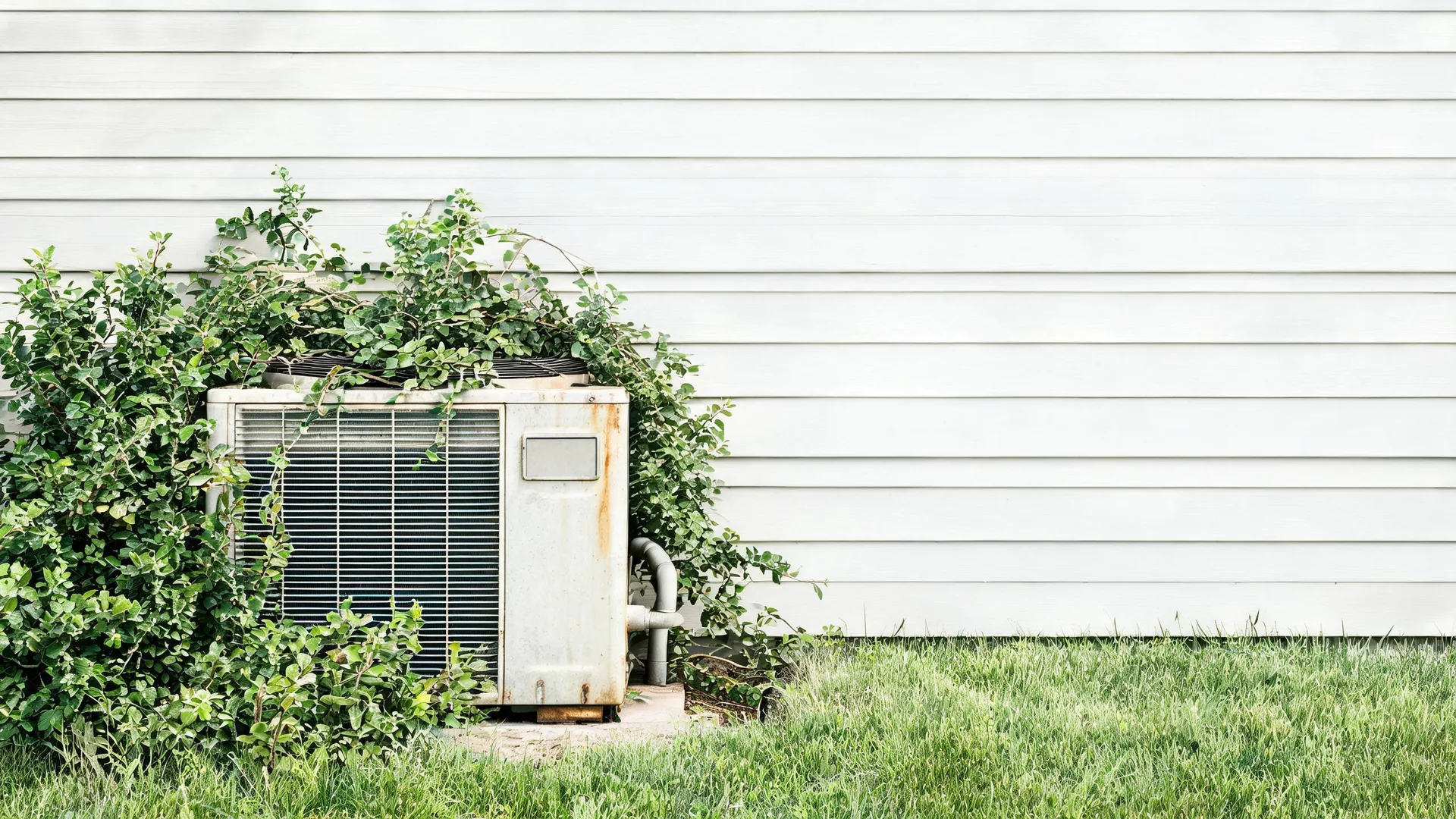
A gray outdoor HVAC unit mounted on a concrete pad beside a house with gray lap siding and a stone foundation.

What to check before you call

Before anyone comes out, check the thermostat batteries and the setting itself. A thermostat set to heat but reading the wrong temperature will make a working heat pump look broken. Next, look at the outdoor unit. If snow or ice has built up around the coil or the fan isn't spinning freely, that alone can cause weak heat or no heat at all. Check the air filter too. A filter clogged with dust chokes airflow, and a heat pump starved for airflow will struggle or ice over even when every part inside it is fine. Walk through the house and feel the vents. Air that's running but barely warm points to the system itself. No air at all points to the blower or a tripped breaker. Check the breaker panel before assuming the worst. A heat pump that's frozen solid on the outside unit, with ice you can see, needs a technician, not a homeowner with a hose.

A small fault forces other parts to cover for it

When one part starts failing, the system does not just work a little worse. A weak capacitor makes the compressor draw harder to start. A low charge makes the compressor run longer to reach temperature. The parts around the failure point take on the extra load, and those parts wear down faster because of it.

Waiting turns a repair into a bigger job

A compressor is built to last the life of the system. Running it low on refrigerant, or with a failing part forcing it to work harder than it should, shortens that. What starts as a bad capacitor or a stuck fan can end as a compressor that will not start at all.

A heat pump in trouble rarely just stops. It tells you first. Short cycling is one of the clearest signs, the system kicking on, running a few minutes, then shutting off before the house warms up. That points to a thermostat problem, a refrigerant issue, or a compressor struggling to keep going. Ice on the outdoor coil that doesn't clear during the defrost cycle is another. A little frost in cold weather is normal, but a coil caked in ice means the defrost board, a sensor, or the reversing valve isn't doing its job. Listen for it too. Grinding, rattling, or a hard clunk when the system switches between heating and cooling usually means a part is wearing out, not settling in. And if the air from the vents has gone lukewarm instead of warm, the system is running but not actually doing the job of a heat pump anymore.

A diagnostic visit starts outside, at the unit itself. The technician checks refrigerant pressure, since a system low on charge will run long and still fall short of the set temperature. They'll pull the cover and look at the capacitor and contactor, the parts that get the compressor and fan started, because a weak one shows up as hard starts or a hum with no spin. Inside, they check the air handler, the blower wheel, the filter, and the coil for ice or dirt that chokes airflow. They'll also run the system through a full cycle, watching how it switches between heating and defrost, since a reversing valve that sticks only shows itself when it's asked to change direction. The point of all this is to find which part is actually failing, not just which part is easiest to blame.