Gas heats most homes in Bowman County
Half the occupied homes in Bowman County heat with utility gas. Another 21.9% run on bottled or LP gas, so most houses here already have a furnace or boiler as the main heat source.
Takes about a minute. No obligation.
Half the occupied homes in Bowman County heat with utility gas. Another 21.9% run on bottled or LP gas, so most houses here already have a furnace or boiler as the main heat source.
If gas already heats your home, a mini split is usually going in for one room or one zone that the furnace doesn't reach well, or to cover cooling. The installer will need to know what's already in the house to size the unit and figure out where the line set and condenser go.
NOAA nClimDiv, 1991–2020 normals
Summer here is short, July and August, with afternoon highs averaging 81°F.
A mini split in Bowman County doesn't need to be the biggest or most efficient unit on the lot, since it won't run hard or run long.




Bowman County is in zone 6A, a cold climate with winters that run long. Any mini split installed here still has to meet the federal minimum for a split-system heat pump. That's 14.3 SEER2 for cooling and 7.5 HSPF2 for heating, the same floor that applies everywhere, since the standard doesn't set a separate rule for ductless units. That number limits what an installer can legally put in. It doesn't tell you what's best for your house. A federal tax credit is available for equipment that qualifies, and it's worth asking about when you're comparing units and quotes.
Half the homes in Bowman County were built in 1972 or earlier. An installer sizing a mini split for a house that old needs to see what's already there, the walls, the room, where a line set can run, before picking a unit. That's a site visit, not a catalog number.
Find a contractorA mini split installation doesn't leave an old system behind the way a furnace swap does. If it's adding a zone, the furnace or boiler keeps running the rest of the house, and the new unit just takes over one room. There's nothing to decommission. If it's replacing an older window unit or electric baseboard in that room, that's what comes out, not the main heating plant. Baseboard heaters get disconnected from their circuit, and that circuit can often be reused for the new condenser if an electrician checks the load first. A window unit just comes out of the window. Either way, the main heat source for the house stays exactly as it was, doing what it's always done, and the mini split works alongside it rather than taking its place.
A mini split sized too large for the room cools the air fast and shuts off before it pulls the moisture out. The room ends up damp and clammy even at the temperature you set. One sized too small runs all the time and still never quite catches up on the hardest days. The right size cycles on, runs long enough to finish the job, and shuts off.
Sizing a mini split means walking the actual space. The installer needs the square footage, the ceiling height, how many windows there are and which way they face, and what sits on the other side of the walls. A room over a garage or with a wall of west-facing glass needs more capacity than the same size room tucked in the middle of the house. The number on a spec sheet only means something once someone has stood in the room it's meant for.
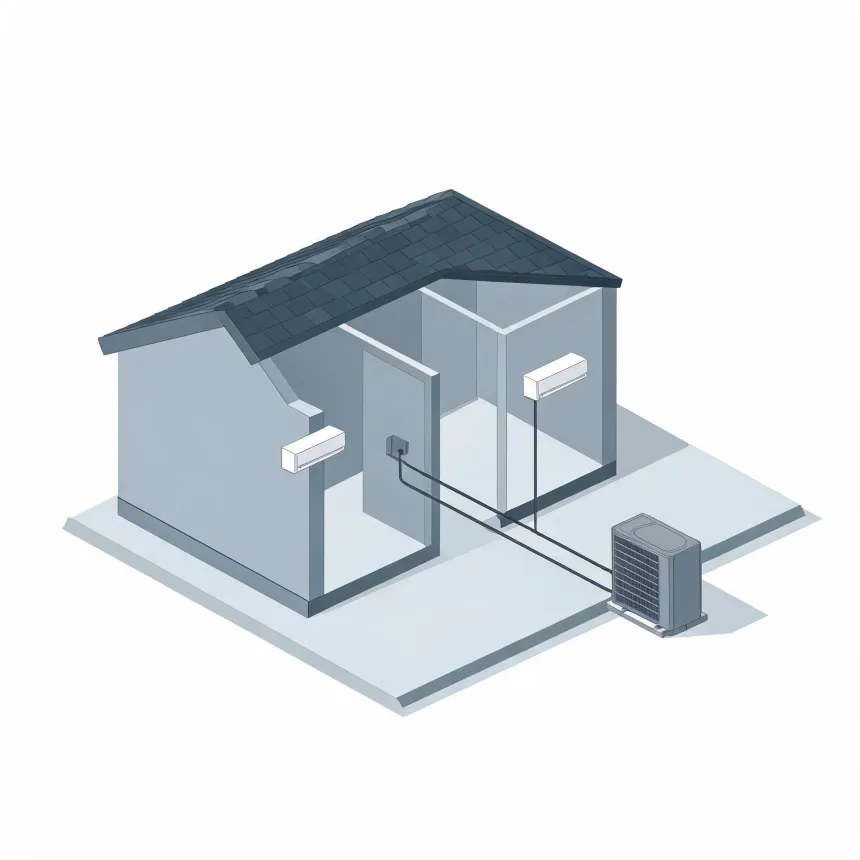
Ask what the installer plans to do about the line set, not just which unit they're selling. That's the copper running between the indoor head and the outdoor condenser, and once it's run and sealed, it's not something you redo easily. Ask how many indoor heads the outdoor unit can support if you think you'll want another zone later, since not every condenser is built to add one. Ask about the warranty terms too, because most manufacturers require a licensed installer to register the unit and vacuum the line set properly, and a warranty can be denied over a skipped step you never saw happen. And ask what happens to the indoor head's condensate, the water it pulls out of the air, and where that line drains to. A unit quoted without an answer to that one is a unit someone hasn't actually planned for your room yet.
A lot of the installation cost is the parts you never see once the job is done. The line set has to be cut to the right length, run through a wall, brazed, and pressure tested for leaks before it's charged with refrigerant. That's labor, not equipment. Where the condenser sits matters too. A straight shot from indoor head to outdoor unit costs less to run than a line set that has to snake around framing or climb between floors. Electrical work adds to it as well, since a mini split needs its own dedicated circuit, and if the panel doesn't have room for one, that's its own job before the unit even goes in. None of that shows up on a price tag at the store, but it shows up on the quote.