





A snow-covered small-town street at dusk, with lit white clapboard houses, bare trees, and a grain elevator silhouetted against an orange and blue twilight sky.

Mini Split Installation in Carrington, ND

Tell us about the job

Takes about a minute. No obligation.

New system or replacementMini-splitFoster County, ND
Step 1 of 2

What ZIP code is the job in?

Electricity in North Dakota ran 11.51 cents per kilowatt-hour in 2024, cheaper than most of the country. That changes the math on a mini split. A high-efficiency unit still costs less to run month to month, but with power this cheap, it takes longer to earn back the difference in purchase price. So the choice for Carrington comes down more to how the unit holds up at your actual winter and summer temperatures, and how well it's sized and installed, than to chasing the highest efficiency number on the spec sheet.

9 months
September through May, your system heats
2 months
July through August, it cools
3°F
the average winter night it heats against
79°F
the average summer afternoon it cools against
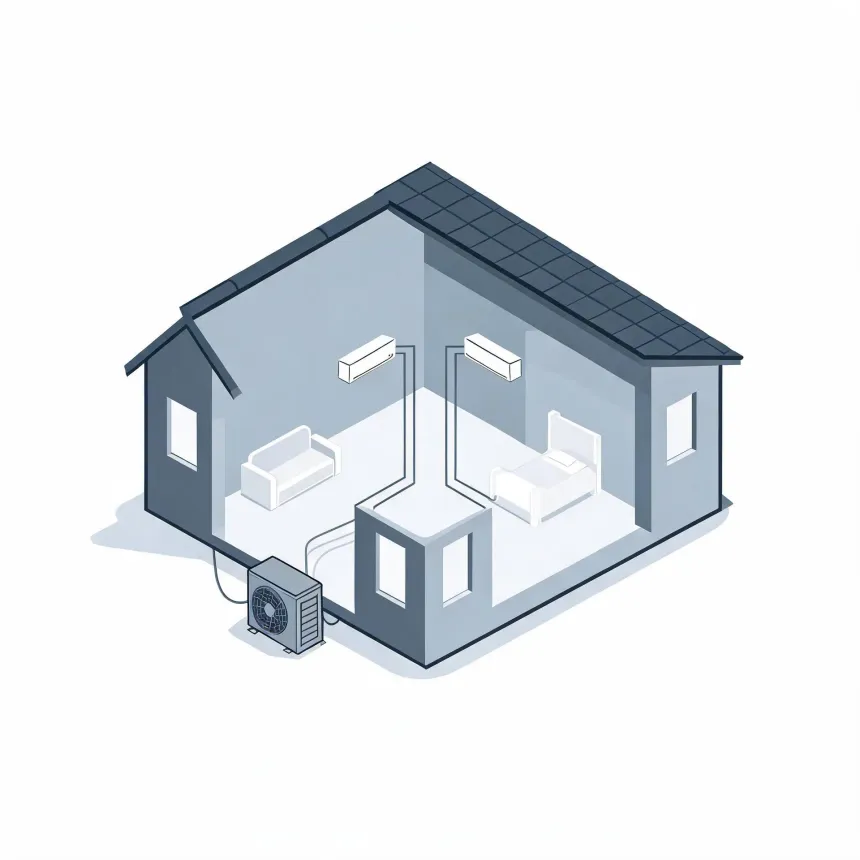
Isometric cutaway illustration of a small house showing two wall-mounted indoor air conditioning units connected by lines to a single outdoor condenser unit beside the building, with a sofa in one room and a bed in another.
Your system heats September through May and cools July through August.

NOAA nClimDiv, 1991–2020 normals

Half the homes in Foster County went up in 1973 or earlier.

A mini split going into a house that old has to work with whatever wiring and layout are already there, not the setup on a spec sheet.

June is the month to get it installed, before two months of cooling start

Cooling runs July through August
Summer afternoons average 79°F
39 damaging wind events from 2015 to 2024

A mini split in Carrington only has to cool for about two months, July and August, with afternoon highs around 79°F. That is not much strain. Most of the compressor's life here gets spent on the heating side, through a long cold season where it has to perform at far lower temperatures. On the cooling end, a reliable mid-range unit will keep up fine. You do not need the top tier of efficiency to handle two months at 79°F.

Any mini split going in here has to meet zone 6A's minimum, and a federal credit can help cover one that does

Zone 6A puts Foster County in a cold, humid climate class, and any split-system heat pump installed here, ductless units included, has to clear 14.3 SEER2 and 7.5 HSPF2 under the federal minimum. That rule narrows the field before you even start comparing brands. A federal tax credit is available on qualifying equipment, which helps offset a unit built to meet it.

Find a contractor
A man in a cap, dark T-shirt and tan work pants walks up porch steps toward a red front door, carrying a worn canvas tool bag, with a potted plant beside the door.
A white outdoor air conditioner condenser unit mounted on metal wall brackets against gray horizontal siding, with a blue sky and white clouds behind it.

Light duty here, so installation matters more than the tier

Two months of real cooling work a year will not wear out a compressor. The heating side carries the load here, and that is still a long season rather than a punishing one, so a mid-range system holds up fine on either end. What actually shortens a unit's life is a line set that never got sealed right or a filter that never got cleaned. Put the money into a contractor who sizes and installs it correctly, not into the top efficiency tier.

Ask for the heat loss and heat gain numbers, not a guess

A contractor should size a mini split by calculating how much heat the space loses in cold weather and gains in warm weather, room by room. Going by square footage alone, or matching whatever the old system was, leads to a unit that's oversized or undersized for what the space actually needs.
Ask what the unit still puts out at the coldest point it will see

Every heat pump loses capacity as the air outside gets colder. The spec sheet should show output at that low end, not just at a mild rating point used to make the unit look good. A model that performs well in mild weather can fall off hard before the real cold sets in, leaving you short exactly when you need the heat most.

Sizing a mini split is not the same as picking a furnace by square footage. Each indoor head is matched to the room it serves, so a contractor has to work out heat loss and heat gain for that specific space, not the house as a whole. Too big and the unit short cycles, reaching the thermostat setting and shutting off before it has run long enough to pull moisture out of the air, so the room feels clammy even at the right temperature. Too small and it runs flat out without ever catching up on the coldest or hottest days. Multi-zone systems add another layer, since the outdoor unit has to be matched to the combined load of every indoor head running at once, not just the sum of their labels. Get that balance right and the system runs long, steady cycles that hold temperature and humidity evenly, which is where a mini split is supposed to earn its keep.

Installation starts with the outdoor unit. It needs a pad or wall bracket, clear space around it for airflow, and a spot where the line set can run to each indoor head without too many bends. From there the installer runs the line set, the power wiring and the condensate drain through a wall sleeve, usually one small hole rather than the ductwork a central system would need. The line set gets connected at both ends, then the whole system is pressure tested to make sure there are no leaks before any refrigerant moves through it. Once it holds pressure, the system gets evacuated to pull out moisture and air, because either one left in the lines will cause problems later. Only after that does the installer release the refrigerant charge, confirm it against what the unit calls for, and run it through a full cycle to check that each head is heating and cooling the way it should.