Most homes here run on propane
Bottled, tank or LP gas heats 56.1% of occupied homes in Grant County. Electricity comes next at 28.4%, and utility gas barely reaches anyone here. A propane furnace or boiler is what you'll find in most houses.
Takes about a minute. No obligation.
Bottled, tank or LP gas heats 56.1% of occupied homes in Grant County. Electricity comes next at 28.4%, and utility gas barely reaches anyone here. A propane furnace or boiler is what you'll find in most houses.
Installing a mini split doesn't mean ripping out your propane furnace. Most owners add one to cover a room or two, or to handle cooling, while the existing system keeps doing the rest of the house.
NOAA nClimDiv, 1991–2020 normals
Half the homes in Grant County went up in 1962 or earlier.
A mini split going into a house that old has to work with the walls and rooms you actually have, not a standard layout.



Cooling here only runs July and August, with afternoon highs averaging around 81°F. That is a short, mild job for a mini split. The cold months ask more of it, since winters in Grant County are long, but that is steady, predictable work, not a strain test. A system that spends most of the year in cold weather and only two months cooling a mild afternoon doesn't get pushed hard either way. That kind of load favors a dependable mini split over the one with the highest efficiency number on the sticker.
Cooling in Grant County starts in July and runs about two months. Putting the mini split in during June means it's running, tested, and set before the first hot afternoon shows up, instead of you scheduling it around a heat wave.
Find a contractorTwo months of July and August afternoons is not enough to wear a mini split down. Pick one for how reliably it runs and how it's backed, not the efficiency number on the sticker. A properly sized unit that's built to last will handle the short cooling stretch here and the long winter without trouble.
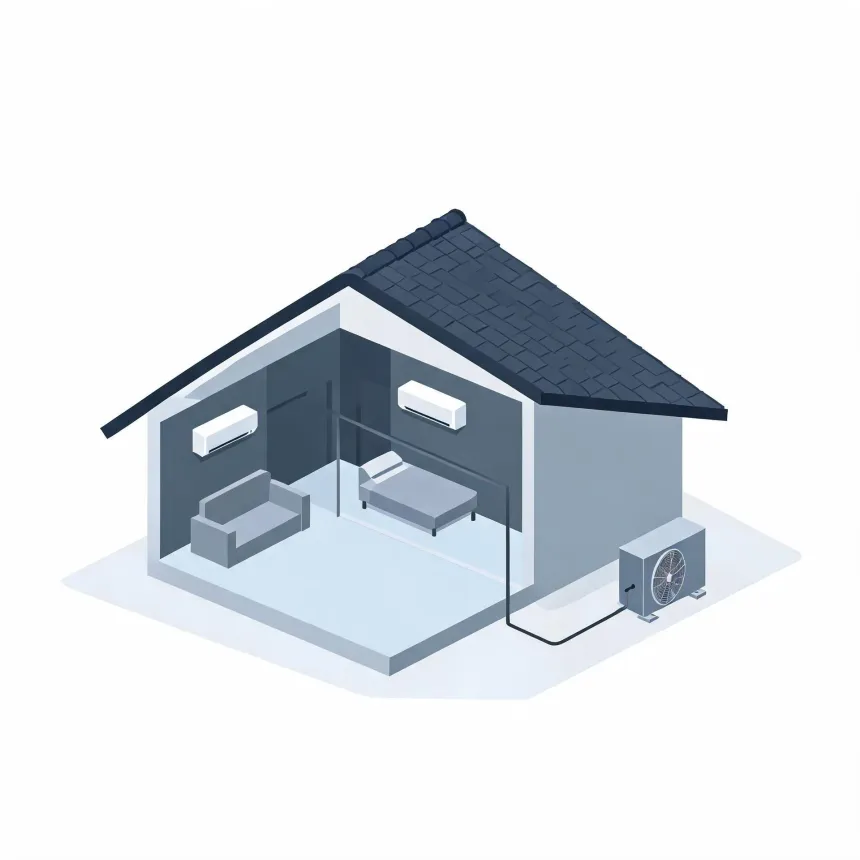
A single indoor head heats and cools one room or an open area well. Covering several rooms means either running multiple heads off one outdoor unit or installing separate systems, and each head adds labor, refrigerant line, and a spot on the wall or ceiling that has to be cut into and run back outside.
The line set between the indoor head and the outdoor unit has to run through a wall and over to wherever the outdoor unit sits. A short, straight run is quick work. Longer runs, or ones that have to go around framing or up through multiple floors, take more line, more time, and more care sealing and insulating the path.
The number on the label, SEER2, tells you how much cooling a mini split delivers for the electricity it draws. It says nothing about heating output, and nothing about how fast a room cools down. A higher-rated unit costs more to buy, and that extra cost comes back over time through lower electric bills, but only if the unit is actually running enough hours to earn it back. Heating is rated separately from cooling, and on most mini splits the heating side carries the bigger share of the work over the year. Whichever number you're looking at, it only describes efficiency. It says nothing about how well the unit is sized for the rooms it covers or how long it will hold up.
Installation starts with the outdoor unit. The crew sets it on a pad or wall bracket, somewhere it can pull in air and drain freely. Inside, the mounting plate goes up first, then the head hangs on it once the wiring and line set are run. A hole gets drilled through the wall to pass the refrigerant lines, drain line, and electrical whip through to the outside. Once everything is connected, the lines get pressure tested and then the system is evacuated to pull out moisture and air before refrigerant is released into them. Only after that does the crew power it on and check that it's heating and cooling the way it should before calling it done.