A snow-covered small-town street at dusk, with lit white clapboard houses, bare trees, and a grain elevator silhouetted against an orange and blue twilight sky.

Mini Split Installation in Langdon, ND

Tell us about the job

Takes about a minute. No obligation.

New system or replacementMini-splitCavalier County, ND
Step 1 of 2

What ZIP code is the job in?

Electricity here runs cheap

North Dakota homes paid 11.51 cents per kilowatt-hour in 2024, well under what a lot of the country pays. A mini split still cuts costs against baseboard or propane heat, but the savings build up slower than they would somewhere with expensive power.

Pick for the climate, not the payback

With power this cheap, chasing the highest efficiency rating on the spec sheet will not earn its keep fast. What matters more is whether the unit is sized and rated to hold up through a Langdon winter and keep up on the hottest days of summer.

9 months
September through May, your system heats
1 months
July through July, it cools
0°F
the average winter night it heats against
76°F
the average summer afternoon it cools against
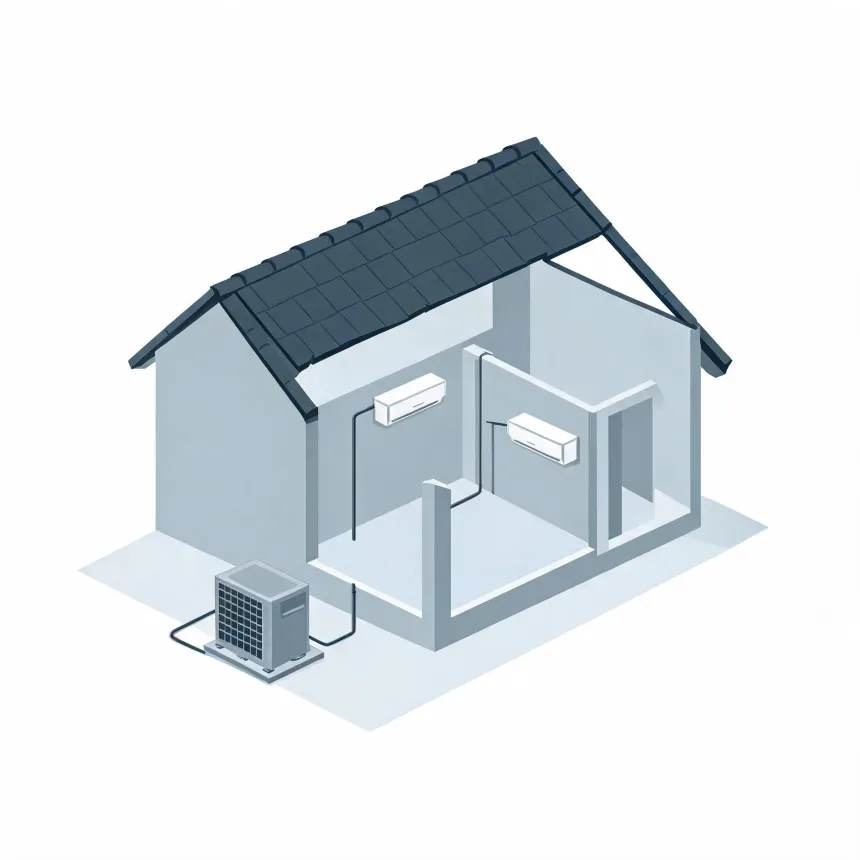
Isometric illustration of a cutaway house with a dark tiled gable roof, showing two wall-mounted indoor split air conditioning units connected by lines to an outdoor condenser unit on the ground outside.
Your system heats September through May and cools July through July.

NOAA nClimDiv, 1991–2020 normals

Cooling only runs one month a year here, July, with afternoon highs averaging 76 degrees.

A mini split in Langdon spends most of its life idle, so a dependable mid-range unit does the job a premium one would.

One month of cooling a year means one chance to get it installed before July

Cooling runs July through July
Summer afternoons average 76°F
56 damaging wind events from 2015 to 2024
Half the homes here were built in 1968 or earlierHalf the homes in Cavalier County were built in 1968 or earlier, and a mini split going into one has to work with a heating setup that old house was never designed around.

Cavalier County sits in zone 7 under the 2021 energy code, the coldest tier there is. A mini split installed here has to be rated for that, not just for a mild winter somewhere else. Because a ductless heat pump counts as a split system under federal rules, it has to meet the same minimums as any other split-system heat pump, no separate or looser standard for going ductless. A system that meets those minimums can also qualify for the federal energy efficiency tax credit. Ask a contractor which models qualify before you settle on one.

Get the sizing right for the house you have

If your house dates to 1968 or earlier, whoever installs your mini split needs to know what heating it replaces or backs up and size the new unit to match, not just to the square footage.

Find a contractor
A man in a dark jacket, cap and tan work pants, seen from behind, carries a worn canvas tool bag up wooden porch steps toward a red front door.
A white mini-split air conditioner outdoor condenser unit mounted on metal brackets against a beige stucco exterior wall, with a blue sky and scattered clouds in the background.

Sized wrong, it runs wrong for as long as it's in the wall

A mini split that's too big will cool the room fast, shut off, and start again a few minutes later. Short cycles like that don't give the system time to pull moisture out of the air, so the room feels clammy even at the right temperature. Run that pattern for years and the compressor wears from the stopping and starting more than it would from just running steady. Too small works the other way. It runs flat out and never catches up on the coldest or hottest hours, straining constantly instead of cycling normally. Getting the size right means a contractor works out the heat loss and heat gain for the specific room or house, not a rule of thumb based on square footage. Ceiling height, window area, insulation and what's on the other side of each wall all factor into that math. A unit sized off square footage alone can land far from what the room actually needs.

Ask how many zones it covers

One outdoor unit can run more than one indoor head, each with its own thermostat, or it can run just a single room. More zones cost more up front but let you heat or cool only the rooms in use. Ask whether the outdoor unit being quoted has enough capacity for every zone running at once, not just one at a time.

Ask what happens below freezing

Not every heat pump holds its output as the temperature drops. Some lose capacity fast once it gets cold and lean on backup heat strips to make up the difference, which costs more to run. Ask for the capacity rating at a low outdoor temperature, not just the rating at a mild one, so you know what the unit actually delivers on the coldest hours.

Whoever installs the mini split still has to deal with whatever is heating the house now. If that's a furnace or boiler staying in place as backup, the installer should leave it fully functional, not just disconnected and hanging there. If a wood stove or electric baseboard is getting replaced outright, ask what happens to it before the day of install, not after. Baseboard heaters usually just get pulled off the wall and the circuit capped or reused. An old furnace or boiler coming out for good means someone has to deal with the gas line, the flue, and in some cases a fuel tank, and that's a separate job from hanging the new indoor and outdoor units. Settle who's handling removal and disposal before the work starts, so it's not a surprise on the invoice.

Installation starts outside with where the outdoor unit sits. It needs clearance on all sides for airflow, a path for the refrigerant lines to reach indoors, and a spot that won't sit under a roof edge where ice and snow sheds straight onto it. Running the line set means drilling through the wall once, at a slight slope so any condensation drains out instead of back in. Indoors, the line set, a drain line and an electrical cable all pass through that same hole to the indoor head, then the whole run gets insulated and sealed where it meets the house. Once both units are mounted and connected, the system gets evacuated with a vacuum pump to pull out air and moisture before the refrigerant lines are opened up, because either one left in the line will keep the system from running the way it's rated to. Only after that does the installer charge the line, power it up and check that it's pulling the temperature and airflow it's supposed to at both ends.