






A dark-clad two-story house with a metal roof and covered porch stands behind a mown lawn, with deciduous trees and a wire fence to the left under an overcast sky.

Mini Split Installation in Mandan, ND

Tell us about the job

Takes about a minute. No obligation.

New system or replacementMini-splitMorton County, ND
Step 1 of 2

What ZIP code is the job in?

Gas heats 67.2% of homes in Morton County, and electricity covers 17.9%. A mini split doesn't compete with the furnace already in the house. It handles the rooms that furnace was never going to manage well on its own, an addition, a bonus room over the garage, a space with no ductwork running to it. Install one alongside the gas furnace and each system does the job it's suited for, with the mini split pulling double duty for cooling in summer. For a home without gas service, a mini split or a multi-zone setup can carry the heating load on its own.

9 months
September through May, your system heats
2 months
July through August, it cools
6°F
the average winter night it heats against
81°F
the average summer afternoon it cools against
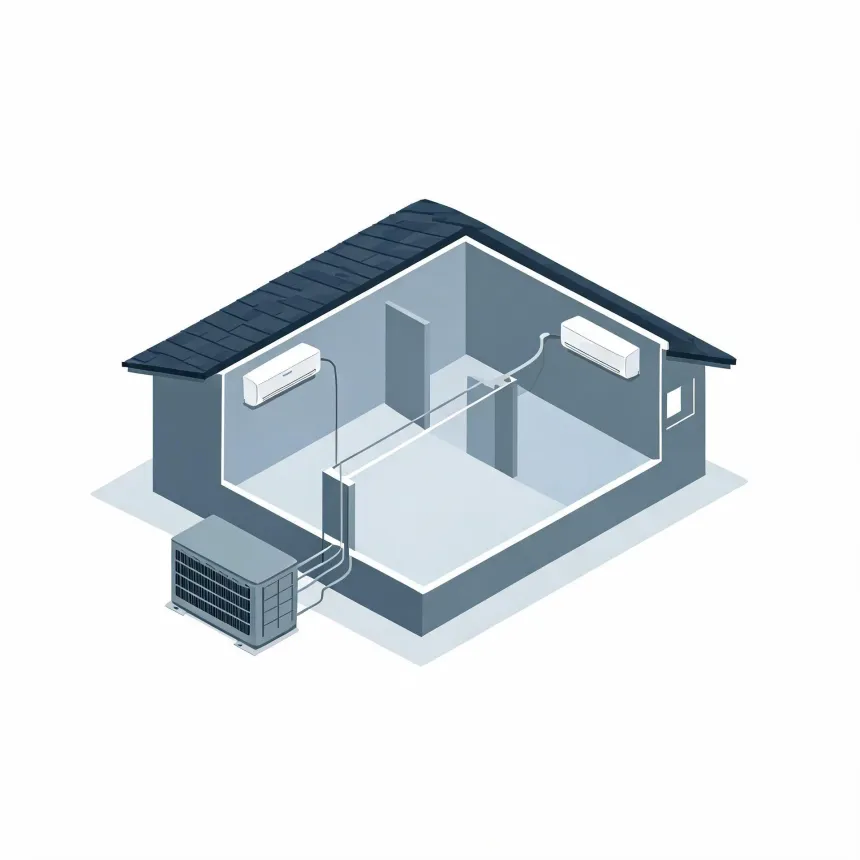
Isometric illustration of a cutaway house showing two wall-mounted mini-split indoor units connected by line sets to a single outdoor condenser beside the exterior wall.
Your system heats September through May and cools July through August.

NOAA nClimDiv, 1991–2020 normals

The number of indoor heads drives the cost more than the brand of equipment.

One room and one outdoor unit is a simple job. Add more rooms and each one needs its own line set run, its own head mounted, and a bigger outdoor unit to carry the load.

Mandan weather doesn't change what size mini split you need

260 severe weather events from 2015 to 2024
7% of homes statewide lost power a day or more in 2024
114 damaging wind events from 2015 to 2024
Mandan weather doesn't change what size mini split you needHalf the homes in Morton County were built in 1980 or earlier, and that doesn't change the load calculation either.

Cooling in Mandan only runs from July through August. That's a short window, which is exactly why June is the month to get a mini split installed rather than the month to start looking. Line sets, mounting the outdoor unit, running power, it all takes time to do right, and a contractor booked solid in late June isn't going to rush a job to fit you in before a heat wave. Get it installed in June and it's tested and running before you need it for a single day.

Cheap power here means fit and installation matter more than the efficiency rating

Electricity in North Dakota runs 11.51 cents per kilowatthour, cheaper than most of the country. A high-efficiency mini split will cost less to run here, but the savings add up slower than they would somewhere with pricier power. That makes this more about getting the right size and a install that holds up than chasing the highest efficiency number on the spec sheet.

Find a contractor
A man in a dark beanie, navy long-sleeve shirt and tan work pants climbs porch steps toward a red front door, carrying a waxed canvas tool bag in his right hand.
A white mini-split air conditioner outdoor condenser unit mounted on metal brackets against a beige stucco exterior wall, with a blue sky and scattered clouds in the background.

Running from morning to night, year after year, sizing is what decides whether it struggles or not

A mini split that's too big cools the room fast, shuts off, then kicks on again a few minutes later. It never runs long enough to pull moisture out of the air, so the room feels cold and clammy at the same time. One that's too small just runs and runs, all day, straining to hold a temperature it can't quite reach, and the compressor wears faster for the effort. Sizing comes from a room by room load calculation, not a rule of thumb based on square footage. A contractor looks at window area, which way the room faces, what's above and below it, how many walls are exterior walls, and what's already heating or cooling that space before adding it up. Get that number right and the unit cycles on, runs a reasonable stretch, and shuts off having done the job once.

Ask what each zone is rated for, not just the total

A multi-zone system has one outdoor unit feeding several indoor heads, and that outdoor unit has a limited capacity to split between them. Ask what happens if every zone calls for cooling at once on the same afternoon. Some systems derate each head when the others are running, so a unit that handles one room fine on its own falls short when the whole house is asking for it at the same time.
Ask who services it once it's in

Mini splits need the outdoor coil kept clear of debris and the indoor filter cleaned on a schedule, and refrigerant work on a line set leak takes the right gauges and the right training for that specific system. Ask the installer whether they service what they sell, or whether a warranty claim down the road means finding someone else who knows that equipment. A system is only as good as the upkeep it actually gets.

If this is replacing a wall unit or an old ductless system, the outdoor condenser and the indoor head both come down, and the line set gets pulled out of the wall or capped off at the penetration. If it's an electric baseboard or a window unit that's being retired in favor of a mini split, the old heater usually gets disconnected rather than reused, since the house won't need it carrying the load anymore. Refrigerant in the old lines has to be recovered properly, not vented, so that part of the teardown isn't a quick pull and haul. Whatever comes out, the wall is left with a sleeve or a patched hole where the new line set will run, and the old mounting bracket spots usually don't line up with where the new head goes.

Install day starts outside. The outdoor unit needs a spot with clearance on all sides for airflow, set on a pad or brackets up off the ground, away from where snow slides off the roof or piles up from plowing. Inside, the head goes high on a wall, on a stud or blocking that can hold its weight, with a clear shot back to where the line set will exit. The crew cores a hole through the wall, sized for the line set, the condensate drain and the electrical whip to all pass through together, then runs the lines, flares the connections, and wraps the whole bundle before it ever gets sealed up. After that comes the vacuum, pulling the line set down to remove moisture and air before refrigerant ever touches it. Skip that step or rush it and moisture sits in the lines, mixes with the refrigerant, and shows up later as a system that won't hold its charge. Once it holds vacuum, the valves open, the system gets powered up, and the contractor checks the line pressures and the temperature split at the head to confirm it's running the way the spec sheet says it should.