June is the month to call
Cooling in Billings County starts in July. A mini split put in during June means it's running and checked out before the first hot day, not in the middle of one.
Takes about a minute. No obligation.
Cooling in Billings County starts in July. A mini split put in during June means it's running and checked out before the first hot day, not in the middle of one.
Homes here only need cooling from July through August. The rest of the year this same system handles heating, so the install has to be sized and set up for both jobs, not just the short cooling stretch.
NOAA nClimDiv, 1991–2020 normals
Electricity in North Dakota ran 11.51 cents per kilowatthour in 2024, well below what most states pay.
A mini split still earns its keep on cold nights and hot afternoons, but a cheaper power rate means the top-efficiency model takes longer to pay for itself here, so pick the one that fits the house, not just the one with the best rating.



Billings County falls under zone 6A, the cold end of the energy code, and that's what a new mini split has to be built for. Any ductless heat pump manufactured from 2023 on has to clear 14.3 SEER2 for cooling and 7.5 HSPF2 for heating. There's no separate rule for ductless systems. A unit sold here has to hit the same minimums as a ducted heat pump. That's the floor, not a recommendation, so it's already built into any system a contractor would install.
Two months of cooling a year is light duty. A reliable system sized right for this house will handle it without trouble, and the heating side is where it earns its keep the rest of the year. That's what to ask for when comparing units.
Find a contractorSEER2 covers cooling and HSPF2 covers heating. A mini split carries both because it does both jobs, and a unit that scores well on one isn't guaranteed to score well on the other. Look at both before comparing anything else.
SEER2 and HSPF2 get measured under fixed test conditions, not the actual swings a house goes through over a year. A mini split sized wrong for the space will run worse than its rating no matter how good that rating looks. Sizing and a proper install decide more of the outcome than the number on the box.
Ask what the low-temperature rating is, not just the HSPF2 number. Some mini splits hold their heat output down to a hard freeze, others taper off hard once it gets cold, and the spec sheet lists a capacity at a specific outdoor temperature. Ask how many zones one outdoor unit is rated to run, and whether adding a zone later means a new outdoor unit or just another indoor head. Ask about the line set length, because the distance between the outdoor unit and each indoor head affects how the system performs and where it can actually go. And ask who sizes the system. It should be a room by room load calculation, not a guess based on square footage.
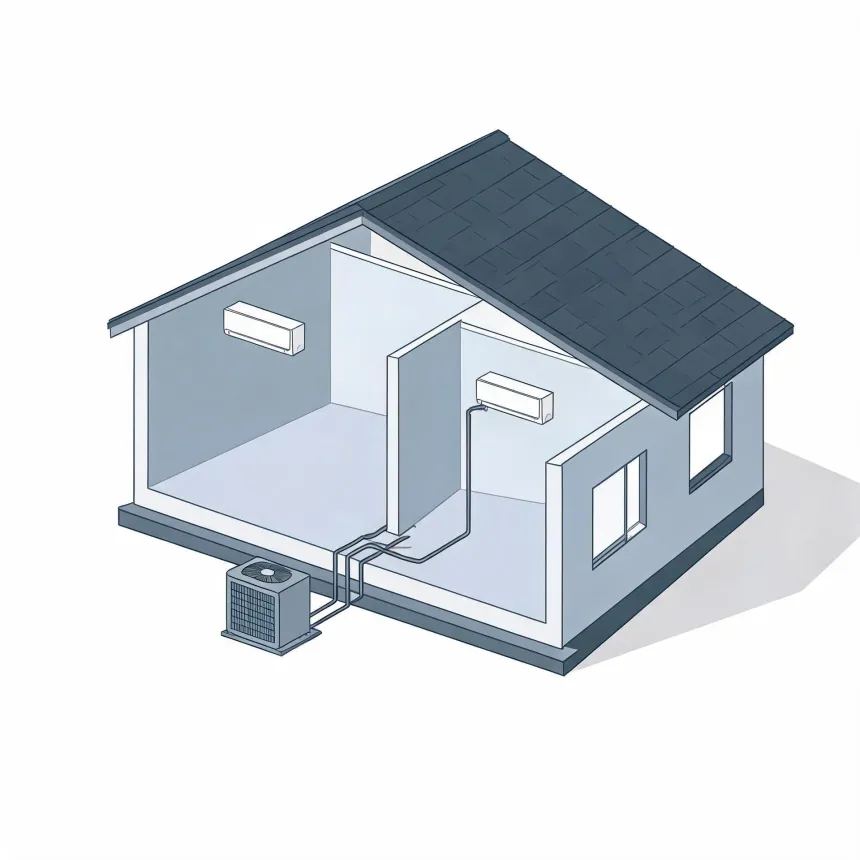
Installation starts with the load calculation if it wasn't already done, then the crew figures out where the outdoor unit and each indoor head actually go. The outdoor unit needs clearance on all sides and a spot where it won't sit under dripping eaves or get buried in a drift. Running the line set means drilling through the wall, so they pick that spot before anything else gets mounted. The indoor head goes up, the line set and drain line run through the wall to the outdoor unit, and the lines get connected and sealed. Then the system gets evacuated to pull moisture and air out of the line set before the refrigerant is released into it. Once it's running, the tech checks the refrigerant charge, confirms both heating and cooling modes work, and walks through the remote or thermostat controls before leaving.