A mowed grassy field bordered on the left by a chain-link fence and on the right by a row of two-story houses with gray roofs and porches, with large leafy trees behind them.

Mini Split Installation in Napoleon, ND

Tell us about the job

Takes about a minute. No obligation.

New system or replacementMini-splitLogan County, ND
Step 1 of 2

What ZIP code is the job in?

Electricity here runs cheap

North Dakota homes paid 11.51 cents per kilowatthour in 2024, well under what a lot of the country pays. A mini split still costs less to run than baseboard heat or window units, but the gap in your power bill won't be as dramatic as the brochures suggest.

Pick the unit that fits the room

With power this cheap, chasing the highest efficiency rating to save on bills makes less sense. Put the money into the right size for the space and a contractor who installs it correctly. That's what decides whether it heats and cools well for years.

9 months
September through May, your system heats
2 months
July through August, it cools
5°F
the average winter night it heats against
79°F
the average summer afternoon it cools against
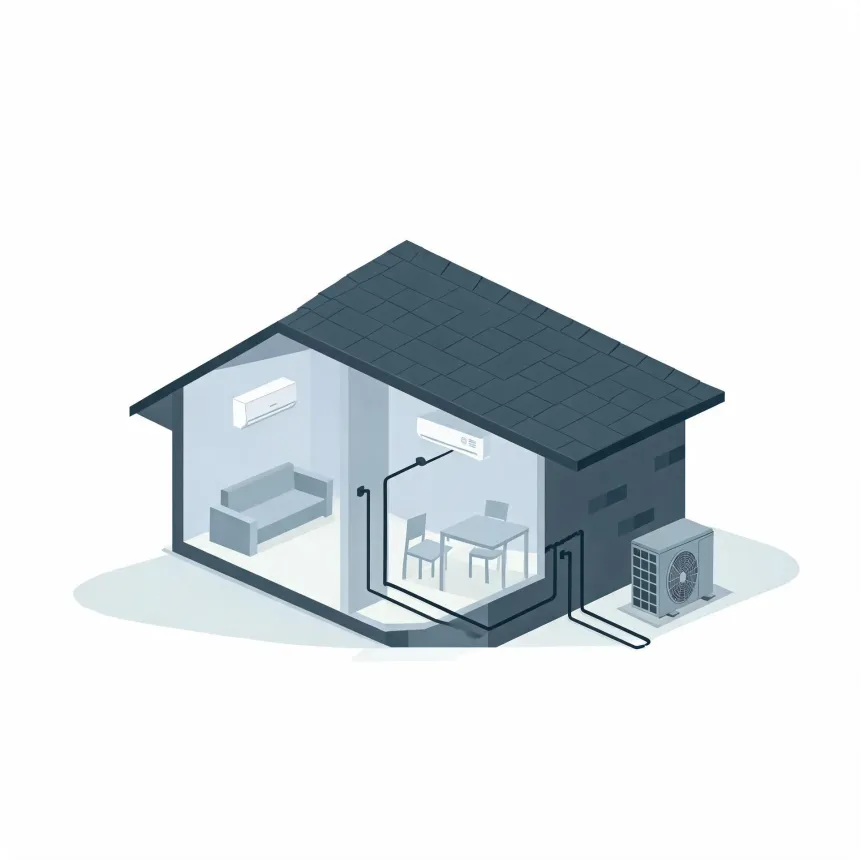
Isometric illustration of a cutaway single-story house showing two wall-mounted mini-split indoor units connected by line sets to an outdoor condenser beside the building, with a sofa, table and chairs inside.
Your system heats September through May and cools July through August.

NOAA nClimDiv, 1991–2020 normals

Half the homes in Logan County went up in 1967 or earlier.

A mini split going into a house that old has to work with the walls, windows and layout already there, not the ones in a showroom.

Two months of real cooling load a year, that's it

Cooling runs July through August
Summer afternoons average 79°F
24 damaging wind events from 2015 to 2024
Get it in before JulyCooling runs July through August here, so June is the month to have it installed.

Logan County sits in zone 6A, a cold climate with winter lasting well into spring. Any ductless mini-split going in has to meet the same federal minimum as other split-system heat pumps. That's 14.3 SEER2 for cooling and 7.5 HSPF2 for heating, for units built from 2023 on. The rule doesn't carve out a lower bar for ductless systems. A unit sized and placed right will do the work here. One picked off a showroom floor without that in mind won't hold up once the cold settles in for months.

Have it sized for the house you have, not a newer one

A contractor who walks your rooms before quoting anything will size the unit and place the head where this house needs it, not where a newer one would. Ask to see that walkthrough before you sign off on equipment.

Find a contractor
A beige split-system air conditioner outdoor condenser unit mounted on metal wall brackets atop a stucco wall.

The rating on the sticker assumes conditions your unit won't see

A compressor that runs light duty most of the year still has to start clean every time it comes on. The efficiency rating on the label gets tested under steady, controlled conditions, not the short runs and long idle stretches a mostly-off system actually sees. That doesn't make the rating false, it just means the real number you'll feel is lower than the one on the sticker. What keeps a unit performing close to its rating over time has more to do with a clean filter, a coil free of dust, and a charge that matches what the manufacturer specified at installation. A top-rated unit installed with the wrong charge or a return side that's restricted will run worse than a mid-rated one set up right.

Where the money actually goes

The unit itself is the smaller piece of the cost. What drives the price is the labor. A line set has to run between the outdoor condenser and the indoor head, and the wall has to be opened to pass it through. A straight shot through one wall costs less than a run that has to go up through an attic or along an exterior wall and get covered over. If the electrical panel needs a dedicated circuit for the new unit, that adds its own wiring work.

Why more than one head changes the job

A single room needs one outdoor unit and one indoor head. Heat or cool more than one room and the job calls for either several single-zone systems or one multi-zone outdoor unit feeding several heads. Each head needs its own refrigerant line, its own mounting spot, and its own place where the wall gets opened. That is why covering a whole house costs more than a quote built around one room.

Every mini split quote should answer the same questions, whether it covers one room or several. Ask what size the compressor is for each room it serves, not just the total for the house. A unit too big for a room cycles on and off fast and never settles into steady operation. One too small runs flat out and still doesn't keep up on the coldest days. Ask where the condensate line drains and how the refrigerant lines are protected where they run outside. Ask what happens to the old equipment if this is a replacement, and whether the new line set reuses the old wall penetration or needs a new one. A contractor who answers these without hesitation has done this work before.

Installation starts with the walkthrough, then the outdoor unit goes in first, set on a pad or brackets against the wall it was planned for. The crew runs the line set next, drilling through the wall at the spot they marked and pulling the refrigerant lines, the condensate drain and the electrical wiring through as one bundle. Inside, the head mounts to a plate secured into studs, not just drywall, because it has to carry its own weight for years without sagging. Once everything's connected, the lines get pressure tested to check for leaks before any refrigerant is released into the system. Then the unit gets charged, powered up, and run through both heating and cooling so the crew can check the temperature split at the head and confirm it's drawing the right amount of current. Expect some drywall dust where the penetration was cut, and expect the crew to seal that opening both inside and out before they leave.