




A snow-covered small-town street at dusk, with lit white clapboard houses, bare trees, and a grain elevator silhouetted against an orange and blue twilight sky.

Mini Split Installation in New England, ND

Tell us about the job

Takes about a minute. No obligation.

New system or replacementMini-splitHettinger County, ND
Step 1 of 2

What ZIP code is the job in?

Utility gas heats close to half the homes in Hettinger County, and electricity comes in well behind it at just under a third. Bottled or LP gas covers most of the rest. A mini split works alongside any of these, since it doesn't replace the furnace, it takes over the jobs where a furnace runs too hard or a window unit can't keep up. If your home runs on gas furnace heat, adding a mini split gives you cooling without ductwork and a second way to heat a room on mild days. Worth checking which fuel your current system uses before you compare quotes, since that tells you what the mini split is actually being added to.

9 months
September through May, your system heats
2 months
July through August, it cools
8°F
the average winter night it heats against
81°F
the average summer afternoon it cools against
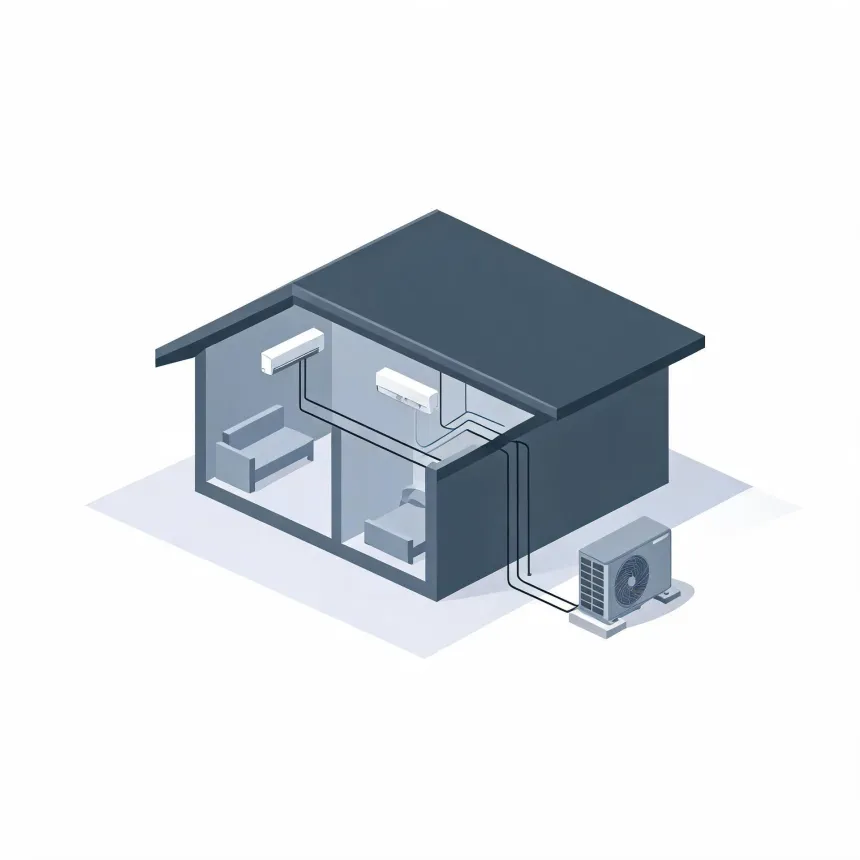
Isometric illustration of a cutaway house showing two wall-mounted mini-split indoor units connected by line sets to an outdoor condenser on a pad outside.
Your system heats September through May and cools July through August.

NOAA nClimDiv, 1991–2020 normals

Cooling here runs about two months a year, July and August, with afternoon highs averaging 81°F.

A mini split in Hettinger County isn't working against heat most of the year, so a reliable mid-range system holds up fine without paying for the top efficiency tier.

Half the homes here were built in 1964 or earlier, and the mini split has to work with the walls it finds

Half the homes here were built by 1964
Cooling runs July through August
Summer afternoons average 81°F

Electricity in North Dakota runs 11.51 cents per kilowatt-hour, cheaper than most of the country. That changes the math on which mini split to buy. A unit with the highest efficiency rating costs more up front, and it earns that back through lower electric bills over time. With power this cheap, the payback stretches out, sometimes past the life of the equipment. A mid-range system that's built well and sized right for the room will cost less to install and less to run than people expect. Put the money into a correct install and a unit that holds up, not into a rating that saves you less here than it would somewhere with a higher power bill.

Replace it before the season

Replace it before the season starts, so it happens on your schedule, not in a hurry.

Find a contractor
A beige split-system air conditioner outdoor condenser unit mounted on metal wall brackets atop a stucco wall.

The old system doesn't retire, it gets reassigned

The old system doesn't get hauled off the day the new one goes in. A furnace or window unit being replaced by a mini split usually stays in place, because the mini split is taking over specific rooms or specific months, not the whole job. If a window unit comes out, check the seal it leaves behind. Those units are rarely airtight to begin with, and the frame or sash can be left loose or cracked once the unit is gone. If a furnace stays in as backup heat, it still needs its own yearly check. A furnace that only runs on the coldest days still has an igniter that can fail and a flue that can block, and going unused doesn't protect it from either. The one thing worth confirming before anything gets disconnected is whether another system in the house depends on it, like a thermostat wired to run both, or a humidifier mounted on the furnace ductwork.

The outdoor unit and the indoor head are matched, not interchangeable

A mini split is engineered as a pair, the compressor outside sized to the head or heads inside. A contractor who swaps in a smaller compressor to cut cost ends up with a system that short cycles or never quite satisfies the room. Getting this match right is most of what you're paying for, more than the equipment itself.
Every wall the line set has to cross adds to the job

The refrigerant lines, power wire and drain line run from the indoor head to the outdoor unit through a hole drilled in the wall, then usually get routed along the outside of the house to reach the compressor. How far that run has to go, how many corners it turns, and whether it crosses brick or siding instead of open framing all change how much work the install takes. A straight run to a nearby exterior wall goes faster than one that has to snake through the house to reach a room in the middle.

Sizing a mini split isn't about matching the square footage of the room to a chart. The right size depends on how much heat the room gains and loses, which comes from the windows it has, which way they face, how much insulation is behind the walls, and what else is nearby throwing off heat, like a kitchen or a run of west sun in the afternoon. A unit sized too big cools the room fast, shuts off, and starts again a few minutes later. That short cycling means it never runs long enough to pull the moisture out of the air, so the room feels cold and damp instead of just comfortable. A unit sized too small runs constantly during the hottest part of the day and still doesn't catch up. Getting it right means a contractor doing a load calculation on that specific room, not guessing off its square footage, and it's worth asking whether that's actually what they did before you sign anything.

Installation starts with the outdoor spot and the indoor spot, and most of the day goes to the parts in between. The crew mounts the indoor head on its bracket, drills the wall for the line set, and sets the outdoor unit on a pad or brackets outside. Then the lines get run between them, the refrigerant lines, the drain line, and the power wire, and that's the part that eats the hours, especially if the run has to turn corners or cross siding. Once everything's connected, the lines get pressure tested and pulled down to vacuum before any refrigerant moves, because trapped air and moisture in the lines will wreck the compressor over time. The last step is running it, checking the head blows cold, checking the drain actually drains, and checking the outdoor unit isn't short cycling. A straightforward single room job can wrap in a day. Add a second head, a long line run, or a wall that fights back, and it stretches past that.