





A snow-covered small-town street at dusk, with lit white clapboard houses, bare trees, and a grain elevator silhouetted against an orange and blue twilight sky.

Mini Split Installation in Rolla, ND

Tell us about the job

Takes about a minute. No obligation.

New system or replacementMini-splitRolette County, ND
Step 1 of 2

What ZIP code is the job in?

Most homes in Rolette County heat with electricity, 65.6% of them. A mini split fits right into that setup, since it runs on electricity too and does both heating and cooling from the same unit. Propane heats most of the rest of the homes here, and a mini split can work alongside a propane furnace or replace it, depending on what you're after. Either way, you're not fighting the grain of how this area already heats its homes.

10 months
September through June, your system heats
1 months
July through July, it cools
0°F
the average winter night it heats against
76°F
the average summer afternoon it cools against
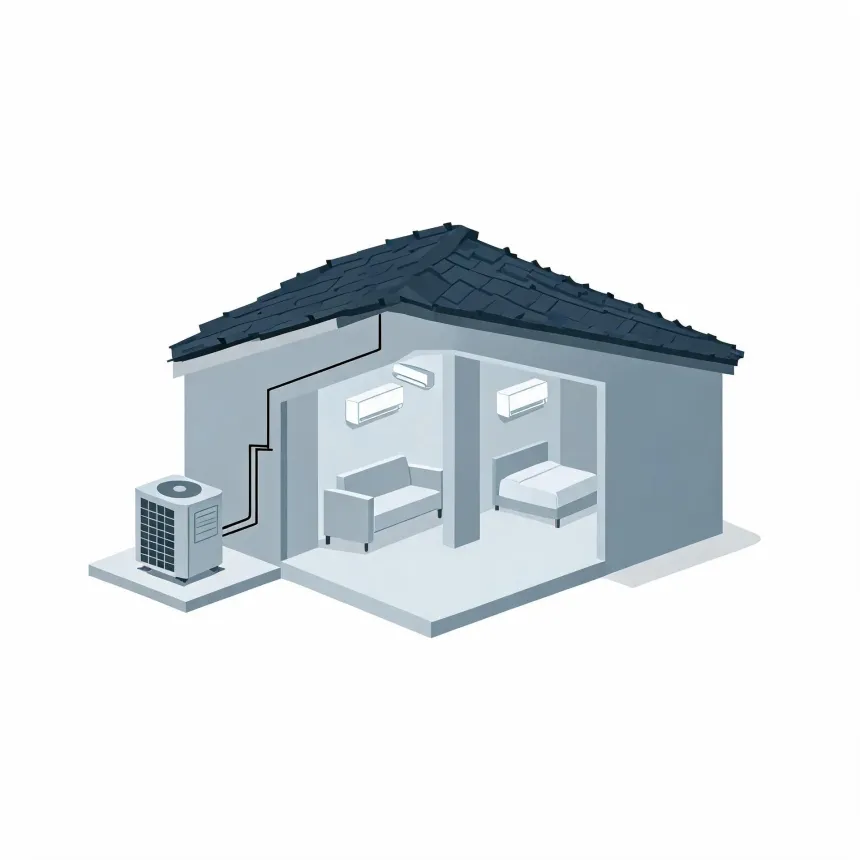
Isometric illustration of a cutaway single-story house with a dark shingled roof, showing three wall-mounted indoor air conditioning units in two rooms connected by lines to an outdoor condenser unit on a pad outside.
Your system heats September through June and cools July through July.

NOAA nClimDiv, 1991–2020 normals

Cooling in Rolette County only runs in July.

Get the mini split installed by June and it's ready before the first hot day, not during it.

A standard mini split is sized for homes like these

Half the homes here were built by 1980
Climate zone 7
Power costs 11.51 cents a kWh statewide

Electricity in North Dakota runs 11.51 cents per kilowatt-hour, cheaper than most of the country. That changes how to think about a mini split here. A more efficient model costs more up front and takes longer to earn that back when power is already cheap. So the case for one mini split over another isn't really about shaving pennies off the electric bill. It comes down to whether it heats and cools this house well through a North Dakota winter and summer, and whether it holds up. Pick for that first.

One mild month of cooling doesn't call for top-end equipment

July is the only month cooling runs here, and even then the afternoon high averages just 76°F. A mini split in Rolette County isn't working against much. That kind of light load is where a reliable, mid-range system holds up fine, no need to pay for cooling capacity this climate won't ask for.

Find a contractor
A man in a cap, dark shirt and tan work pants, seen from behind, climbs porch steps toward a red front door while carrying a canvas tool bag filled with screwdrivers.
A white mini-split air conditioner outdoor condenser unit mounted on metal brackets against a beige stucco exterior wall, with a blue sky and scattered clouds in the background.

Sizing comes from the room, not a guess

Sizing a mini split is about matching the compressor to the room, not just the square footage. Too big and it cools the air fast, shuts off, then starts again before it ever pulls the moisture out, so the room feels cold and damp at once. Too small and it runs flat out all day, never catching up, which wears on the compressor and still leaves the room uncomfortable. A contractor works this out with a load calculation that looks at window area, insulation, ceiling height and how the rooms connect, not a rule of thumb based on floor space alone. Get it right and the unit cycles on and off at a steady pace, holding temperature without strain. That's what decides how long it lasts, more than the brand on the case.

The old furnace or AC doesn't have to go anywhere

A mini split can run alongside an existing furnace instead of replacing it. The furnace keeps handling the coldest stretch if that's what's wanted, and the mini split takes over the rest. Nothing says the old system has to be torn out just because a new one is going in.
If it does come out, that's its own job

Pulling a furnace or central AC means disconnecting gas or electric lines, capping ductwork or leaving it in place, and hauling off the old equipment. Refrigerant in an old AC has to be recovered properly, not vented. That work gets scoped separately from the mini split install itself.

A couple things are worth asking straight out when you're comparing units. First, how many indoor heads does the outdoor compressor support, and is it sized to add another zone later if you want one, or is it maxed out with this install. Second, ask what the low end of its heating range actually is. Every mini split lists a temperature where it stops keeping up, and that number matters more here than the cooling spec does. Ask too about the line set length the warranty allows, since running it farther than the manufacturer spec can void coverage before the unit ever fails on its own. And ask who services it. A brand with a thin dealer network nearby means a longer wait when a part needs replacing, no matter how good the unit is on paper.

The efficiency rating on a mini split's label tells you how much heat it moves for the electricity it uses, nothing more. It doesn't tell you how fast the unit heats or cools a room, and it doesn't tell you how well it's built. Units with the same rating can perform very differently once it's actually cold outside, because the rating gets measured under fixed lab conditions, not in real wind or real cold. What the rating is good for is comparing running cost between models before you buy. What it won't tell you is whether the compressor holds up outdoors year after year, or whether the unit keeps heating once the temperature drops past the point where it starts to struggle. Treat it as one factor, not the whole decision.