Electricity runs most homes here
Electricity heats 60.1% of homes in McKenzie County, more than gas or anything else. A mini split is an electric system, so it fits into a setup already built around electric heat.
Takes about a minute. No obligation.
Electricity heats 60.1% of homes in McKenzie County, more than gas or anything else. A mini split is an electric system, so it fits into a setup already built around electric heat.
Utility gas heats 17.4% of homes here, and LP gas heats another 20.1%. If your house runs on either, ask what a mini split would replace and what, if anything, stays in place alongside it.
NOAA nClimDiv, 1991–2020 normals
Cooling in McKenzie County runs July through August.
Get the mini split installed by June and it's already running when you need it, not stuck on a waitlist in July.




Sizing a mini split comes down to the heat load of the room it's covering, not the square footage alone. A contractor works out how much heat that space gains in summer and loses in winter, counting the windows, the ceiling height, and how many walls face outside. Too big and the unit short cycles, cooling the room fast then shutting off before it pulls the moisture out of the air, so the room feels cold and clammy at once. Too small and it runs flat out on the hottest days and still can't keep up. The right size runs longer, steadier stretches at partial output, which is where these systems actually hold their efficiency. An outdoor unit matched to the real load, not the biggest one on the lot, is the one that keeps the room comfortable without running harder than it has to.
Cheap power means a high-efficiency model takes longer to pay back the difference in running cost. Put the weight on getting the size and the installation right instead, since that's what decides how this system heats and cools your house.
Find a contractorA mini split that runs for years without trouble comes down to parts nobody puts on the brochure. Ask how many indoor heads will pull off the same outdoor unit. Add a zone and the compressor has to answer to another head calling for cooling, so ask how it handles every head running at once, not just one. Ask about the line set too, how far it has to run and how many bends it takes to reach the outdoor unit. A long or tightly bent run makes the compressor push harder to move refrigerant, and that shows up later as wear. Ask what happens if one indoor head needs service down the road. On some multi-zone systems a tech can work on one head without touching the others. On some he can't. None of this shows up on a spec sheet. Worth asking before the outdoor unit goes on the pad, not after.
A mini split quote covers the condenser, the line set, the wiring, the pad or bracket it sits on, and the labor to run everything between the outdoor unit and each indoor head. A contractor who quotes only the equipment and skips the mounting and electrical work is leaving out most of what actually gets installed.
An indoor head mounted on an easy wall with a short, straight run to the outdoor unit costs less to install than one on a far wall or through a tricky stud bay. Every extra foot of line set and every bend adds material and labor, and running power to the outdoor unit location is its own piece of work if nothing is already there.
The number on the label, the SEER2 rating, tells you how much cooling a mini split produces for the electricity it uses over a season, averaged across mild days and hot ones. A higher number means more cooling per unit of power, but only on average. It doesn't tell you what the unit does on the single hottest afternoon, and it doesn't account for how the system is installed. A unit with a strong rating set up with a line set that's too long, or sized wrong for the room, won't deliver the efficiency printed on the box. The rating describes the equipment in a lab, not the equipment on your wall. What it's worth to you depends on how many hours a year the system actually runs, since a better rating only pays back through hours of use.
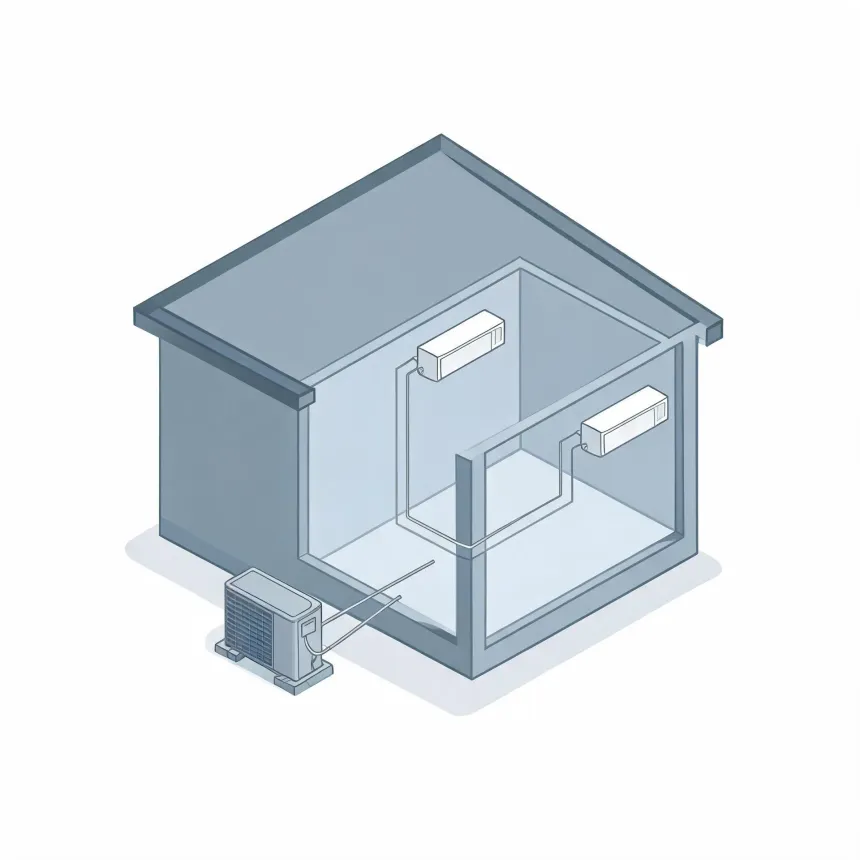
Installation day starts with the outdoor unit going on its pad or wall bracket, set where it has clearance for airflow and for service later. Then comes the line set, the copper tubing that carries refrigerant between the outdoor unit and the indoor head, run through a wall sleeve and sealed where it passes through. The indoor head goes up next, mounted level so condensate drains the way it is supposed to instead of pooling. Once everything is connected, the line set gets pulled down to a vacuum before any refrigerant moves through it, which pulls out moisture and air that would otherwise sit in the lines and cause corrosion or a weak charge down the road. A system charged without that step can look fine at first and run into trouble later. Last comes the test run, checking that the indoor head calls for cooling or heat and the outdoor unit answers.