





A snow-covered small-town street at dusk, with lit white clapboard houses, bare trees, and a grain elevator silhouetted against an orange and blue twilight sky.

AC Installation in Fort Yates, ND

Tell us about the job

Takes about a minute. No obligation.

New system or replacementCentral ACSioux County, ND
Step 1 of 2

What ZIP code is the job in?

Most homes in Sioux County run on bottled, tank or LP gas, 72.8% of them. Electricity heats 9.7%. If your furnace runs on LP gas now, a new central AC system just adds a cooling coil and an outdoor condenser to what you already have, tying into the same ductwork. The furnace handles heat, the new unit handles cooling, and neither has to change how the other works. That's the simplest install there is, and it's why most AC jobs out here look the same from house to house.

3 months
June through August, your air conditioner is on duty
82°F
the average summer afternoon it cools against
37 hail events
in ten years, and hail bends the fins on outdoor coils
13.4 SEER2
the federal minimum any new unit must meet
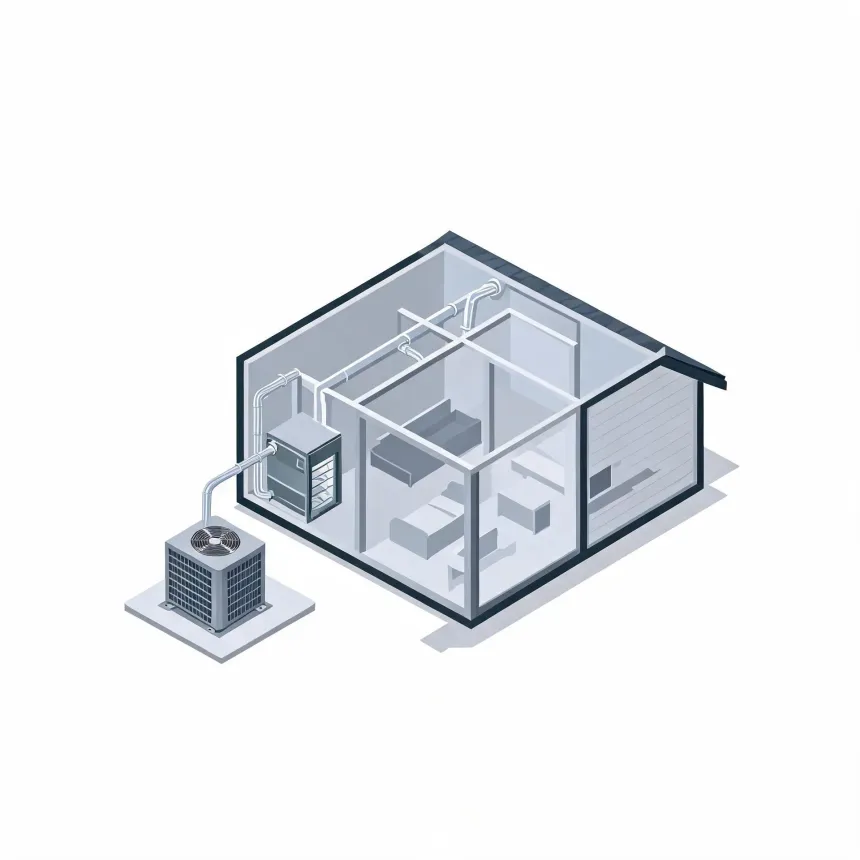
Isometric grayscale illustration of a cutaway house showing interior rooms, ductwork, an indoor air handler, and an outdoor condenser unit on a pad connected by lines.
Your air conditioner works hardest from July through August.

NOAA nClimDiv, 1991–2020 normals

Electricity in North Dakota runs 11.51 cents per kilowatthour, well below what most states pay.

A high-SEER2 condenser costs more up front and takes longer to earn that back here, so picking one for reliability and fit matters more than chasing the efficiency number.

May is the month to get this done, before June asks your new system to work

Cooling runs June through August
Summer afternoons average 82°F
49 damaging wind events from 2015 to 2024
Three months of work a yearCooling only runs June through August here, with afternoon highs around 82°F.

The size of the condenser matters more than anything else on the invoice. Too big and it cools the air fast without pulling the moisture out, so the house feels clammy even at the right temperature. Too small and it runs constantly, chasing a setpoint it can't reach on the hottest days. Getting that size right means someone measures the house, the windows, the insulation, not just matching whatever was there before. The ductwork gets looked at too. If it's undersized or leaky, a new condenser still has to push air through it, and that limits what the system can do no matter how good the unit is. Line set length, where the outdoor unit sits, whether the electrical panel can take the new circuit, all of that factors in before the first number gets written down.

Pick a system built to last, not one built to impress

Three months of light duty is not much to ask of a condenser. A reliable mid-range system will keep up with those afternoons just fine. Put the budget into a unit that fits the house and holds up, not one chasing an efficiency number it won't get much use out of here.

Find a contractor
A gray cylindrical air conditioning condenser unit mounted on a concrete pad next to a light-colored vinyl-sided house exterior.

Sized for the house, not the invoice

A load calculation looks at floor area, ceiling height, window count and direction, and how much insulation is doing its job. It adds all of that up room by room. That's the only way to land on the right size. Match the new unit to the one that was already out there, or size it off square footage alone, and it can land wrong in either direction. Short cycling is the usual sign of oversizing. The condenser kicks on, satisfies the thermostat fast, and shuts off before it's run long enough to pull humidity out of the air. That start and stop wears on the compressor faster than a longer, steady run would. Undersized shows up differently. The system runs nearly nonstop on the hottest days and still can't hold the setpoint, because it was never built to move that much heat out of that much space.

The old unit doesn't sit around as a spare

Whoever installs the new system disconnects the old condenser, cuts it loose from the line set and the electrical circuit, and hauls it away. It gets recycled for the refrigerant and metal inside it. There's no reason to keep an old condenser on hand once the new one is in, since it won't bolt onto a different system later.

The refrigerant has to come out first

Old condensers hold refrigerant under pressure, and it can't just be vented into the air. A contractor recovers it into a tank before the unit gets disconnected. That's a legal requirement, not an extra step tacked on, so it's already priced into a proper installation rather than something that gets billed separately.

An outdoor air conditioning condenser unit positioned on a concrete pad next to a blue-sided house, surrounded by green shrubs and flowering hydrangeas at sunset.

Going above the federal minimum saves little here, about $20 a year.

  • A higher-efficiency unit$90 a year
  • A new unit at the federal minimum, 13.4 SEER2$110 a year

Estimates for a typical Sioux County home, from EIA household energy data, North Dakota fuel prices and NOAA climate normals. Your home will differ.

Install day starts with the old system still running. The crew shuts it down, recovers the refrigerant, then disconnects the line set and the electrical whip before the old condenser comes off its pad. Setting the new one takes its own care. The pad has to sit level, with clearance around the unit for airflow. The line set gets routed and connected, and a new circuit gets landed if the old one isn't rated for it. Inside, the coil gets swapped or added above the furnace. Before any refrigerant goes in, that line set gets pulled into a vacuum and checked for leaks. Any moisture or air left behind causes problems later, so that step doesn't get rushed. Once the system is charged, it gets run and checked, airflow at the vents, pressure in the ducts, the thermostat actually talking to the new equipment. A furnace that's staying in place usually just needs the coil above it seated right and the drain line clear.