




A snow-covered suburban street at dusk with lit houses and bare trees under a twilight sky.

AC Repair in Bismarck, ND

Tell us about the job

Takes about a minute. No obligation.

RepairCentral ACBurleigh County, ND
Step 1 of 2

What ZIP code is the job in?

Half the homes in Burleigh County were built in 1988 or later. That puts a lot of the housing stock here well within range for a working air conditioner, especially if yours came with the house. A system that age has usually got plenty of service left in it. Worth finding out before anyone starts talking about replacing it. If your AC is acting up and the house is on the newer side, repair is the more likely answer.

2 months
July through August, your air conditioner is on duty
80°F
the average summer afternoon it cools against
74 hail events
in ten years, and hail bends the fins on outdoor coils
96 wind events
in ten years, and wind drives debris into outdoor units
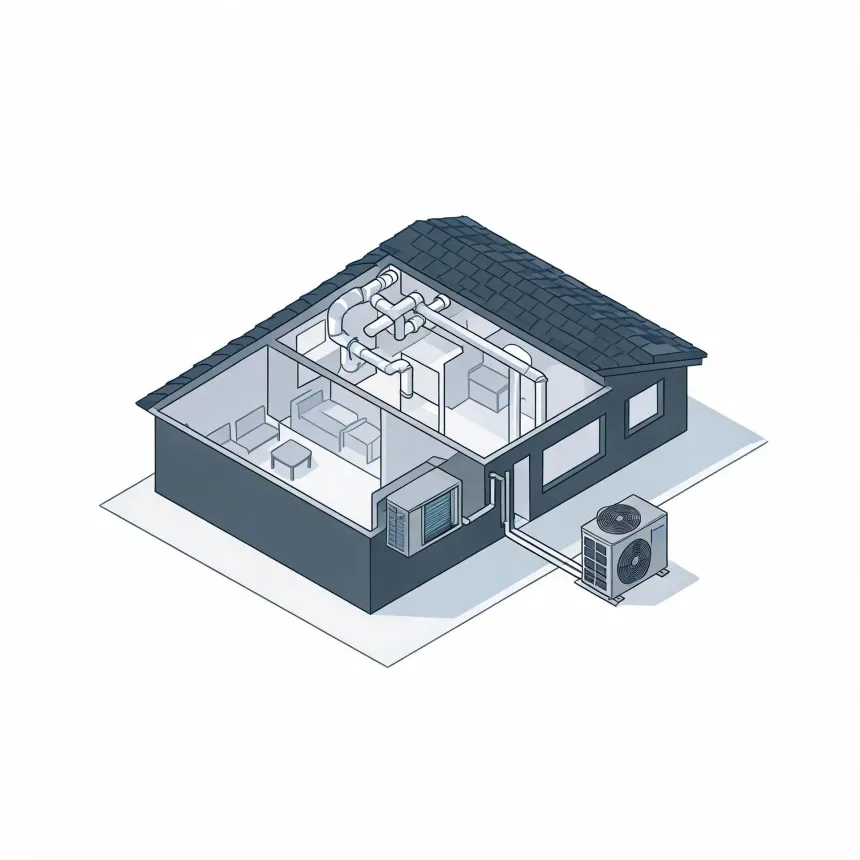
Isometric line illustration of a cutaway single-story house showing interior rooms with furniture, ceiling ductwork, an indoor air handler, and an outdoor condenser unit connected by lines along the exterior wall.
Your air conditioner works hardest from July through August.

NOAA nClimDiv, 1991–2020 normals

A compressor straining against a low charge keeps drawing the same current while it does less work.

Run it that way long enough and the compressor itself is what needs replacing.

Two months of cooling, and July is when a weak AC shows it

Cooling runs July through August
Summer afternoons average 80°F
96 damaging wind events from 2015 to 2024

If your AC is acting up, a technician can check the model and serial number on the unit itself and tell you what you're working with. That's worth doing before anyone brings up replacement. A failing capacitor, a low charge, a bad contactor, none of that means the system is done. It means one part needs attention. Get the diagnosis first and let that decide what happens next.

Your AC has had an easy job. A repair should hold up.

Two months of cooling a year is not much to ask of a system. Your AC here isn't fighting the load it would somewhere hotter, so if it's acting up now, age or a worn part is the more likely reason, not years of strain. That usually means it's worth fixing.

Find a contractor
A gray metal air conditioning condenser unit mounted on a concrete pad in a flat grassy field under a partly cloudy sky.

What a failing AC sounds and feels like before it quits

Short cycling is the one most people notice first. The system kicks on, runs for a few minutes, shuts off, then starts again before the house has cooled. That pattern wears on a compressor fast. Warm air out of the vents while the unit runs is another. It means something isn't finishing the job, whether that's low refrigerant, a failing compressor, or a blocked coil. Ice on the refrigerant line or the indoor coil points the same direction. A system that won't hold a set temperature, or struggles more on the hottest part of the day than it used to, is telling you a part is losing ground. None of these mean the whole system is finished. They mean something specific is wrong and worth having looked at before it takes something else with it.

What you can look at yourself

Check the thermostat is set to cool and the temperature is actually below room temperature. Go outside and look at the condenser. If the fan isn't spinning at all, or the whole unit is silent, check your breaker panel first. Look at the filter too. A filter packed with dust chokes airflow and can make a healthy system act like a broken one.

Where to stop

Anything past the filter and the breaker is inside the cabinet or in the refrigerant line, and that's not a place to go exploring. Opening the condenser or touching the lines without the right gauges can turn a simple fix into a bigger one. Once you've ruled out the thermostat, the breaker and the filter, the rest is a job for someone with the tools to see what's actually happening.

An outdoor central air conditioning unit mounted on a concrete pad beside a blue-sided house at sunset.

A new air conditioner would save little on running costs in Burleigh County, so the repair decision comes down to the unit's condition.

  • A new one at the federal minimum, 13.4 SEER2$90 a year
  • An older air conditioner$100 a year

Estimates for a typical Burleigh County home, compared with an older unit built to the previous federal minimum, from EIA household energy data, North Dakota fuel prices and NOAA climate normals. Your home will differ.

Repair makes sense when a part like a capacitor or contactor has failed.

Replacement makes sense when the compressor has failed or the system uses R-22 refrigerant, which is no longer made.

A diagnostic starts outside at the condenser, with the panel off and the contractor watching what the unit actually does when it's told to run. Readings come next. Refrigerant pressure, the current the compressor is drawing, the capacitor's output against what it's rated for. Those numbers point at a part faster than guessing ever could. Inside, the coil gets checked for ice or buildup, and airflow gets traced back to the filter and the return. A system that's short cycling or running warm usually shows its cause in that first set of readings, before anything gets opened up or replaced. Most of the visit is testing, not guessing.