






A snow-covered suburban street at dusk with lit houses and bare trees under a twilight sky.

AC Repair in Crosby, ND

Tell us about the job

Takes about a minute. No obligation.

RepairCentral ACDivide County, ND
Step 1 of 2

What ZIP code is the job in?

Your air conditioner only works July and August here, with afternoon highs averaging 78 degrees. That is a light load compared to what the same unit would face further south. A compressor or capacitor that runs under that kind of mild demand year after year tends to hold up well, so when something does go wrong, it is usually not from being worked hard. Wind and hail are more likely to have caused trouble than the heat ever did, both common in Divide County over the past decade. Either way, a unit with an easy workload like this is usually worth repairing rather than replacing.

2 months
July through August, your air conditioner is on duty
78°F
the average summer afternoon it cools against
20 hail events
in ten years, and hail bends the fins on outdoor coils
36 wind events
in ten years, and wind drives debris into outdoor units
Isometric grayscale illustration of a cutaway house showing interior rooms, ductwork, an indoor air handler, and an outdoor condenser unit on a pad connected by lines.
Your air conditioner works hardest from July through August.

NOAA nClimDiv, 1991–2020 normals

Cooling here runs July and August, nothing more.

Have it looked at in June, before the first hot day finds whatever was already weak.

Half the homes in Divide County are old enough that their AC may be too

Half the homes here were built by 1963
Cooling runs July through August
Summer afternoons average 78°F

Since the strain on your system is light here, a repair call is usually about finding one specific cause, not chasing general wear. A contractor can check the unit for things that fail from age, like a weak capacitor or a clogged coil. They can also check for things that fail from an event, like a bent fan blade or a cracked panel from hail. Thirty-six damaging wind events and twenty hail events hit Divide County over the past decade. That means outdoor units here take hits that have nothing to do with how hard they've run. If your AC is acting up after a storm, mention it. That detail alone can point straight to the fix.

Before you pay for a repair, find out how much life is left

Half the homes in Divide County were built in 1963 or earlier. If yours is one of them, the AC may be original or close to it. A repair is still worth doing on a unit that has had an easy run here, but ask the contractor straight out how many years it likely has left. That answer should decide whether this repair makes sense or whether you're about to sink money into a system on its way out.

Find a contractor
A man in a cap, dark jacket and tan work pants walks up concrete steps toward a red front door, carrying a worn canvas tool bag, with a potted shrub beside the entry.
A gray residential air conditioner condenser unit mounted on a concrete pad in an open grass field.

The system usually tells you before it quits

Most AC failures give some kind of warning before the system quits outright. A unit that short cycles, shutting off soon after it starts, is usually struggling with a failing capacitor or a coil so dirty it can't shed heat. Warm air blowing from the vents points toward low refrigerant or a compressor that isn't pulling its weight anymore. A breaker that trips every time the unit kicks on means something is drawing too much current, often the compressor itself. Grinding or squealing from the outdoor unit usually means a motor bearing is going. Ice on the refrigerant lines looks like it needs more cooling but almost always means airflow is restricted or the charge is low. None of these signs get better by waiting. A capacitor that's starting to go will keep failing a little more each time the unit cycles, and a compressor running on bad current keeps taking damage with every start until it stops starting at all.

A weak start turns into a dead compressor

A compressor struggling to start on a failing capacitor pulls hard on its windings every time it tries. Let that go on long enough and the windings overheat and short out. What would have been a capacitor swap turns into a compressor replacement, and the compressor is the heart of the unit.

A dirty coil makes the whole system work against itself

A coil caked with dirt can't shed heat the way it should, so the system runs longer to hit the same temperature. That extra runtime pushes pressures higher than the unit was built to handle, and high pressure is what blows seals and cracks lines. A problem that started as a simple cleaning turns into a leak.

Aerial view of a gray outdoor air conditioning condenser unit mounted on a concrete pad next to a house with vinyl siding.

A new air conditioner would save little on running costs in Divide County, so the repair decision comes down to the unit's condition.

  • An older air conditioner$70 a year
  • A new one at the federal minimum, 13.4 SEER2$70 a year

Estimates for a typical Divide County home, compared with an older unit built to the previous federal minimum, from EIA household energy data, North Dakota fuel prices and NOAA climate normals. Your home will differ.

Repair makes sense when a part like a capacitor or contactor has failed.

Replacement makes sense when the compressor has failed or the system uses R-22 refrigerant, which is no longer made.

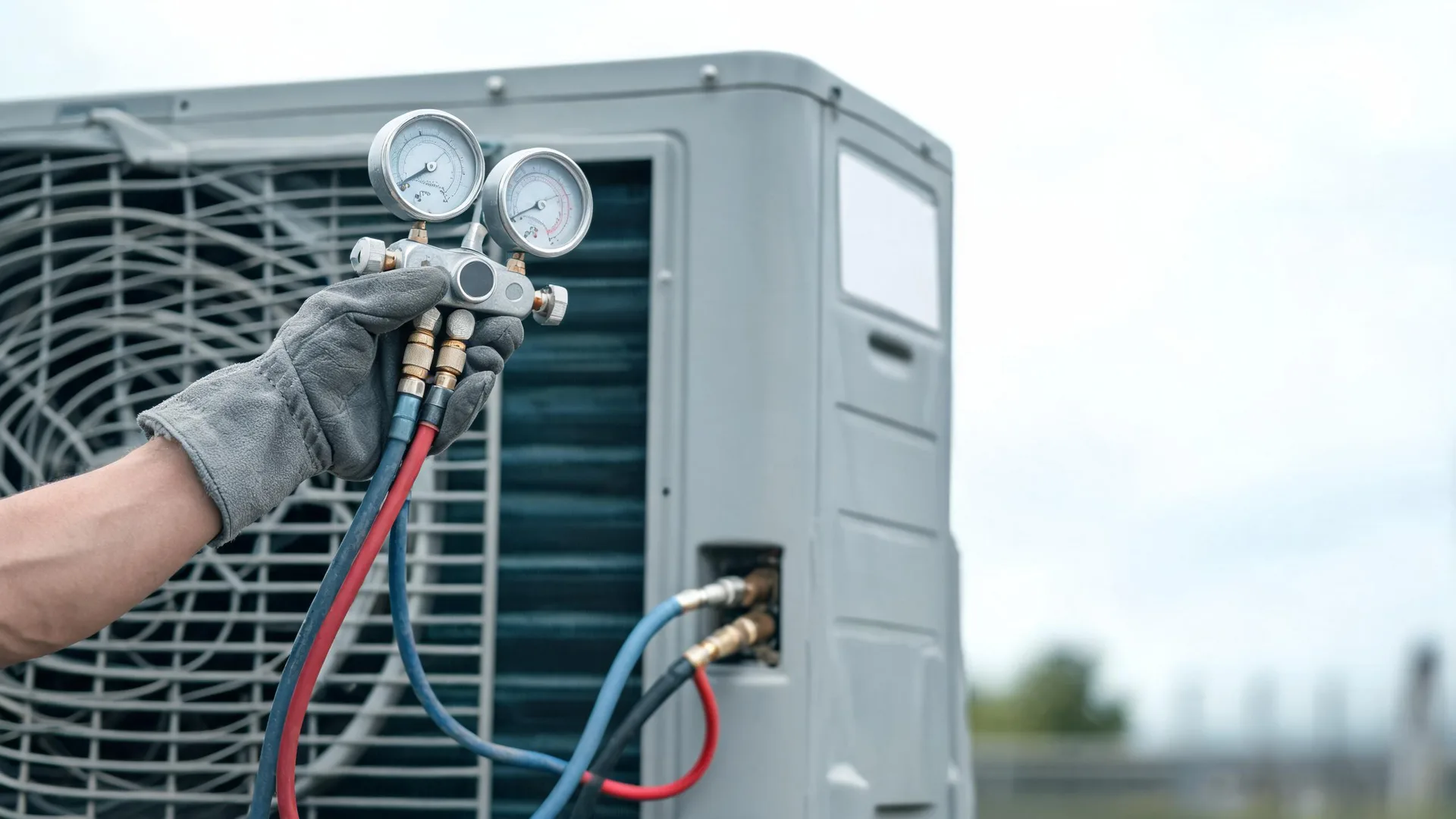
A diagnostic visit starts before any panel comes off. A contractor will ask what the unit is doing. Short cycling, running nonstop, blowing warm, tripping a breaker, each points somewhere different. From there it's gauges and a meter. They check refrigerant pressure, the capacitor's charge, the contactor's condition, and amp draw on the compressor and fan motor. Airflow gets checked too. A blocked return or a dirty coil can mimic a refrigerant problem and send someone chasing the wrong fix. Once the actual cause turns up, that's when you hear what it takes to put it right.