





A snow-covered small-town street at dusk, lined with illuminated two-story houses and a grain elevator on the horizon.

AC Repair in Dickinson, ND

Tell us about the job

Takes about a minute. No obligation.

RepairCentral ACStark County, ND
Step 1 of 2

What ZIP code is the job in?

Your air conditioner only has to work two months a year here, July and August, with afternoon highs averaging around 81 degrees. That's a light load. A compressor or capacitor here isn't fighting heat most of the year, it runs a short stretch and sits idle the rest of the time. So when something goes wrong, it's rarely because the unit has been run into the ground. More often it's a part that failed on its own, or something that sat unused since last summer and needs attention before it'll run right again. That usually makes it worth fixing.

2 months
July through August, your air conditioner is on duty
81°F
the average summer afternoon it cools against
64 hail events
in ten years, and hail bends the fins on outdoor coils
95 wind events
in ten years, and wind drives debris into outdoor units
Isometric cutaway illustration of a single-story house showing interior rooms with furniture, overhead ductwork, an indoor air handler unit, and an outdoor condenser unit connected by lines at the side of the building.
Your air conditioner works hardest from July through August.

NOAA nClimDiv, 1991–2020 normals

Half the homes in Stark County were built in 1986 or later.

A system installed with a newer house in Dickinson still has working life in it, and that's worth knowing before you replace instead of repair.

Two months of work a year, then it sits until June

Cooling runs July through August
Climate zone 6A
Power costs 11.51 cents a kWh statewide

A refrigerant leak is the clearest example. Run the system low on charge and the compressor works harder to move what's left, which drives its temperature up. Keep that going and the compressor can burn out, and that's a different repair than fixing the leak that caused it. A weak capacitor works the same way. It can still kick the compressor on, but the hard start that follows puts strain on the motor windings every cycle it runs. A dirty condenser coil outside does similar harm from a different angle. Airflow drops, heat has nowhere to go, and the compressor runs hotter than it was built to. None of these start as compressor problems. They end as compressor problems if the system keeps running while the real issue sits ignored.

Check the system's age before you rule out repair

If your AC came with the house, check when the house was built before you assume the unit is old. A system installed with a newer home still has years ahead of it, and that's a system worth calling a repair tech for first.

Find a contractor
A gray metal air conditioning condenser unit mounted on a concrete pad in a flat grassy field under a partly cloudy sky.

What actually fails, and why hours don't explain it

A compressor that only runs a couple months a year still fails the same handful of ways any compressor does. A capacitor weakens with age, and once it's too weak to push the compressor through a hard start, that start draws more current than the motor windings are built for. A refrigerant leak doesn't care whether the system is running or shut off, it loses charge either way, and a compressor working with low charge runs hotter than it should. A dirty condenser coil blocks the heat the system needs to shed, and the compressor runs hotter for that reason too. None of this is about hours on the clock. It's about whether the part doing the work is in shape to do it, and a season of sitting idle is also a season where a failing capacitor or a slow leak goes unnoticed until the system turns back on.

What you can check at the thermostat and the vents

Set the thermostat a few degrees below room temperature and listen for the outdoor unit to kick on. If it doesn't start at all, check the breaker before anything else, since a tripped breaker is something you can reset yourself. Inside, feel the air at a vent. Warm or weak airflow with the system running points to something past what's safe to check on your own, but a dirty filter is worth a look first. A filter clogged with dust blocks airflow across the evaporator coil, and that alone can make a system blow warm or freeze up.

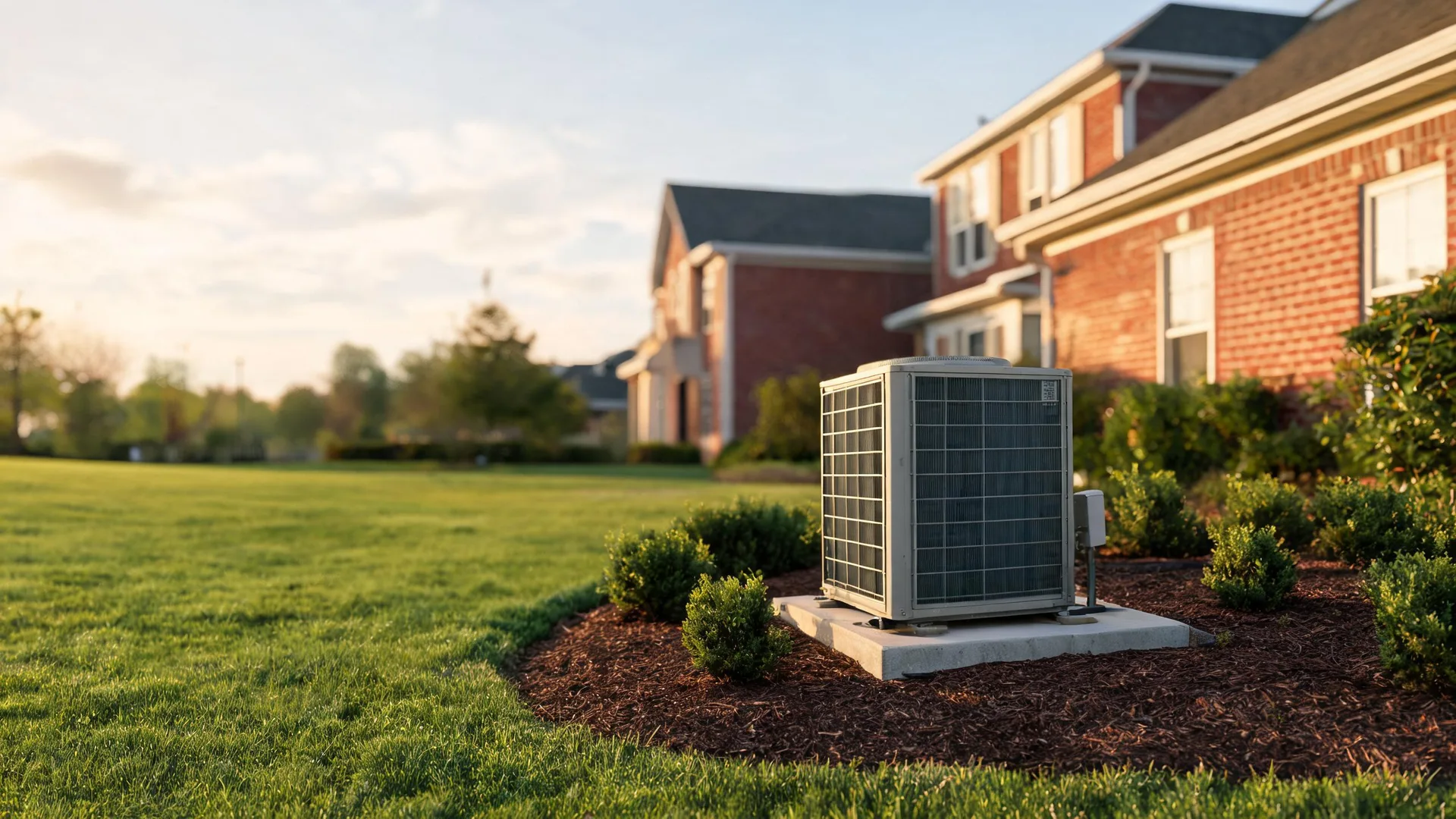
What's worth a look outside, and what isn't

Walk out to the condenser and check that nothing is pressed against it. Leaves, grass clippings, or a trimmer left leaning on the cabinet block airflow across the coil, and clearing that space is safe to do yourself. Ice on the lines or the coil means shut the system off and let it thaw before anyone touches it further. Past that, taking the cabinet apart or handling anything electrical isn't a homeowner job. The capacitor inside holds a charge even with the power off.

Overhead view of a gray outdoor AC condenser unit on a concrete pad beside a mulched garden bed and a house with vinyl siding.

A new air conditioner would save little on running costs in Stark County, so the repair decision comes down to the unit's condition.

  • A new one at the federal minimum, 13.4 SEER2$90 a year
  • An older air conditioner$100 a year

Estimates for a typical Stark County home, compared with an older unit built to the previous federal minimum, from EIA household energy data, North Dakota fuel prices and NOAA climate normals. Your home will differ.

Repair makes sense when a part like a capacitor or contactor has failed.

Replacement makes sense when the compressor has failed or the system uses R-22 refrigerant, which is no longer made.

Repair makes sense as long as the problem is isolated and the compressor hasn't been damaged by it. A failed capacitor, a stuck contactor, a low-voltage wire that's come loose at the board, these are contained problems. Swap the part, the system runs the way it did before. What changes the math is when the compressor itself is the thing that's failed. It's the most expensive part in the system, and a contractor will often tell you straight that replacing just the compressor costs enough that putting that money toward a new system is the better call. Age matters here too, but not the way people think. It's not that an old unit is doomed. It's that an old unit is more likely to have a second and third problem waiting behind the first one, so a repair that looks simple can turn into a longer list once the tech is actually in there. Ask what failed and why before you decide anything. A part that gave out on its own is a repair. A part that failed because something upstream was ignored is worth asking about before you fix it and send the system back out to fail the same way again.