





A snow-covered residential street at twilight with illuminated houses, bare trees, and an orange horizon glow beneath a deep blue sky.

AC Repair in Elgin, ND

Tell us about the job

Takes about a minute. No obligation.

RepairCentral ACGrant County, ND
Step 1 of 2

What ZIP code is the job in?

Elgin gets about two months of real cooling weather, July and August, with afternoon highs averaging 81. That's a short season for an air conditioner to earn its keep, and it means less wear than a unit would see further south. A system here that's breaking down isn't being worn out by the climate. More likely it's a part that's aged out, or something that got missed on a service call a while back. Hail and wind do pass through the county fairly often, so an outdoor unit that's acting up after a storm is worth a look too. Either way, a repair on a system like this is usually worth making.

2 months
July through August, your air conditioner is on duty
81°F
the average summer afternoon it cools against
73 hail events
in ten years, and hail bends the fins on outdoor coils
57 wind events
in ten years, and wind drives debris into outdoor units
Isometric illustration of a cutaway house showing interior ductwork, an indoor air handler and furniture, connected by lines to an outdoor condenser unit on a pad.
Your air conditioner works hardest from July through August.

NOAA nClimDiv, 1991–2020 normals

AC here starts earning its keep in July.

June is the time to get it looked at, before the first hot stretch finds the weak part.

Half the homes in Grant County were built by 1962, which is reason enough to ask how old the AC is

Half the homes here were built by 1962
Cooling runs July through August
Summer afternoons average 81°F

It's usually worth repairing

It has an easier job here than in most places, so your air conditioner is often in decent shape. Repair is usually worth it.

Find a contractor
An outdoor residential air conditioning condenser unit mounted on a concrete pad, surrounded by gravel with a blue sky in the background.

What actually breaks isn't about how hard it's running

A capacitor is usually the first thing to go. It holds the charge that kicks the compressor and the fan motor into motion. That charge weakens a little every time the system starts, and eventually the motor just hums instead of turning over. A contactor wears out the same slow way. Its contacts pit and burn a little with every cycle until they stop making a clean connection. The fan motor itself can seize or run slow, often because its bearings have worn or because a failing capacitor left it straining to start. Refrigerant leaks show up at the joints and the coil, usually from a slow rub against the cabinet or a factory connection that was never quite tight. None of this comes down to how many days the system ran. It comes down to how many times it started and stopped, and how many years it's done that.

What you can check yourself

Look at the outdoor unit first. If the fan isn't spinning but you hear a hum, that's often a bad capacitor or a seized motor, not something to force or fix by hand. Check the thermostat batteries and make sure it's set below room temperature and on cool. Go to the breaker panel and look for a tripped breaker, both the one for the indoor air handler and the one for the outdoor unit. Pull the air filter and hold it up to a light. If you can't see light through it, swap it, a clogged filter can starve the system enough to make it act like it's failing.

What tells you to stop and call

Ice on the refrigerant lines or the indoor coil means something's wrong with airflow or charge, and running it longer only makes it worse. A burning smell or a breaker that trips again right after you reset it means stop and don't try that breaker a third time. Water pooling near the indoor unit usually means a clogged drain line or a cracked pan, and it's worth catching before it damages the floor underneath. If the outdoor fan spins but the air coming from the vents isn't cold, that points to the compressor or the refrigerant charge, and that's a job for someone with gauges, not a screwdriver.

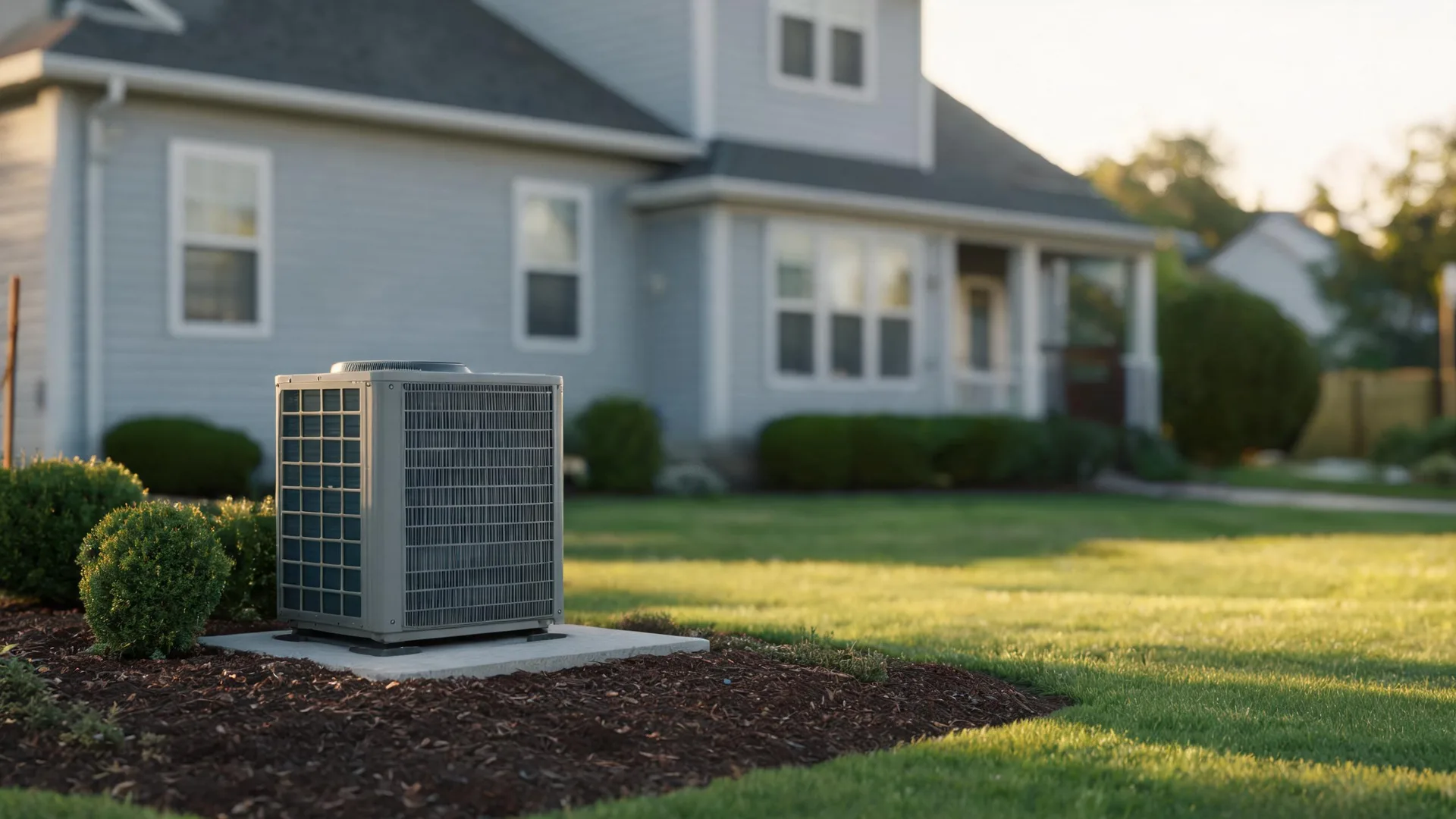
An outdoor air conditioning condenser unit mounted on a concrete pad next to a blue-sided residential house at sunset.

A new air conditioner would save little on running costs in Grant County, so the repair decision comes down to the unit's condition.

  • A new one at the federal minimum, 13.4 SEER2$100 a year
  • An older air conditioner$110 a year

Estimates for a typical Grant County home, compared with an older unit built to the previous federal minimum, from EIA household energy data, North Dakota fuel prices and NOAA climate normals. Your home will differ.

Repair makes sense when a part like a capacitor or contactor has failed.

Replacement makes sense when the compressor has failed or the system uses R-22 refrigerant, which is no longer made.

A repair is worth making when the part that failed is one piece and everything else in the system still looks and sounds right. A capacitor, a contactor, a fan motor, each one can be swapped on its own without touching the rest of the system. What changes the math is when the compressor itself is the problem. That's the one part that can't be replaced on its own for anything close to the cost of the others, so a failing compressor is usually where a tech stops and asks whether to keep going at all. The coil matters too. A coil that's corroded through in one spot will usually show the same wear further along, since it's aged under the same conditions for the same stretch of time. One clean repair on an otherwise sound system is a good bet. A second major repair on the same unit within a short stretch is the system telling you something more than one part is done.