A snow-covered suburban street at dusk with lit houses and bare trees under a twilight sky.

AC Repair in Lisbon, ND

Tell us about the job

Takes about a minute. No obligation.

RepairCentral ACRansom County, ND
Step 1 of 2

What ZIP code is the job in?

Checking the system, not just the symptom

A tech will check refrigerant charge, look at the condenser coil, test the capacitor and inspect the air handler before touching anything. Weak airflow or warm air can trace back to several different parts, so the visit starts with narrowing down which one is actually failing.


What it means for the fix

Once the cause is clear, the tech can tell you if it is a quick part swap, like a capacitor or contactor, or something bigger, like a failing compressor. That is also when you find out if the unit is worth repairing at all, or if it has reached the point where another breakdown is likely soon.

3 months
June through August, your air conditioner is on duty
80°F
the average summer afternoon it cools against
28 hail events
in ten years, and hail bends the fins on outdoor coils
46 wind events
in ten years, and wind drives debris into outdoor units
Isometric cutaway illustration of a small house showing interior rooms, ductwork, an indoor air handler, and an outdoor condenser unit connected by lines, on a plain white background.
Your air conditioner works hardest from June through August.

NOAA nClimDiv, 1991–2020 normals

Cooling in Ransom County runs June through August.

May is the month to get a weak part found before the first hot stretch finds it for you.

Half the homes in Ransom County were built in 1969 or earlier

Half the homes here were built by 1969
Cooling runs June through August
Summer afternoons average 80°F
Three months of work a yearAfternoons average 80°F here, June through August, and that's the heavy lifting.

Warm air from the vents when the thermostat is set low usually points to the refrigerant charge or a failing compressor, not the thermostat itself. Short cycling, where the unit shuts off a couple minutes after starting, often means a dirty condenser coil or a sensor that's reading the temperature wrong. A hard, repeated clicking at startup is usually the capacitor struggling to get the compressor or fan motor going. Ice on the refrigerant line means airflow is restricted somewhere, either a dirty filter or a blower that isn't moving enough air across the coil. Any grinding or squealing from the outdoor unit is a motor bearing wearing out, and it won't fix itself by waiting.

Get it looked at early

Problems tend to show up in the first weeks of the season, when the load hits a part that was already weak.

Find a contractor
An outdoor air conditioning condenser unit mounted on a concrete pad beside a house, with electrical conduit running to a wall-mounted disconnect box.

What to check before the tech shows up

Before anyone comes out, check the filter. Pull it out and hold it up to a light. If you can't see light through it, that's restricting airflow and can cause a lot of what feels like a bigger problem. Go outside and look at the condenser unit. Clear away any leaves, grass clippings or debris piled against the fins, and make sure nothing is sitting on top of it blocking airflow. Check that the outdoor fan is actually spinning when the system is running. Inside, make sure every supply vent is open and nothing is stacked in front of a return. Check the thermostat batteries if it has a screen that's dim or blank. None of this fixes a bad capacitor or a refrigerant leak, but it rules out the easy stuff first and gives the tech a clearer picture of what's actually wrong.

A weak part doesn't hold steady

A capacitor that's starting to go won't stay at the same weak level. Every start puts more strain on it until it fails outright, usually stranding the compressor or fan motor at the worst time. A coil that's a little dirty gets dirtier every day the system runs, because airflow across it keeps dropping as it's asked to do the same job with less air moving.

One bad part pulls others down with it

A low refrigerant charge makes the compressor work harder to hit the same temperature, and running it that way shortens its life. Restricted airflow from a clogged filter can ice the refrigerant line, and once ice builds up it blocks airflow even further. What starts as one failing part can take down a part that was fine to begin with.

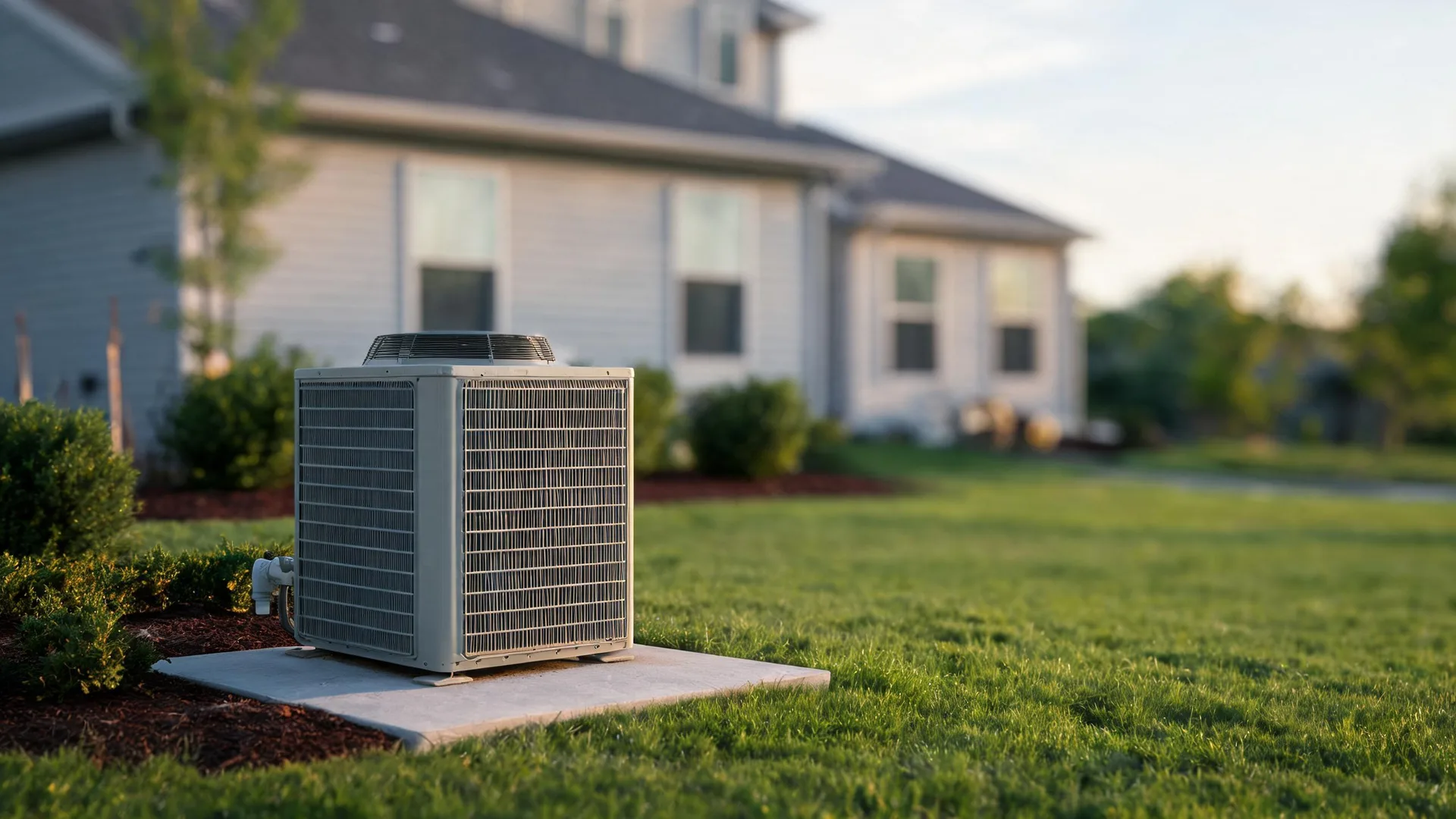
An outdoor air conditioning condenser unit positioned beside a blue-sided house at sunset.

A new air conditioner would save little on running costs in Ransom County, so the repair decision comes down to the unit's condition.

  • A new one at the federal minimum, 13.4 SEER2$100 a year
  • An older air conditioner$110 a year

Estimates for a typical Ransom County home, compared with an older unit built to the previous federal minimum, from EIA household energy data, North Dakota fuel prices and NOAA climate normals. Your home will differ.

Repair makes sense when a part like a capacitor or contactor has failed.

Replacement makes sense when the compressor has failed or the system uses R-22 refrigerant, which is no longer made.

Age matters more than any single part when you're deciding whether to fix or replace. A capacitor or contactor is cheap and quick to swap, and it's worth doing no matter how old the system is. A compressor is a different question. It's the most expensive part in the unit, and on an older system a tech will often tell you straight that putting a new compressor in a cabinet that old doesn't make sense, because the next failure is never far behind. Ask what else is wearing out alongside the part that broke. A system that's only ever needed this one repair is a different case than one where every visit turns up something new. If the refrigerant it uses is getting harder to find, that's worth asking about too, since it changes the math on repair versus replacement.