






A chain-link fence runs diagonally across a mown lawn in front of a row of two-story light-colored houses with dark roofs, framed by large leafy trees under an overcast sky.

AC Repair in Medora, ND

Tell us about the job

Takes about a minute. No obligation.

RepairCentral ACBillings County, ND
Step 1 of 2

What ZIP code is the job in?

Half the homes in Billings County were built in 1983 or later. That's a lot of houses here with a newer system behind the wall, not an old one patched onto something that's been through decades of wear. If your AC came with a house from that newer half, there's a good chance it still has real life left in it. Worth knowing before you decide whether to fix it or replace it.

2 months
July through August, your air conditioner is on duty
81°F
the average summer afternoon it cools against
41 hail events
in ten years, and hail bends the fins on outdoor coils
38 wind events
in ten years, and wind drives debris into outdoor units
Isometric cutaway illustration of a small house showing interior rooms, ductwork, an indoor air handler, and an outdoor condenser unit connected by lines, on a plain white background.
Your air conditioner works hardest from July through August.

NOAA nClimDiv, 1991–2020 normals

Your AC only runs about two months a year here, July and August.

A machine that short on work usually isn't worn out. If something's wrong, it's more likely a fix than a sign it's done.

June is for checking it, not waiting on it

Cooling runs July through August
Summer afternoons average 81°F
38 damaging wind events from 2015 to 2024
A light workload most of the yearJuly and August average 81°F here, nothing close to the strain AC units take on further south.

So if your AC is acting up, get the actual problem looked at before you assume the worst. A capacitor, a contactor, a low charge, those are normal repairs on a system with plenty of years left in it. Nothing about a newer unit failing means it's failing for good. Get a straight answer on what's wrong before you decide what it's worth.

Repair it

If your system came with a newer house, it likely has plenty of life left. Repair is usually the right call.

Find a contractor
A man in a dark beanie, navy long-sleeve shirt and tan work pants climbs porch steps toward a red front door, carrying a waxed canvas tool bag in his right hand.
An outdoor air conditioning condenser unit mounted on a concrete pad beside a house, with electrical conduit running to a wall-mounted disconnect box.

What to check before you call

Before anyone comes out, there's a handful of things worth checking yourself. Look at the thermostat first. Make sure it's set to cool and set below room temperature, and if it runs on batteries, swap them. Next go to the breaker panel and check that the breaker for the outdoor unit hasn't tripped. Then go outside and look at the condenser. If the fan isn't spinning and you don't hear any hum, that's worth noting for the tech. Check the air filter too. A filter clogged with dust chokes off airflow and can make the whole system struggle, and that one's on you to replace regularly anyway. Look at the vents inside and make sure none of them got closed or blocked by furniture. Last thing, check around the indoor unit for water pooling, which usually means a clogged drain line. None of this tells you exactly what's wrong, but it rules out the simple stuff and gives the tech something to go on when they get there.

A capacitor wears out from running, not from a mistake anyone made

The capacitor gives the compressor and fan motor the jolt they need to start. It charges and discharges every cycle, and that wears it down until it can't hold enough charge to get the motor going. That's a part reaching the end of its normal life, not a sign anything else is wrong.

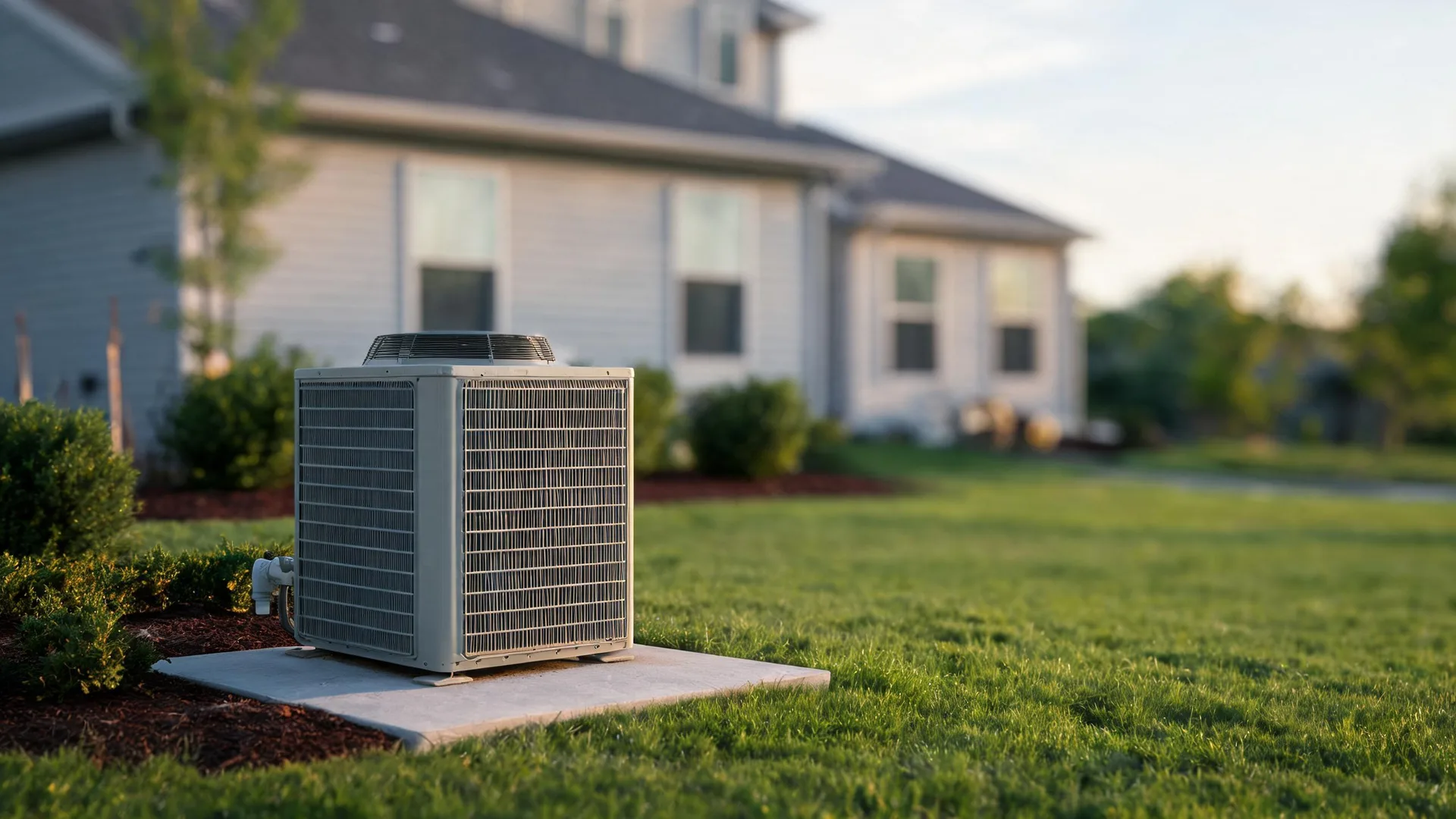
A dirty condenser coil is a common, avoidable failure

The outdoor coil has to shed heat into the air, and it can't do that once it's coated in dirt, grass clippings or cottonwood fluff. A blocked coil is one of the more common reasons a system stops cooling well even though nothing inside it has actually broken. Rinsing it off before summer is one of the simpler ways to avoid that call altogether.

An outdoor air conditioning condenser unit positioned beside a blue-sided house at sunset.

A new air conditioner would save little on running costs in Billings County, so the repair decision comes down to the unit's condition.

  • A new one at the federal minimum, 13.4 SEER2$90 a year
  • An older air conditioner$100 a year

Estimates for a typical Billings County home, compared with an older unit built to the previous federal minimum, from EIA household energy data, North Dakota fuel prices and NOAA climate normals. Your home will differ.

Repair makes sense when a part like a capacitor or contactor has failed.

Replacement makes sense when the compressor has failed or the system uses R-22 refrigerant, which is no longer made.

A good tech can tell you a lot just by how the system fails. A unit that's slow to cool but still gets there eventually is a different problem than one that blows warm air outright, and both are different from one that trips the breaker every time it starts. Sudden, complete failure usually points to one bad part, a capacitor, a contactor, a control board, something that can be swapped without touching the rest of the system. Gradual decline, where it cools less well every year, points more toward the compressor itself losing efficiency, and that's a harder call. Age matters less than how the system is failing. A unit that runs fine and then just stops is usually one part away from running fine again.