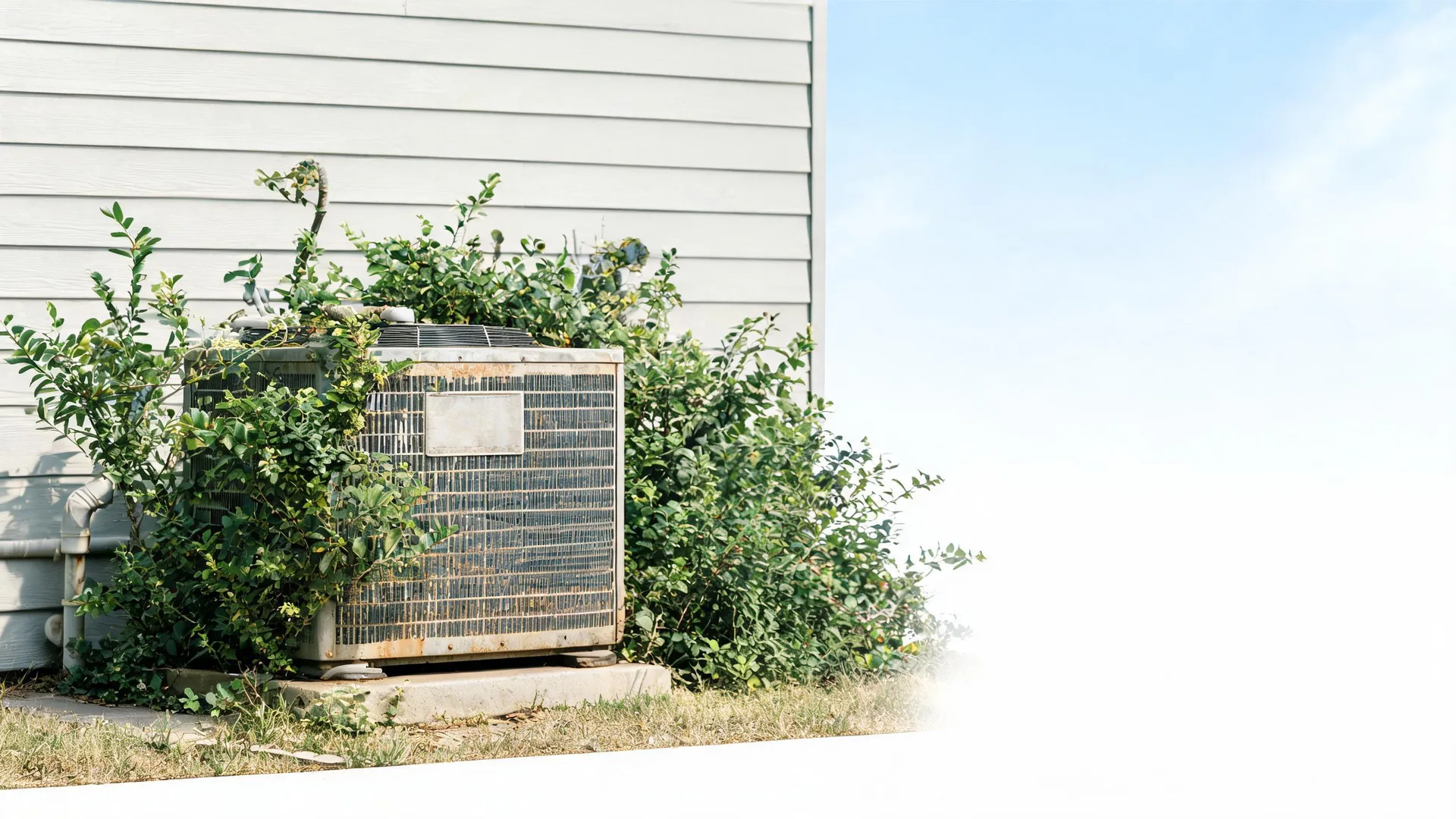
Overhead view of a gray residential air conditioning condenser unit mounted on a concrete pad beside a house with asphalt shingle roofing.

AC Repair in Minot, ND

Tell us about the job

Takes about a minute. No obligation.

RepairCentral ACWard County, ND
Step 1 of 2

What ZIP code is the job in?

The tech checks before touching anything

A good diagnostic starts with questions. When the trouble started. What sound or smell showed up. Whether the air still gets cold at all. Then comes the thermostat, the condenser outside, and the airflow at the vents. The refrigerant charge, the capacitor, and the contactor all get checked before anyone pulls a part off the unit.


The diagnosis decides the rest

A weak capacitor or a dirty coil usually means a repair that same visit. A failing compressor or a refrigerant leak in an older system is a harder call to make. The diagnosis is what tells you which one you are dealing with, and whether it is worth fixing at all.

2 months
July through August, your air conditioner is on duty
79°F
the average summer afternoon it cools against
70 hail events
in ten years, and hail bends the fins on outdoor coils
51 wind events
in ten years, and wind drives debris into outdoor units
Isometric cutaway illustration of a single-story house with a dark shingled roof, showing interior rooms with ductwork and an indoor air handler connected to an outdoor condenser unit beside the building.
Your air conditioner works hardest from July through August.

NOAA nClimDiv, 1991–2020 normals

AC in Ward County only runs about two months a year, July and August, with afternoon highs averaging 79°F.

A unit with a light workload like that is usually worth repairing instead of replacing.

Two months is short, but June is when a weak part shows itself

Cooling runs July through August
Climate zone 7
Power costs 11.51 cents a kWh statewide

If the house came with the system, check the year it was built. Half the homes in Ward County went up in 1984 or later, and a system that age or younger is rarely the reason it's struggling now. That's worth telling the tech before they start, not after. It points them toward the part that failed instead of toward the whole unit, and it's the difference between replacing a capacitor and replacing a system that didn't need it.

A newer system is usually worth repairing

Half the homes in Ward County were built in 1984 or later. If that's your house, the AC probably isn't old enough to be the problem on its own. Worth getting a tech out to look at the actual part before anyone talks about replacing the system.

Find a contractor
A man in a dark shirt and tan work pants, seen from behind, carries a worn canvas tool bag up concrete steps toward a red front door, with a potted evergreen shrub beside the entry.
A gray residential air conditioning condenser unit mounted on a concrete pad outdoors, surrounded by green grass under a partly cloudy blue sky.

The same few parts cause most of the trouble

Most AC trouble traces back to the same few parts. The capacitor gives the compressor and fan motor the jolt they need to start. It weakens with age and heat, and when it fails the unit hums but the fan doesn't spin, or nothing happens at all. The outdoor coil gets caked with dirt, pollen, and grass clippings over time. A dirty coil can't shed heat the way it should, so the compressor runs harder and hotter than it was built to, and that shortens its life. The refrigerant charge is supposed to stay sealed and constant for the life of the system. If it's low, there's a leak in the line somewhere, and adding refrigerant without finding that leak never holds. A system that short-cycles, turning on and off every few minutes, is usually fighting one of these problems. Catching it early, before the compressor overheats from the strain, is what keeps a repair a repair instead of a replacement.

What you'll notice first

Warm air from the vents when the thermostat is set low. A fan that runs but no cold coming out. Ice on the outdoor unit or the line running to it. A hum from outside with no fan movement. Water pooling near the indoor unit. Any of these means something has already failed, not just started to wear.

What it sounds like matters too

A click and nothing starting up usually points to the capacitor or contactor. Grinding or screeching points to a motor bearing giving out. Short-cycling, where the unit shuts off minutes after starting, points to a sensor problem or a coil overheating. The sound narrows down the part before anyone opens the cabinet.

Overhead view of an outdoor AC condenser unit on a concrete pad next to a house with a dark shingle roof.

A new air conditioner would save little on running costs in Ward County, so the repair decision comes down to the unit's condition.

  • An older air conditioner$80 a year
  • A new one at the federal minimum, 13.4 SEER2$80 a year

Estimates for a typical Ward County home, compared with an older unit built to the previous federal minimum, from EIA household energy data, North Dakota fuel prices and NOAA climate normals. Your home will differ.

Repair makes sense when a part like a capacitor or contactor has failed.

Replacement makes sense when the compressor has failed or the system uses R-22 refrigerant, which is no longer made.

Age is one way to judge a system, but it's not the only one. A compressor that's been running fine for years and suddenly trips on a bad capacitor is still a good compressor. Swap the part and the system is back to normal, because the part that failed has nothing to do with the parts that didn't. The harder calls come when the compressor itself is the problem, or when a refrigerant leak has been patched more than once. At that point you're not fixing a system, you're renting time on one that's already decided to go. A tech who's honest with you will tell you which situation you're in before they recommend either path.