






Overhead view of a gray outdoor AC condenser unit on a concrete pad beside a mulched garden bed and a house with vinyl siding.

AC Repair in Mohall, ND

Tell us about the job

Takes about a minute. No obligation.

RepairCentral ACRenville County, ND
Step 1 of 2

What ZIP code is the job in?

June is when to get a system checked here, before cooling starts in July. Two months isn't much room to lose, and a weak part usually gives out once the heat actually arrives and the unit has to run hard. If something was already marginal, the first hot stretch is when it fails. A technician can catch a lot of that in advance, but once August is underway there's little season left to waste on a repair that gets put off.

2 months
July through August, your air conditioner is on duty
79°F
the average summer afternoon it cools against
33 hail events
in ten years, and hail bends the fins on outdoor coils
27 wind events
in ten years, and wind drives debris into outdoor units
Isometric cutaway illustration of a house interior showing ducted air handling equipment and duct runs through rooms, connected by piping to an outdoor condenser unit on a pad outside the wall.
Your air conditioner works hardest from July through August.

NOAA nClimDiv, 1991–2020 normals

Your AC here only runs July and August, with afternoons averaging 79°F.

A compressor doesn't wear out on a season that short, so a broken AC is usually one bad part, not a system worn down from overwork.

Half the homes here date to 1973 or earlier, old enough that the AC may be original to the house

Half the homes here were built by 1973
Cooling runs July through August
Summer afternoons average 79°F
A short season, not a hard oneCooling here runs July and August, afternoons near 79 degrees, so a repair is usually worth making.

If your AC came with the house, and the house was built in 1973 or earlier, that unit may be near the end of what it can give you. Ask the technician how much life is left in it before you put money into a major part. A compressor or coil repair on a unit that old is a different decision than the same repair on a newer system. If the AC was swapped out more recently than the house itself, none of this applies, so it's worth knowing which one you actually have before deciding anything.

Get it looked at early

Problems tend to show up in the first weeks of the season, when the load hits a part that was already weak.

Find a contractor
A gray cylindrical air conditioning condenser unit mounted on a concrete pad next to a light-colored vinyl-sided house exterior.

What a failing AC sounds and feels like before it quits

A failing AC usually says so before it quits outright. It runs longer than it used to without the house feeling any cooler, or the air at the vents is weak and not as cold as it should be. You might hear it cycle on and off more than usual, or try to start a few times before it catches. Warm air blowing when it should be cold often points to a refrigerant leak or a failing compressor. Ice on the copper line or the indoor coil usually means airflow is restricted, often by a dirty filter, or that refrigerant is low. A musty smell can mean standing water in the drain pan or a clogged condensate line. None of these fix themselves by waiting, and a part that's already weak tends to give out the first time it has to work, rather than easing into the job.

Most failures are electrical, not mechanical

A capacitor weakens, a contactor's contacts burn and pit, a fan motor's bearings go. These parts fail on their own timeline, from age and from heat cycling, not because the system is being pushed too hard. They're also the easiest failures to fix, since the compressor and coil are untouched.

What a bad capacitor looks like from outside

The outdoor unit hums but the fan doesn't spin, or the compressor tries to start and can't. A capacitor holds its charge for a moment after the power is cut, so a technician tests it rather than guessing from the symptom alone. Left alone, a motor that keeps trying to start against a weak capacitor can burn out.

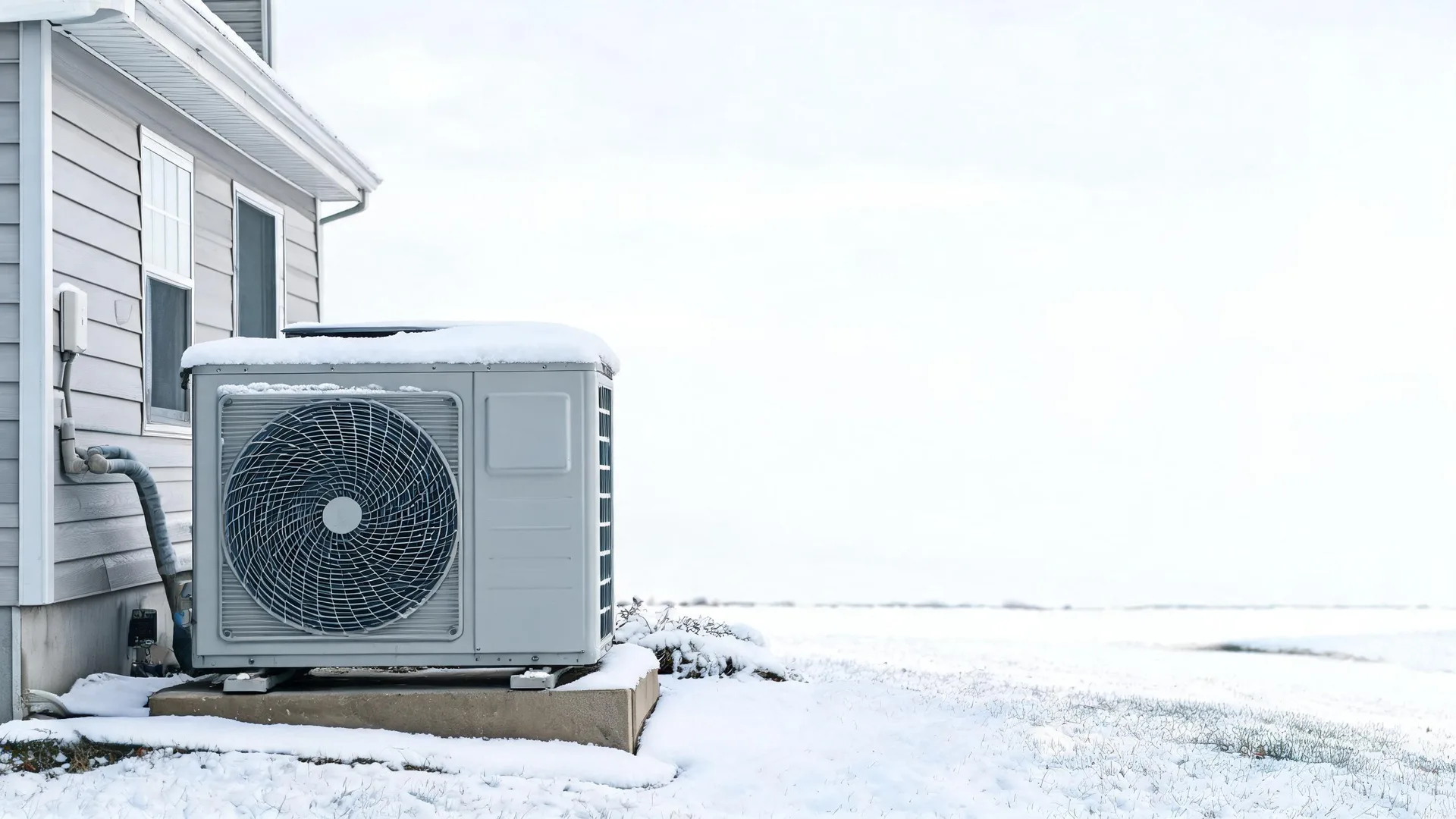
An outdoor air conditioning condenser unit installed beside the exterior wall of a blue vinyl-sided house at sunset.

A new air conditioner would save little on running costs in Renville County, so the repair decision comes down to the unit's condition.

  • An older air conditioner$80 a year
  • A new one at the federal minimum, 13.4 SEER2$80 a year

Estimates for a typical Renville County home, compared with an older unit built to the previous federal minimum, from EIA household energy data, North Dakota fuel prices and NOAA climate normals. Your home will differ.

Repair makes sense when a part like a capacitor or contactor has failed.

Replacement makes sense when the compressor has failed or the system uses R-22 refrigerant, which is no longer made.

A technician looks at the same few things to decide whether a repair makes sense. Age and condition of the compressor matter most, since that part is expensive to replace and often costs close to a new system once labor is added in. A failing capacitor, a bad contactor, or a blown fan motor are usually straightforward repairs on a unit that's otherwise sound. The coil is a different story. A coil leak can sometimes be sealed, but a coil riddled with corrosion usually means another leak shows up somewhere else soon after. If the refrigerant type the system uses is on its way out, parts and recharges for it get harder to find and cost more each year. None of this is a reason to replace a unit that's basically healthy. It's a reason to ask, before paying for the part, what else on that same system is likely to go next.