A two-story black-clad house with a dark metal roof, white-trimmed windows and a small covered porch, standing behind a wire fence on a grassy lawn with tall deciduous trees behind it under an overcast sky.

AC Repair in Napoleon, ND

Tell us about the job

Takes about a minute. No obligation.

RepairCentral ACLogan County, ND
Step 1 of 2

What ZIP code is the job in?

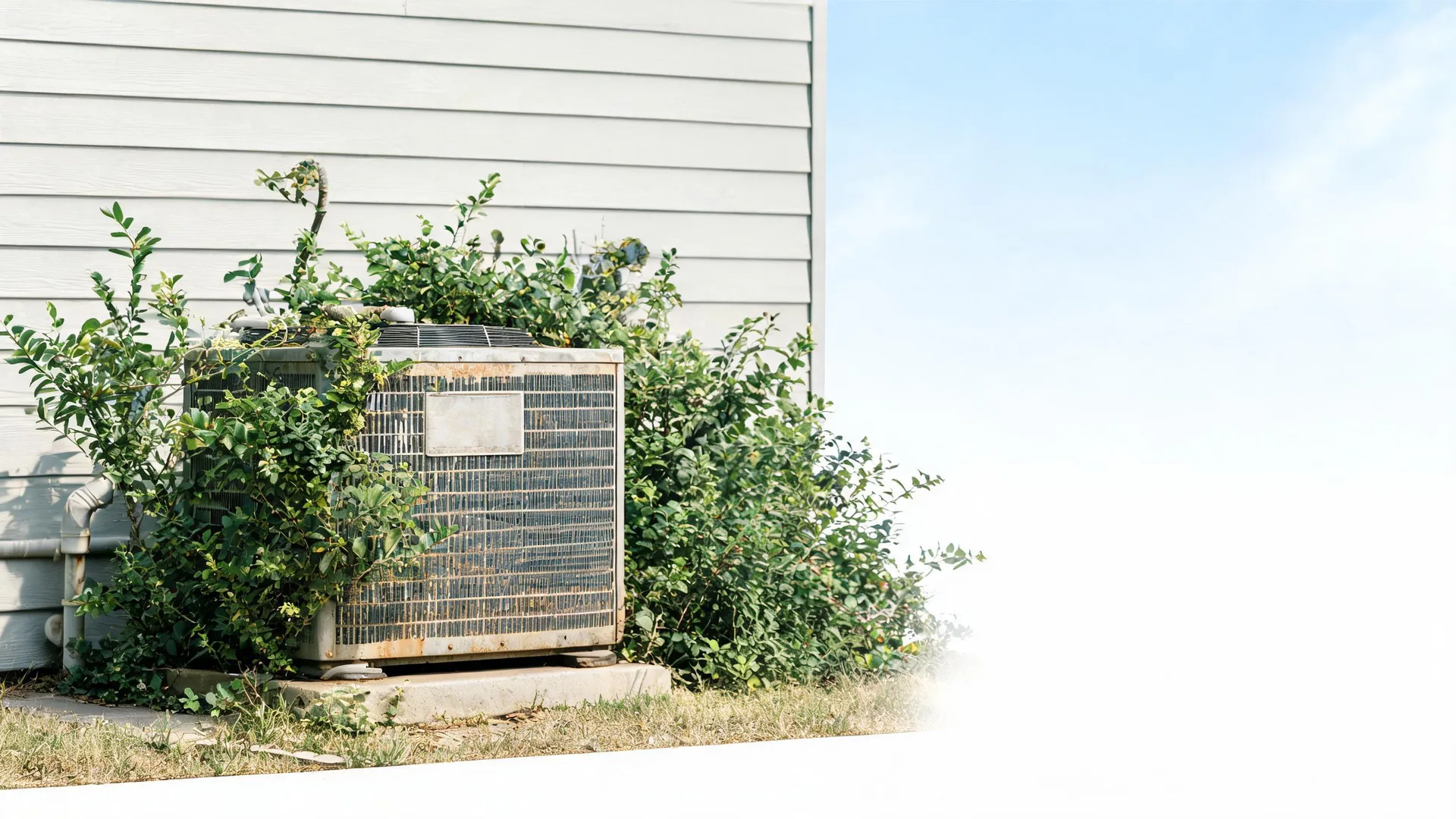
A dirty condenser coil is the most common cause

The outdoor unit pulls air through a coil to dump heat from the house outside. When that coil is caked with grass clippings, cottonwood fluff or dust, the system can't shed heat the way it should, so it runs longer and the compressor works harder than it was built to. Left alone, that extra strain is what burns a compressor out early.


A weak capacitor shows up as a system that won't start

The capacitor gives the compressor and fan motor the jolt they need to get going. They weaken slowly with age and heat, and when one finally gives out, the unit either hums without starting or the fan spins but the compressor never kicks in. It's a small part, but it stops the whole system cold.

2 months
July through August, your air conditioner is on duty
79°F
the average summer afternoon it cools against
38 hail events
in ten years, and hail bends the fins on outdoor coils
24 wind events
in ten years, and wind drives debris into outdoor units
Isometric cutaway illustration of a small home interior with furniture and ducting, showing an indoor air handler connected by lines to an outdoor condenser unit on a pad.
Your air conditioner works hardest from July through August.

NOAA nClimDiv, 1991–2020 normals

Your AC here only runs about two months a year, July and August, with afternoon highs averaging 79°F.

A compressor that light on work doesn't wear out fast, so fixing yours now is usually worth it.

Half the homes here were built by 1967, and a system that old is worth asking about

Half the homes here were built by 1967
Cooling runs July through August
Summer afternoons average 79°F
A light couple of months of work a yearLogan County hits two months of cooling, July and August, with afternoons averaging 79°F

If your AC came with the house, ask the contractor straight out how much life it has left before you commit to a big repair on it. A system that old has had a long run already, but that doesn't mean replace it on principle. What matters is what's actually failing. A weak capacitor is worth fixing on a unit of any age. A compressor on its way out is a different conversation. Get the diagnosis first, then weigh the age of the unit alongside it, not in place of it.

It's usually worth repairing

It has an easier job here than in most places, so your air conditioner is often in decent shape. Repair is usually worth it.

Find a contractor
A gray metal air conditioning condenser unit mounted on a concrete pad in a flat grassy field under a partly cloudy sky.

What to check before you call

Before anyone comes out, there's a handful of things worth looking at yourself. Check the thermostat is set to cool and the setting is actually below room temperature, since a setting bumped by accident looks exactly like a dead system. Go to the breaker panel and see if the AC breaker has tripped. Outside, look at the condenser unit and clear away any grass, leaves or weeds blocking airflow into the coil. Inside, pull the air filter and hold it up to light. If you can't see light through it, it's choking the system and needs to be swapped. Check that the vents inside the house are open and not blocked by furniture or rugs. If the outdoor unit isn't running at all, listen for a hum. A hum with no fan movement points to a capacitor or motor issue, and that's not something to force or poke at. If ice has built up on the indoor coil or the copper line running outside, turn the system off and let it thaw before anyone touches it further, since running it iced up can flood the compressor with liquid refrigerant. None of this fixes a bad capacitor or a dying compressor, but it rules out the simple stuff first.

A refrigerant leak gets worse the longer it runs

A system low on refrigerant still tries to cool the house, and the compressor keeps working against a charge it doesn't have. That runs it hotter than it was built to handle. A small leak left alone this way can end in a compressor replacement instead of a simple recharge and leak repair.

A failing capacitor can take the compressor with it

When a capacitor is going but not gone, the compressor sometimes starts hard instead of failing to start at all. Forcing that start over and over strains the windings inside the compressor. Swapping a capacitor early is quick. Replacing a compressor it damaged on the way out is not.

Aerial view of a square outdoor air conditioning condenser unit on a concrete pad beside a house wall with a sliding glass door.

A new air conditioner would save little on running costs in Logan County, so the repair decision comes down to the unit's condition.

  • A new one at the federal minimum, 13.4 SEER2$80 a year
  • An older air conditioner$90 a year

Estimates for a typical Logan County home, compared with an older unit built to the previous federal minimum, from EIA household energy data, North Dakota fuel prices and NOAA climate normals. Your home will differ.

Repair makes sense when a part like a capacitor or contactor has failed.

Replacement makes sense when the compressor has failed or the system uses R-22 refrigerant, which is no longer made.

Repair versus replacement comes down to what's actually broken, not how the unit looks or how old it is. A capacitor, a contactor, a fan motor, these are wear parts, and swapping one doesn't say anything bad about the rest of the system. A compressor is different. It's the one part that isn't practical to replace on its own, since the cost of doing that job properly rivals putting in a new system built around a new compressor. So the real question a tech is answering isn't 'how old is this unit' but 'is the part that failed a wear part or the compressor itself.' Ask what failed and why, and let that answer carry more weight than the age of the unit sitting next to it.