






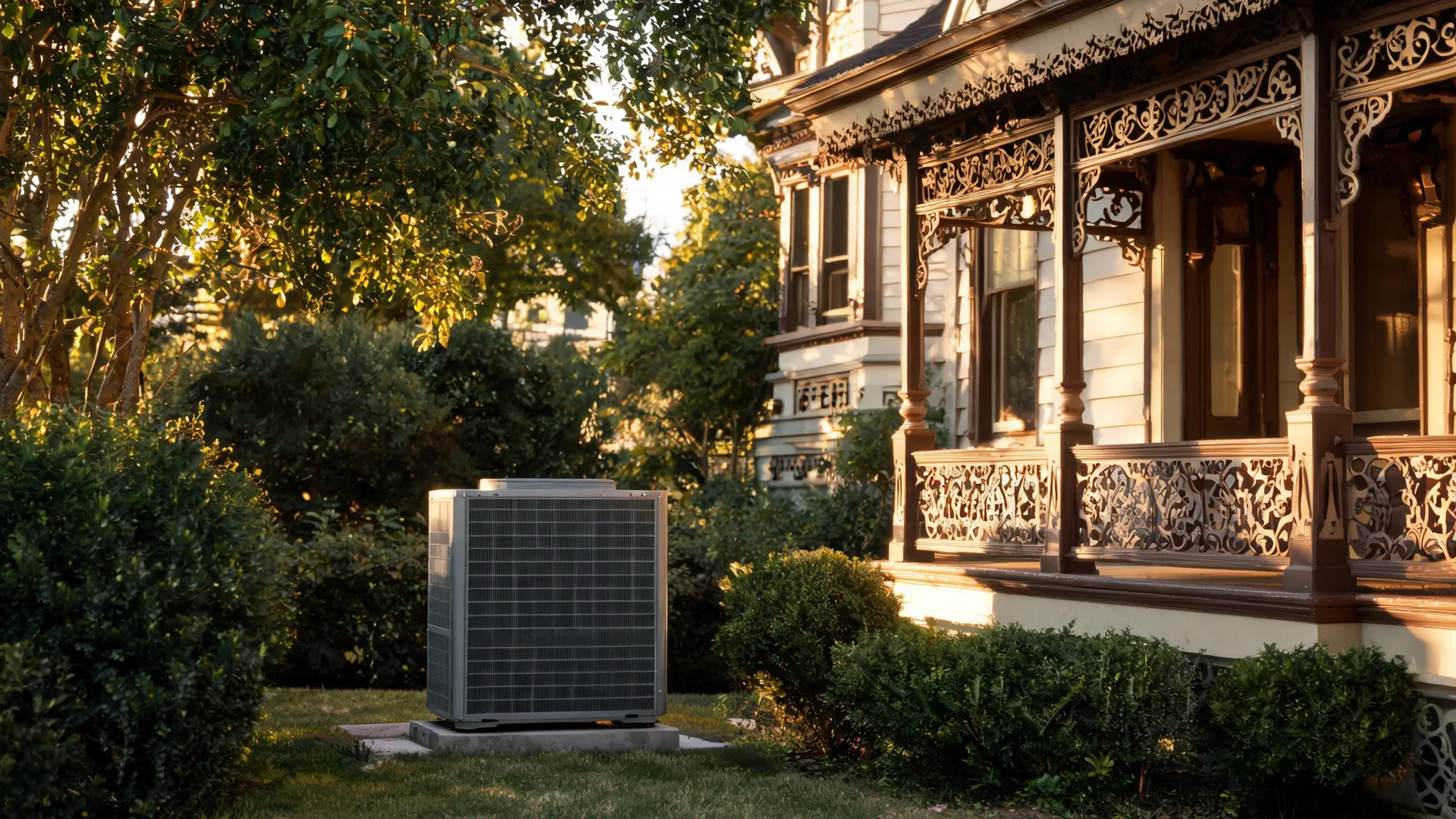
An outdoor air conditioning condenser unit on a concrete pad next to the gray vinyl siding of a residential home.

AC Repair in Rugby, ND

Tell us about the job

Takes about a minute. No obligation.

RepairCentral ACPierce County, ND
Step 1 of 2

What ZIP code is the job in?

Cooling only runs two months here, July and August. That short window is exactly why a breakdown in the first weeks of July catches people off guard. The system sat unused since last summer, and whatever was already marginal in it, a weak capacitor, a low charge, a dirty coil, gets exposed the moment it has to run hard. If your AC is struggling right when the heat shows up, that's not bad luck. It's the same part that was already on its way out finally getting tested.

2 months
July through August, your air conditioner is on duty
78°F
the average summer afternoon it cools against
29 hail events
in ten years, and hail bends the fins on outdoor coils
41 wind events
in ten years, and wind drives debris into outdoor units
Isometric line illustration of a cutaway house showing interior rooms with ductwork, an air handler and furnace, connected by lines to an outdoor condenser unit on the ground outside.
Your air conditioner works hardest from July through August.

NOAA nClimDiv, 1991–2020 normals

Summers here top out around 78°F, two months of real work a year.

A system worked this lightly is usually fine underneath, so a repair here most often brings it back for good.

Half the homes in Pierce County are old enough that their AC is on borrowed time

Half the homes here were built by 1972
Climate zone 7
Power costs 11.51 cents a kWh statewide

Get it looked at early

Problems tend to show up in the first weeks of the season, when the load hits a part that was already weak.

Find a contractor
A man in a dark cap, dark long-sleeved shirt and tan work pants walks up porch steps toward a red front door, carrying a worn canvas tool bag.
An outdoor air conditioning condenser unit mounted on a concrete pad beside a house, with electrical conduit running to a wall-mounted disconnect box.

Running it through a problem rarely fixes the problem

A weak capacitor makes the compressor work harder to start. Every cycle it survives leaves it a little weaker, until one cycle it doesn't. A low charge runs the compressor hotter than it was built to run, and that heat breaks down the oil that's supposed to protect it. A dirty coil makes the whole system move more heat through less airflow, so the compressor runs longer to do the same job. None of this gets better with more runtime. It gets worse, faster, the longer the system keeps pushing through it. Shutting it off before the breakdown is what keeps the compressor alive. Running it until it quits on its own usually ends with the compressor gone, not just the part that failed first.

What you'll notice first

The air coming out of the vents feels wrong before anything else does. It runs but doesn't cool, or it cools slower than it used to. Sometimes the system short cycles, kicking on and off instead of running a steady stretch. A hissing sound near the outdoor unit can mean refrigerant escaping. A clicking that won't stop often means the compressor is trying to start and failing.

What it means for the job

A weak capacitor shows up as that clicking, the compressor straining to start and not making it. A low charge shows up as warm air and long runtimes. A dirty coil shows up as weak cooling that gets worse over a stretch of hot days. Catching it at the hissing or clicking stage is usually a part swap. Waiting until the system won't run at all usually means the compressor already took the damage.

Overhead view of a gray outdoor AC condenser unit on a concrete pad beside a mulched garden bed and a house with vinyl siding.

A new air conditioner would save little on running costs in Pierce County, so the repair decision comes down to the unit's condition.

  • A new one at the federal minimum, 13.4 SEER2$70 a year
  • An older air conditioner$80 a year

Estimates for a typical Pierce County home, compared with an older unit built to the previous federal minimum, from EIA household energy data, North Dakota fuel prices and NOAA climate normals. Your home will differ.

Repair makes sense when a part like a capacitor or contactor has failed.

Replacement makes sense when the compressor has failed or the system uses R-22 refrigerant, which is no longer made.

So how do you know if a given repair is worth paying for. Age by itself isn't the test. A compressor is the part that matters most, and if that's still good, most of what fails around it, a capacitor, a contactor, a fan motor, is a straightforward swap that puts the system back to normal. What changes the math is when the compressor itself is the thing that's damaged, or when the repair needed is the second or third one in a short stretch. A system that keeps needing attention is usually telling you the compressor is already wearing out underneath, even if the part failing today is something smaller. One honest repair on a system that's otherwise sound is almost always the right call. Chasing a string of them on the same unit usually isn't.