





A snow-covered residential street at twilight with illuminated houses, bare trees, and an orange horizon glow beneath a deep blue sky.

AC Repair in Wahpeton, ND

Tell us about the job

Takes about a minute. No obligation.

RepairCentral ACRichland County, ND
Step 1 of 2

What ZIP code is the job in?

May is a good time to get a weak AC looked at here, before cooling starts up in June. A system that struggled last August doesn't fix itself sitting idle all winter. The first hot stretch in June is when a tired capacitor or a low charge finally gives out, because that's the first time all year the system has to work hard. Get it checked while it's still sitting idle, not after it's run flat out for a week straight.

3 months
June through August, your air conditioner is on duty
80°F
the average summer afternoon it cools against
45 hail events
in ten years, and hail bends the fins on outdoor coils
82 wind events
in ten years, and wind drives debris into outdoor units
Isometric cutaway illustration of a house interior showing ducted air handling equipment, ceiling ducts, furniture in two rooms, and an outdoor condenser unit connected by lines outside the wall.
Your air conditioner works hardest from June through August.

NOAA nClimDiv, 1991–2020 normals

A breaker that keeps tripping means something is pulling too much power, and flipping it back on won't fix that.

Check the breaker once, and if it trips again, leave it off and let a tech find out why.

Half the homes here are old enough that the AC could be original equipment

Half the homes here were built by 1972
Climate zone 6A
Power costs 11.51 cents a kWh statewide

Get it looked at early

Problems tend to show up in the first weeks of the season, when the load hits a part that was already weak.

Find a contractor
A gray residential air conditioner condenser unit mounted on a concrete pad in an open grass field.

What to listen for before the air turns warm

Warm air out of the vents is usually the first thing anyone notices, but it's worth watching for before that. A system short cycling, running a few minutes and shutting off, is straining something even if the air still feels cool. Ice on the line outside or on the coil means airflow or charge is off, and running it that way longer just stresses the compressor. A hum when the unit tries to start but doesn't is a motor or capacitor that can't get going on its own anymore. None of these fix themselves by running the system less or waiting for a cooler day.

A weak capacitor forces the compressor to work harder every time it starts

Once a capacitor is failing, the compressor draws more power trying to get going on its own. That extra strain heats the windings, and a compressor that overheats enough times can fail for good. What started as a part worth replacing turns into a system that needs replacing.

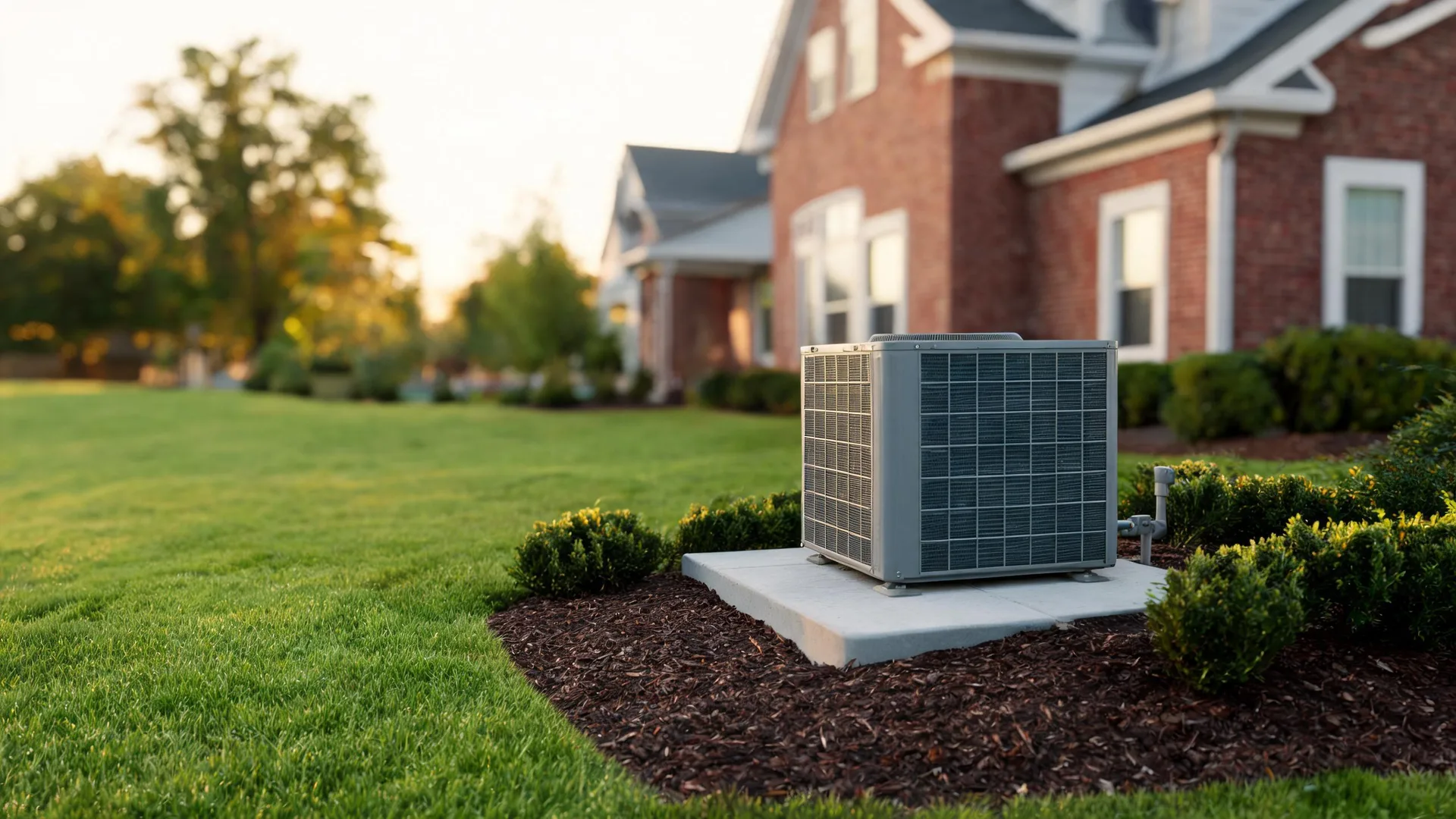
A low charge lets the compressor run hotter than it should

Refrigerant does more than cool the air. It also carries heat away from the compressor as it cycles through. With a low charge, the compressor runs hotter with every cycle, and continued run time wears it down faster than a system with the right charge ever would.

An outdoor air conditioning condenser unit installed beside the exterior wall of a blue vinyl-sided house at sunset.

A new air conditioner would save little on running costs in Richland County, so the repair decision comes down to the unit's condition.

  • A new one at the federal minimum, 13.4 SEER2$110 a year
  • An older air conditioner$120 a year

Estimates for a typical Richland County home, compared with an older unit built to the previous federal minimum, from EIA household energy data, North Dakota fuel prices and NOAA climate normals. Your home will differ.

Repair makes sense when a part like a capacitor or contactor has failed.

Replacement makes sense when the compressor has failed or the system uses R-22 refrigerant, which is no longer made.

The question is usually about the compressor, not the whole unit. A compressor that's still running fine is worth protecting with a new capacitor or a recharge, since those are small parts compared to what they support. But a compressor that's already been running hot, overheating and cycling off for months, may have worn windings that no new part fixes. Age matters less than how the system was run. A unit that short cycled or ran low on charge for a season took more wear than one that was serviced when the first sign showed up. If the compressor itself needs replacing, that's usually the point where a tech will talk through whether to put a new compressor in an old system or replace the whole thing.